Hakama — Japanese skirt-trousers: what they are and who wears them today
Hakama (袴) are wide Japanese trousers with pleats that are tied over a kimono with cords. There are two types: umanori-bakama (馬乗袴) with divided, trouser-like legs — for horseback riding, and andon-bakama (行灯袴) without a division, resembling a long skirt. Today hakama are worn in aikido, kendo, and iaido, by Shinto shrine priestesses, and by university graduates at graduation ceremonies.
Hakama are confused sometimes with trousers, sometimes with a skirt — and both are partly right: the construction differs between models and eras. Let's look at how umanori-bakama differs from andon-bakama, where the fashion of wearing hakama to graduation among Japanese female students came from, and why in anime they are so often mistaken for ordinary wide trousers.
How hakama are constructed and what types exist
Hakama are wide pleated trousers that are tied over a kimono with long himo cords rather than a belt. There are two main types. Umanori-bakama (馬乗袴, "riding hakama") — with an internal division into two legs, like ordinary trousers: in the Edo period, samurai wore them on horseback. Andon-bakama (行灯袴) — without a division, solid, more like a wide tube skirt, named after the andon paper lantern because of their shape.
- Pleats: five in front and one or two in back — the count of back pleats varies between workshops.
- Koshi-ita (腰板) — a stiff insert panel at the back that keeps the hakama spread out and prevents them from crumpling at the waist.
Seven pleats and the seven virtues of bushido
In dojo, it is often told that the pleats of hakama are not just a cut but an encoded instruction. The five front pleats are associated with the five Confucian virtues — humanity, duty, etiquette, wisdom, and loyalty — which also entered the bushido code. About the back pleats, versions differ: some speak of one symbolizing the path of sincerity without duplicity, others of two to make exactly seven. This is a beautiful explanation retold in kendo and other schools, not a fixed historical standard: women's models have a different number of pleats altogether.
Who wears hakama today
- Aikido, kendo, iaido, and in many kyudo schools — hakama are part of the uniform.
- Shinto shrine priestesses miko — recognizable scarlet hibakama (緋袴) over a white top.
- Groom at a traditional wedding — dark kimono with family crests, haori and hakama together are called montsuki haori bakama.
- Graduates of Japanese universities — kimono with hakama at the diploma ceremony (卒業式の袴).
- Actors in historical films and stage productions — hakama remain part of the conventional costume of the samurai era.
Hakama at graduation: where the fashion came from
The uniform of university graduates was invented not by random fashion but by a specific person. Shimoda Utako, who headed the academic affairs at Kazoku Jogakko — a school for girls from noble families — designed women's hakama modeled after court attire: without division into legs, comfortable for movement. At first, students of privileged schools dressed this way, then the fashion spread to women's educational institutions across the country, and hakama became associated with female students for a long time. As a school uniform, hakama were worn until the beginning of the Showa era, and since the 1990s they have become a customary outfit for female students at graduation.
袴 — a sign with "clothing" on the left
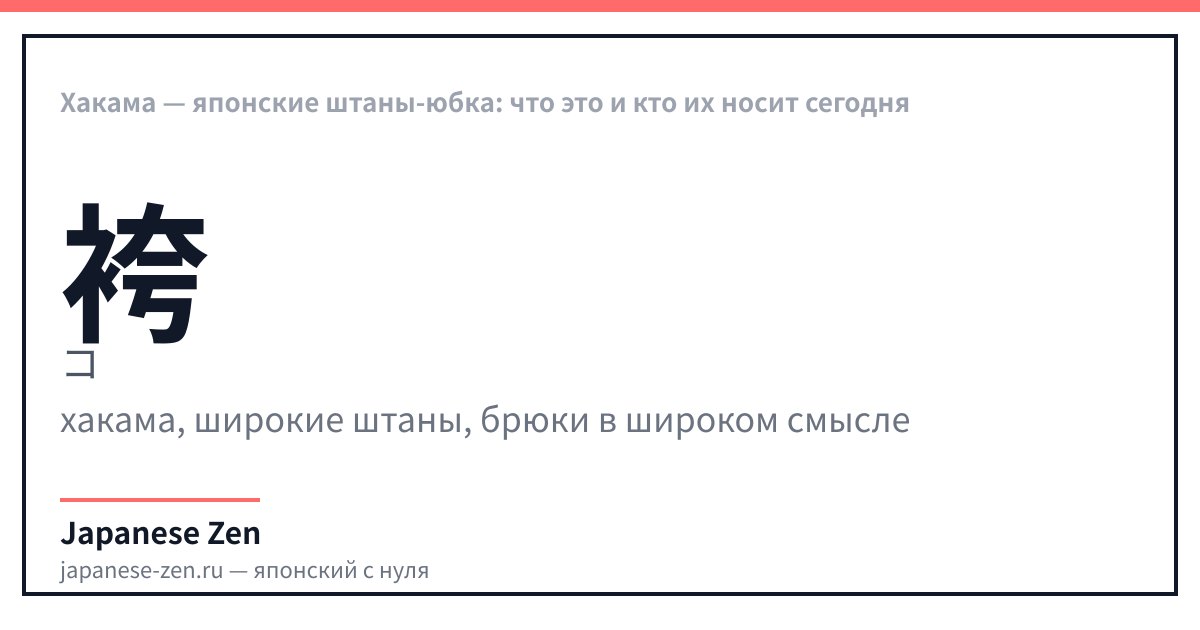
袴 — значение: hakama, wide trousers, trousers in a broad sense — онъёми: コ、ク — кунъёми: はかま、ずぼん — 11 штрих(ов). 袴 — "hakama": on the left of the character is the element 衤, derived from 衣 "clothing", on the right is the part responsible for the reading.
Write 袴 along the guides — the character for hakama with the "clothing" element on the left.
| Japanese | Reading | Translation |
|---|---|---|
| 袴 | hakama · hakama | Wide pleated trousers worn over a kimono |
| 馬乗袴 | umanori bakama · umanori bakama | Hakama with divided legs, for horseback riding |
| 行灯袴 | andon bakama · andon bakama | Skirt-like hakama without a division |
| 紋付羽織袴 | montsuki haori bakama · montsuki haori bakama | Formal groom's outfit with family crests |
| 腰板 | koshiita · koshiita | Stiff insert panel at the back of hakama |
| 緋袴 | hibakama · hibakama | Scarlet hakama of Shinto priestesses miko |
What else is written with the same element
The element 衤 (abbreviated form of 衣 "clothing") on the left of a kanji almost always indicates a garment. Besides 袴, it appears in 裾 (suso, "hem") and 袖 (sode, "sleeve") — both clothing parts literally adjacent to hakama on the body.
Hakama in anime and manga
- "Haikara-san ga Toru" (はいからさんが通る, manga by Waki Yamato, 1975–1977) — a Taisho-era schoolgirl in hakama and boots, an image still associated with students of the early century.
- "Sakura Taisen" (サクラ大戦, 1996) — a franchise started with a Sega Saturn game, later series and OVA; the protagonist Sakura Shinguji fights in kimono and hakama.
- "Rurouni Kenshin" (るろうに剣心, manga by Nobuhiro Watsuki, 1994–1999) — Kenshin Himura almost always in kimono and hakama, the classic silhouette of a former warrior of the Meiji era.
Hakama or just wide trousers
On screen, hakama are easily confused with ordinary wide trousers: the silhouette is similar, and details like himo and koshi-ita are hard to make out in a couple of frames. Context helps to distinguish them — hakama are almost always worn over a kimono, not as a separate costume, and they are held by ties at the waist, not by an elastic band or belt.
FAQ
- What are hakama?
- Traditional Japanese pleated trousers: they are worn over a kimono and tied with himo cords. In some models the legs are divided, in others they are sewn as a solid "skirt". Today hakama are primarily a uniform for budo and a festive outfit.
- What are Japanese skirt-trousers called?
- This variant without a division into legs is called andon-bakama (行灯袴) — the name is related to the shape resembling an andon paper lantern. It is this type that is worn more often today: it is more convenient in everyday life than hakama with divided legs.
- Why do hakama have seven pleats?
- A popular dojo explanation is that the five front pleats symbolize the five Confucian virtues from the bushido code, and the back pleats represent the path without duplicity. This is a beautiful mnemonic, not a confirmed historical standard: the number of back pleats differs between workshops and models.
- Who wears hakama today?
- Practitioners of aikido, kendo, and iaido, Shinto shrine priestesses miko — in scarlet hibakama, grooms at traditional weddings, and graduates of Japanese universities at diploma ceremonies. They are also worn by actors in historical films and stage productions.
- How do hakama differ from kimono?
- Kimono is a one-piece garment with an overlapping front, tied with an obi belt. Hakama are separate wide trousers or skirt-trousers that are worn over the kimono and tied with separate cords: they are not an alternative to kimono but an item worn together with it.
- How is "hakama" written in kanji?
- 袴, read as はかま. On the left of the character is the "clothing" element, on the right is the part responsible for the reading. The same element on the left is in 裾 "hem" and 袖 "sleeve", other parts of traditional clothing.
Sources
Updated: 2026-09-14