Kendo — fighting with shinai: what kind of sport it is and how a match unfolds
Kendo (剣道) is a modern sport: fighting with bamboo shinai swords in full bogu protective gear — the men mask, the dō chest protector, and the kote gloves. The winner is the one who lands a clean, loud (with kiai) strike to a permitted zone that the judges count. It is not the same as the martial kenjutsu of the warrior era, from which kendo grew only after the ban on carrying swords in 1876.
From the outside, kendo looks like a loud stick fight in hockey-style padding. In reality it is a sport with ranks and a federation, where judges will not count even an accurate strike without the right form and kiai.
What kendo is today
Kendo (剣道) is a sport: fighting with bamboo shinai swords in bogu protective gear — the men mask, the dō chest protector, the kote gloves, and the tare waist guard. Victory comes from clean strikes to permitted zones with a mandatory loud kiai shout at the moment of attack; judges raise flags to award ippon. Kendo is practiced in dōjō at schools, universities, and clubs of the All Japan Kendo Federation; it is part of the physical education curriculum in Japanese schools and of police training.
Kenjutsu and kendo are not the same thing
- Where it is practiced: dōjō at schools, universities, and clubs of the All Japan Kendo Federation (全日本剣道連盟).
- Who practices: children from elementary school and adults; kendo is part of Japanese police training.
- Ranks: the dan (段) and kyū (級) system — from beginner to master, as in judo and karate-dō.
- Equipment: a shinai and a full bogu set are mandatory in competitions; without them, you train kata or work with a bokken.
How a match unfolds, step by step
- Both fighters bow to each other and put on the men mask before the start.
- They take the initial chūdan-no-kamae stance — shinai pointed at each other.
- They attack with a mandatory kiai — a loud shout at the moment of the strike; without it, the strike will not be counted.
- They strike one of the permitted zones: men (head), dō (torso), or kote (wrist); the tsuki thrust is allowed only for experienced fighters.
- They maintain composure after the strike — distance and stance — rather than turning their back on the opponent.
- Judges raise flags if the strike was clean and complete: that is ippon.
- The fighter with two ippon or with the advantage at the end of the allotted time wins.
What you must not do
- Strike unprotected zones — only strikes to men, dō, kote, and the permitted tsuki are counted.
- Attack without kiai — a formally accurate strike without a shout will not be counted by the judges.
- Lose composure right after the strike: turning your back or relaxing strips the strike of ippon status.
- Start a match without a mutual bow at the beginning and end of the bout.
剣道 — “the way of the sword”: how kenjutsu became kendo
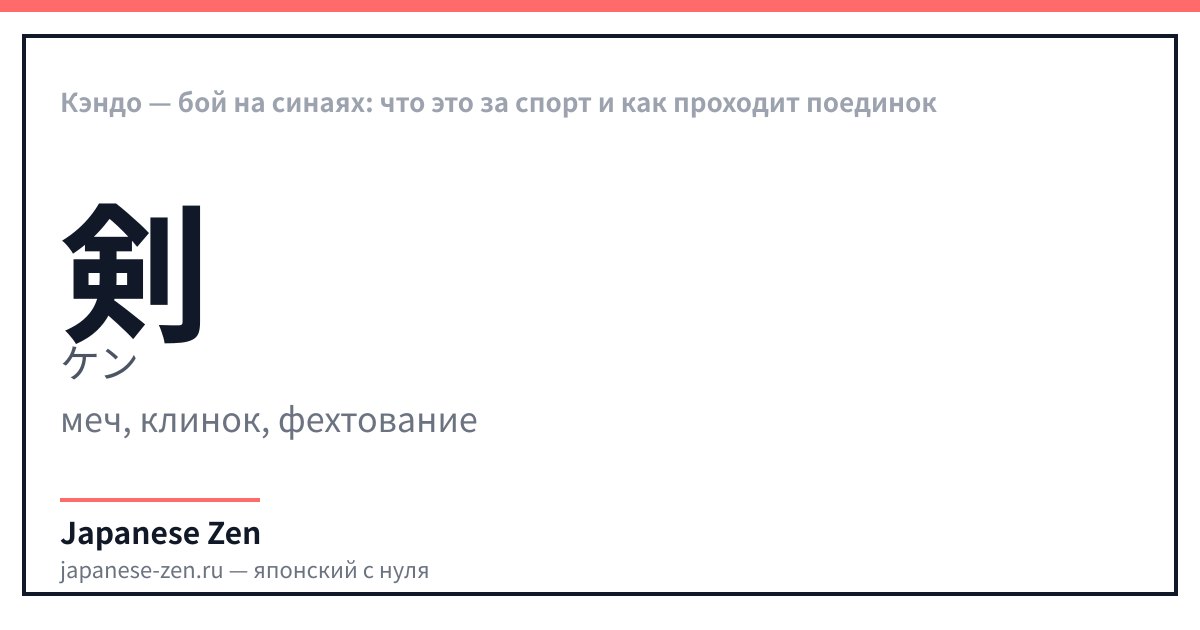
剣 — значение: sword, blade, fencing — онъёми: ケン — кунъёми: つるぎ — 10 штрих(ов). 剣 — “sword”: the first character in 剣道 (kendō). The second character 道 “way” appears in dozens of words — from 柔道 “judo” to 書道 “calligraphy.”
| Japanese | Reading | Translation |
|---|---|---|
| 剣道 | kendō · kendō | The way of the sword, a modern sport |
| 面 | men · men | Mask and strike (guard) to the head |
| 胴 | dō · dō | Chest protector and strike to the torso |
| 小手 | kote · kote | Glove and strike to the wrist |
| 気合 | kiai · kiai | Battle shout at the moment of the strike |
| 一本 | ippon · ippon | A clean, counted point |
How 剣道 is read and what it literally means
剣道 is read けんどう: 剣 — “sword,” 道 — “way.” The name did not appear immediately: until the end of the 19th century, combat fencing was called kenjutsu (剣術) — “the art of the sword.” Replacing “jutsu” with “dō” reflects the transformation of a combat skill into a discipline for competition and education, not only for victory in real combat.
Listen to the words kendō, men, dō, and kote — the app will rate your pronunciation.
Kendo in anime
Kendo becomes the central theme of anime less often than no-holds-barred martial arts, but there is one title built entirely around it.
- “Bamboo Blade” (バンブーブレード) — an anime and manga entirely about a school kendo club, with accurate terminology and match rules.
- A kendo club as a backdrop of school life is a common secondary element in many high-school anime.
- Games and films about samurai with katana usually depict kenjutsu or stylized combat, not sport kendo with a shinai and protective gear — these are different things.
FAQ
- What is kendo?
- Kendo (剣道) is a modern sport: fighting with bamboo shinai swords in bogu protective gear. Victory comes from clean strikes to permitted zones with a mandatory kiai shout; strikes are counted by judges. It is practiced in dōjō at schools, universities, and federations around the world.
- How does kendo differ from kenjutsu?
- Kenjutsu is combat fencing with a real sword or its wooden imitation, without sport rules. Kendo is a 20th-century sport: bamboo shinai, full protective gear, points for strikes to permitted zones. Kendo grew out of kenjutsu after the ban on carrying swords in 1876.
- How does a kendo match unfold?
- Fighters bow, take their stance, and attack each other with shinai strikes to men, dō, or kote, always with kiai — a loud shout at the moment of the strike. Judges award ippon only for a clean, complete strike with composure maintained afterward, not merely for a touch.
- How is “kendo” written in Japanese?
- 剣道, read けんどう. 剣 — “sword,” 道 — “way,” literally “the way of the sword.” Before this name appeared at the end of the 19th century, the same activity was called kenjutsu (剣術) — “the art of the sword,” without a sport connotation and without a single federation with common match rules for all schools.
- Can you try kendo without being Japanese or a professional?
- Yes, kendo clubs exist all over the world and accept adult beginners with no experience: the basic stance and strikes are learned within a few months of regular practice. A full bogu protective set is usually lent out at the start, buying it right away is not necessary, and a shinai is inexpensive.
- In which anime is kendo shown?
- The closest to real rules is “Bamboo Blade,” an anime and manga about a school kendo club with accurate terminology and equipment. In other series, kendo more often appears as a backdrop of school life, rather than as the subject of a separate plot with precise match rules and refereeing terminology.
Sources
Updated: 2026-09-10