Kenjutsu — what this tradition is and how it goes
Kenjutsu (剣術) is the martial art of swordsmanship from the warrior era, designed for real combat with a real blade or its wooden imitation. Do not confuse it with modern kendo (剣道) — a competitive sport using bamboo swords (shinai) and protective gear, which grew out of kenjutsu after the ban on carrying swords in 1876.
Kendo, which is taught in Japanese schools today, is not a direct continuation of martial swordsmanship, but a sport reinvented under new rules: carrying swords was prohibited, but people still wanted to train.
What is kenjutsu and how is it different from kendo
Kenjutsu is a general name for martial schools of Japanese swordsmanship that developed during the warrior era and are designed for combat with a real blade or its wooden imitation — the bokken. Kendo is a 20th-century sport: a bamboo sword (shinai), protective gear with a mask, and points for strikes to allowed areas. Kenjutsu teaches how to kill with a sword; kendo teaches how to compete in speed and accuracy of strikes without injury.
- Weapon: kenjutsu uses a real or wooden sword; kendo uses a split bamboo shinai.
- Protection: in kenjutsu, there is none or it is minimal; in kendo, a full set of equipment: mask, chest protector, gloves.
- Target of the strike: kenjutsu is not limited by rules; kendo only counts a strike to an allowed area with a valid call.
- Status: kenjutsu is a martial art of individual schools; kendo is a unified sports federation with ranks.
Schools of the Muromachi period
Kenjutsu schools began to form during the Muromachi period, when warriors needed a systematic transmission of combat experience: techniques were recorded and passed from teacher to student within a ryu — a school with its own charter and lineage.
How kenjutsu became kendo
- 1868–1876: the Meiji Restoration destroys the old order, and the 1876 decree prohibits most of the population from carrying swords in daily life.
- Kenjutsu masters switch to the bamboo shinai and protective gear — these were already used for training matches in some schools.
- 1895: the Dai Nippon Butoku-kai is founded — an organization that began to unify disparate schools under common rules.
- 1900s–1920s: kendo is introduced into Japanese schools as a subject of physical education.
- After the war, martial arts are banned for several years by the occupation authorities.
- 1952: kendo is revived as a civilian sport with a new federation and ranking system.
- Today, kendo competitions are held worldwide, while kenjutsu is preserved separately — in old schools with lineages from the warrior era.
What is koryu
Koryu — 'old schools' — are martial traditions that developed before the Meiji Restoration and are passed from teacher to student without adaptation to sports rules. Few have survived to this day: for example, Katori Shinto-ryu and Kashima Shinto-ryu — schools with centuries-old lineages where kenjutsu is still taught in its pre-sport, non-competitive form.
Words and characters: 剣術
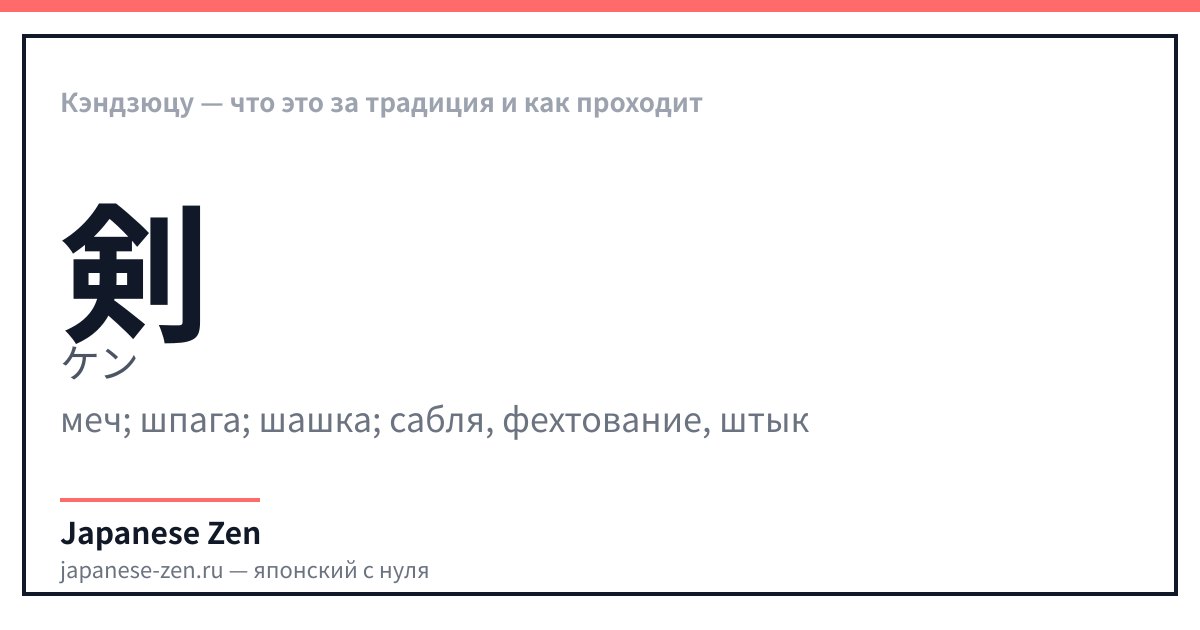
剣 — значение: sword; épée; saber, fencing, bayonet, sting — онъёми: ケン — кунъёми: つるぎ — 10 штрих(ов). 剣 — 'sword': the first character in 剣術 (kenjutsu) and 剣道 (kendo). The second character 術 'art, technique' is not in the kanji database, so the card only analyzes 剣.
| Japanese | Reading | Translation |
|---|---|---|
| 剣術 | kenjutsu · kenjutsu | Art of the sword, fencing |
| 剣道 | kendō · kendo | Way of the sword (modern sport) |
| 竹刀 | shinai · shinai | Bamboo training sword |
| 防具 | bōgu · bogu | Protective armor for kendo |
| 古流 | koryū · koryu | Old school (martial tradition before the Meiji era) |
剣術 — art of the sword, 剣道 — way
剣術 is read 'kenjutsu' and literally means 'art of the sword': 剣 — 'sword', 術 — 'technique, art', the same character as in 忍術 (ninjutsu). In 剣道, the second character is replaced with 道 — 'way': the same transition from 'technique' to 'way' that happened with judo and karate-do in the 20th century.
Listen to the words kenjutsu and kendo and repeat — the app will evaluate your pronunciation.
Kenjutsu in anime and games
Screen fencing almost always stylizes movements, but you can recognize a scene as kenjutsu rather than sport kendo by context: a real blade without protective gear, not a training match with a mask.
- 'Vagabond' by Takehiko Inoue — dojos and duels throughout the manga are depicted as kenjutsu schools of Musashi's era, without sports rules.
- 'Rurouni Kenshin' — duels are staged in the spirit of classical kenjutsu; the hero's school is fictional in the story.
- 'Samurai Champloo' — staged sword fights without protective gear, stylistically closer to kenjutsu than to sport kendo.
FAQ
- What is kenjutsu?
- Martial swordsmanship with the Japanese sword from the warrior era — a collection of schools that taught how to win in real combat, not how to score points under rules.
- How is kenjutsu different from kendo?
- Kenjutsu uses a real or wooden sword and is not limited by sports rules; kendo uses a bamboo shinai, protective gear, and points for strikes to allowed areas.
- When and why did kenjutsu become kendo?
- After the 1876 decree that prohibited carrying swords in daily life: masters switched to the training shinai and protection, and by 1952 kendo had developed into a modern sport.
- How do you write 'kenjutsu' in Japanese?
- 剣術, where 剣 — 'sword', 術 — 'art, technique'. It is read 'kenjutsu', literally 'art of the sword'.
- What is koryu?
- 'Old schools' — martial traditions that developed before the Meiji Restoration and are passed down without adaptation to sport. Examples are Katori Shinto-ryu and Kashima Shinto-ryu.
- Where in anime is real kenjutsu shown?
- In the manga 'Vagabond' about Musashi, in 'Rurouni Kenshin', and in 'Samurai Champloo' — in all three, fights take place without sport protective gear.
Sources
Updated: 2026-08-29