Dojo — the hall for budo and zen practice: layout and etiquette
Dojo (道場) is a hall where budo is practiced: kendo, judo, karate, aikido, kyudo. The word is originally Buddhist — it referred to the place where the Buddha attained enlightenment, and only in the 20th century did it become associated with sports halls. Inside the dojo, a clear etiquette applies: shoes off at the entrance, a bow, and a designated spot for senior students.
Dojo doesn't translate neatly — 'place of the way.' In practice it's a simple rule: the hall doesn't exist for winning, but for training regularly and without improvising on the small details.
What a dojo is and how it differs from an ordinary gym
Dojo (道場) is a hall for regular budo training: kendo, judo, karate, aikido, kyudo, and other martial ways. The term goes back to the Buddhist 道場 (bodhimanda) — the place where the Buddha attained enlightenment; in Zen Buddhism, a dojo still refers to a meditation hall as well. In the sports sense, the word took hold in the 20th century along with the formation of modern budo. What distinguishes a dojo from an ordinary gym isn't the equipment but the status of the space: you don't drop in from the street between errands, hierarchy and ritual apply here, not just a training schedule.
What the space inside consists of
- Kamiza — the wall or alcove at the far end of the hall toward which bows are directed: a portrait of the school's founder or calligraphy with a motto is hung there.
- Shinzen — a small altar, if the dojo is connected to Shinto or Buddhist tradition; not present in every hall.
- Floor — tatami in traditional aikido and judo schools, wooden flooring in kendo and karate.
- Weapons and gear — shinai, bokken, and bows are kept on special stands, not tossed against the wall.
- Inscriptions — calligraphic scrolls with the school's motto or the names of instructors on the walls.
道場 — 'place of the way': what's embedded in the name of the hall
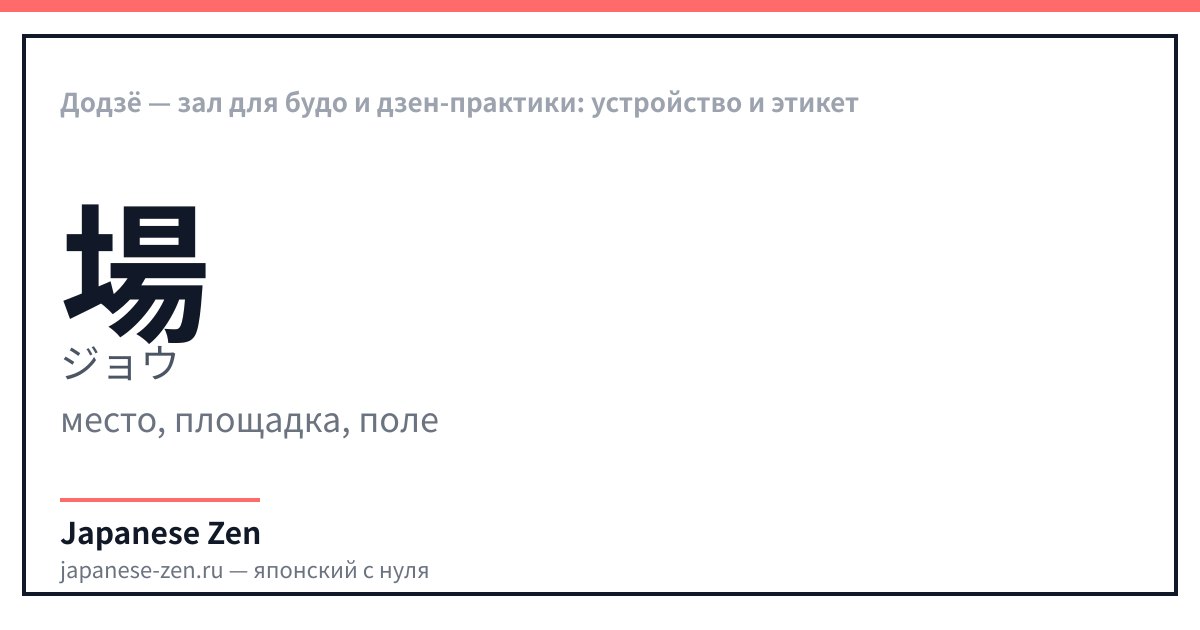
場 — значение: place, site, field — онъёми: ジョウ、チョウ — кунъёми: ば — 12 штрих(ов). 場 — 'place, site': the second character in 道場 (dojo). The same character appears in 会場 'meeting place' and 広場 'square' — everywhere it points to a space, not a building.
| Japanese | Reading | Translation |
|---|---|---|
| 道場 | dōjō · dōjō | Training hall |
| 上座 | kamiza · kamiza | Seat of honor, facing the seniors |
| 正座 | seiza · seiza | Formal sitting posture before class begins |
| 礼 | rei · rei | Bow, a form of greeting |
| 先生 | sensei · sensei | Teacher, instructor |
Why a dojo is not just a 'hall'
In Buddhist tradition, 道場 is not a sports facility but a 'place of the way': there one seeks not victory but the right direction of practice. The sports schools of the 20th century inherited this word along with part of its seriousness — hence the demands for order that seem excessive to someone used to an ordinary fitness gym.
Write 場 along the guides — the character for 'place' that makes up the word 'dojo.'
How to behave if you've come to watch a training session
- Take off your shoes at the entrance — even if you've just come to watch, not to train.
- Bow toward the kamiza when entering the hall and before leaving.
- Sit where you're told: the spot by the wall is usually meant for guests, not for those training.
- Don't step on other students' mats and rugs without permission.
- Don't touch the weapons on the stands — shinai, bokken, and bows are not taken without asking.
- Keep quiet during the instructor's explanations, even if the session seems to be dragging on.
Common mistakes tourists make
The most common mistake is taking photos without permission and talking at full volume during training: a dojo perceives noise as disrespect toward the people in the hall, even if no one says anything out loud.
Dojo in anime and games
In anime, a dojo is almost never just a set — it's a character in its own right, tied either to the hero's family or to the goal of the entire plot.
- 'Ranma ½' — the Tendo family dojo is at the center of almost the entire story: the characters live there and nearly all the fights take place there.
- 'Kenichi: The Mightiest Disciple' — the Ryozanpaku dojo, where masters of several schools train under one roof.
- 'Yawara! A Fashionable Judo Girl' — the dojo of the heroine's grandfather, who has trained her since childhood; a classic sports anime about judo.
FAQ
- What is a dojo?
- A dojo (道場) is a hall for budo training: kendo, judo, karate, aikido, kyudo, and other martial ways. The word is originally Buddhist and meant 'place of the way' — where one sought enlightenment, not just physical skill. It only became associated with sports halls in the 20th century.
- Why do you need a dojo if you can train in an ordinary gym?
- A dojo isn't about equipment but about the status of the place: hierarchy applies here, rituals for entering and leaving, designated spots for seniors. This framework keeps training discipline stricter than the schedule of an ordinary fitness club, and constantly reminds you that training is not just physical exercise but part of a broader tradition.
- How is 'dojo' written in Japanese?
- 道場, read as どうじょう. 道 — 'way,' 場 — 'place, site': literally 'place of the way.' The same character 場 appears in 会場 'meeting place' and in 広場 'square' — everywhere it points to a space, not a specific building. The word came from Buddhist terminology long before it came to denote a sports hall.
- Is a dojo only for martial arts?
- No. In the Zen Buddhist tradition, a dojo also refers to a meditation hall: the original meaning of the word is broader than 'martial arts hall.' The modern narrow usage for budo only took hold in the 20th century, although today in common usage it is this meaning that appears noticeably more often than the original Buddhist one.
- How should you behave if you've come to watch a training session?
- Take off your shoes at the entrance, bow toward the kamiza, sit where you're told, and don't touch the weapons on the stands without permission. Talking at full volume and filming without asking during training is a bad idea in any dojo, even if no one formally reprimands you.
- In which anime is a dojo shown?
- In 'Ranma ½' — the Tendo family dojo, the central setting of almost the entire series. In 'Kenichi: The Mightiest Disciple' — the Ryozanpaku dojo, where masters of several schools train under one roof. In the classic 'Yawara!' — the dojo of the heroine's grandfather, who has trained her since childhood.
Sources
Updated: 2026-09-10