Zanshin — What the Remaining Heart Means
Zanshin (残心) — "remaining heart": the alertness that persists after an action has already been completed. It is a working term in budo, not an abstract concept. In kendo, a strike without zanshin is not counted by the judges; in kyudo, it names the posture and attention after the shot; in aikido, the control over the partner after a throw. The general meaning is one: the technique has ended, the readiness has not.
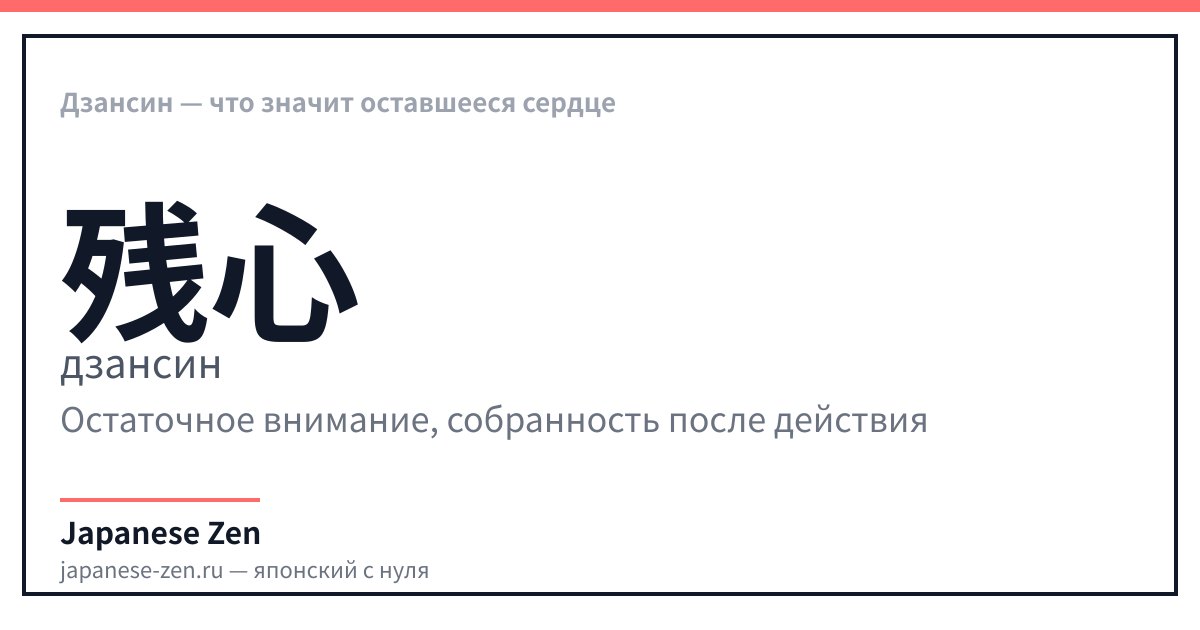
A rare Japanese concept whose absence can earn you a formal rejection from a judge: in kendo, a clean-looking strike without zanshin simply does not count.
What "zanshin" means
Zanshin is a state of alert attention that does not switch off together with the technique. The logic is simple and quite practical: a fight does not end at the moment of impact, the opponent may continue, and a person relaxed after a strike is not ready for that. Therefore in budo, zanshin is not a wish but part of the technique: the position of the body, the distance, the direction of the gaze and the breathing after the action are evaluated as strictly as the action itself. Outside the dojo the word is used less often and usually metaphorically — about a driver who does not exhale immediately after a difficult maneuver.
| Japanese | Reading | Translation |
|---|---|---|
| 残心 | zanshin · zanshin | Residual attention, composure after an action |
| 残る | nokoru · nokoru | To remain |
| 武道 | budō · budō | Martial ways, martial arts |
| 一本 | ippon · ippon | A clean point in a match |
| 気を抜く | ki o nuku · ki o nuku | To relax, to lose concentration |
Why "remaining heart" sounds more lyrical than it is
Literally 残心 is "remaining heart", and in English this sounds lyrical, though there is nothing lyrical in the term. "Remaining mind" and "lingering awareness" are closer, but they also soften it. The most accurate is a descriptive translation: "readiness not withdrawn after an action". By the way, zanshin can also be understood the other way around, as "what is left of your attention": if after a strike none of it remains, then everything was spent on the swing.
Breaking down the character 残
残 — значение: remainder, balance — онъёми: ザン、サン — кунъёми: のこ.る、のこ.す、そこな.う、のこ.り — 10 штрих(ов). 残 (zan, nokoru) — "to remain, remainder". On the left is the radical 歹 "decayed bones", on the right 戔 — two 戈 "dagger-axe" signs stacked on top of each other. The grim etymology of "what is left after a battle" sounds more fitting in a budo term than anywhere else.
What parts make up the term
The second character is 心, "heart-mind": the same as in 初心 (shoshin) and 無心 (mushin). Japanese keeps reason and feeling in one character, so 残心 is correctly read both as "remaining attention" and as "remaining presence of mind". There is also a homonymous spelling 残身 — "remaining body": it is sometimes used in kyudo, emphasizing that after the shot it is primarily the form that is preserved, not the intention. Both spellings are legitimate, and the dispute between them in shooting schools continues to this day.
Write 残 along the guides — the character of "remainder" from which the term is built.
How zanshin looks in kendo, kyudo and aikido
| Discipline | How zanshin looks | What happens without it |
|---|---|---|
| Kendo | after the strike the fighter maintains distance, turns to face the opponent and keeps the shinai ready | the judges do not raise their flags: a strike without zanshin does not give ippon, even if the hit was clean |
| Kyudo | after the shot the archer remains in the open posture and holds it for a few seconds, gazing toward the target | the shot is considered incomplete; in the rules zanshin is a separate eighth stage of the hassetsu ceremony |
| Aikido | after the throw, control over the partner and the distance is maintained, the gaze does not wander away | the technique is judged as unfinished: a partner left unattended can formally get up and continue |
| Iaido | the blade is shaken off and returned to the scabbard without losing control of the surrounding space | sheathing the sword turns into a decorative gesture rather than part of the technique |
| Karate | after a scored technique the fighter restores stance and distance rather than celebrating | in competition rules, the absence of zanshin is grounds for not awarding a point |
What people get wrong about zanshin
- "Zanshin is a meditative state." No, it is a technical requirement with formal markers: distance, body position, direction of gaze. The judge evaluates not the fighter's inner experience but what is visible from outside.
- "It is the same as concentration." Concentration is needed before and during an action; zanshin is strictly after. The difference is fundamental: failure usually happens precisely on the exhale, when the task seems solved.
- "The term is ancient, from the samurai era." The combination itself appears in the teachings of old schools, but zanshin received its current strict formulation in the 20th century, when kendo and kyudo federations wrote down competition rules.
- "Zanshin is about aggression." It is rather about distrust of one's own success. In aikido, where the task is not to win but to neutralize, zanshin is required exactly as much as in a sword duel.
FAQ
- What does "zanshin" mean?
- Zanshin is the composure that remains after a completed action. A martial arts term: the technique is finished, but the distance, stance and attention are maintained, because the opponent is still in the fight.
- How is "zanshin" written in kanji?
- 残心, read as ざんしん. The character 残 means "to remain, remainder", 心 means "heart, mind". Literally "remaining heart". In kyudo there is also the spelling 残身, "remaining body", with an emphasis on form.
- Why is a strike without zanshin not counted in kendo?
- Because the rules require a completed technique, not a touch. If after the strike the fighter relaxes, turns away or loses distance, the judges do not raise their flags: ippon assumes that the fight could have continued.
- How does zanshin differ from ordinary attentiveness?
- By timing. Attentiveness works before and during an action; zanshin is strictly after, when the task seems solved and the tension drops on its own. It is precisely in that interval that missed strikes most often happen.
- Does zanshin exist outside martial arts?
- In everyday Japanese the word is rare and used figuratively — about someone who does not exhale immediately after a difficult task. In the tea ceremony a similar idea is described differently: the host follows the guest with his gaze and does not put away the utensils right away.
- How is zanshin connected to shoshin?
- They share the character 心 and the same training frame: shoshin is responsible for the attitude to the task before it begins, zanshin for the state after it is completed. In the dojo both words are heard from the same instructor in the same training session.
Sources
Updated: 2026-09-05