Gaman — what the Japanese idea of endurance means
Gaman (我慢, がまん) means "to endure, to hold yourself in check": not passive suffering, but self-restraint that in Japan is considered a mark of an adult. People endure heat, pain, inconvenience and the urge to complain. The word came from Buddhist vocabulary, where 我慢 meant the exact opposite — pride and clinging to one's own ego. Gaman does have a dark side, and in Japan itself people talk about it openly.
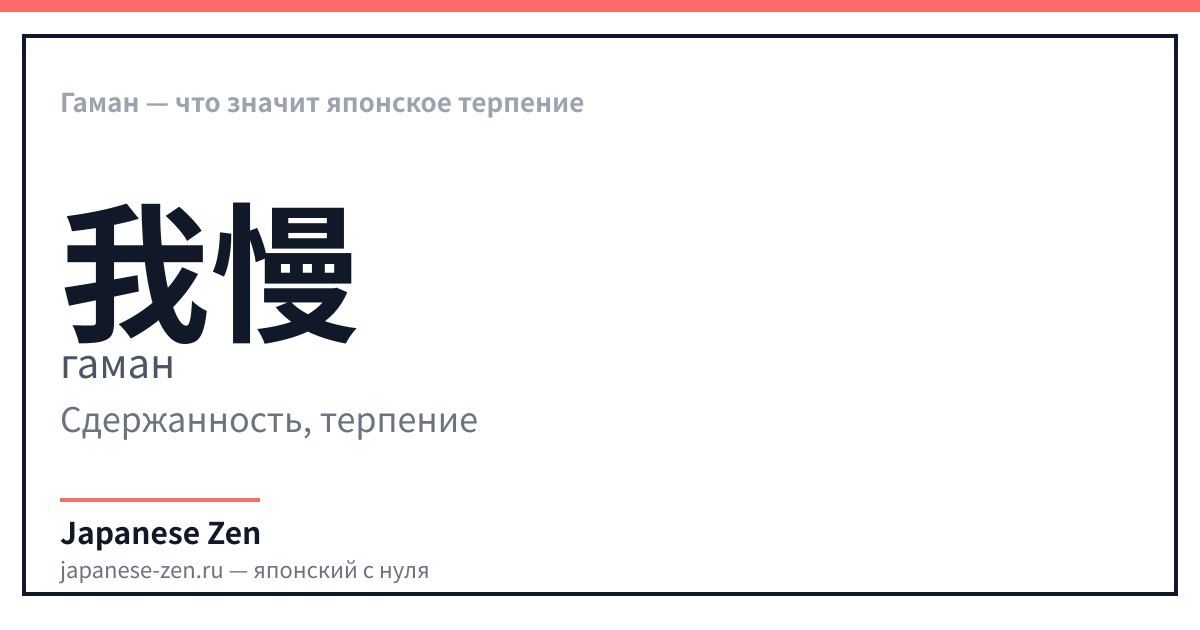
A word that every Japanese child hears and almost every dental patient too. It is translated as "patience" — and that immediately loses half the meaning: gaman is not about how hard things are for a person, but about others never seeing it.
What "gaman" means
我慢 is a noun and the verb 我慢する: to endure, to hold back, to do without something. It is said of heat without air conditioning, of pain, of the urge to talk back to a boss, and of a child who does not beg for a toy. The key in the word is not the hardship itself but holding oneself in: the person does not show what it costs them. Hence the evaluation: 我慢強い "patient" sounds like praise for someone's character, not like sympathy.
Why "patience" is an imprecise translation
The English word "patience" is about duration: a person puts up with something difficult for a long time. Gaman is about composure in public: not whining, not snapping, not causing inconvenience to others. That is why the word carries social weight: gaman is seen as a contribution to the common order. Its closest Japanese neighbor 辛抱 (shinbō) sounds more old-fashioned and closer to "endurance for the sake of a result."
| Japanese | Reading | Translation |
|---|---|---|
| 我慢 | gaman · gaman | Self-restraint, endurance |
| 我慢する | gaman suru · gaman suru | To endure, to hold oneself back |
| 辛抱 | shinbō · shinbō | Endurance, perseverance |
| 我慢強い | gamanzuyoi · gamanzuyoi | Patient, tough |
| 痩せ我慢 | yasegaman · yasegaman | To endure out of pride, pretending everything is fine |
| もう我慢できない | mō gaman dekinai · mō gaman dekinai | I can't take it anymore |
The writing 我慢 and its Buddhist past
The first character 我 means "I, one's own," the second 慢 means "arrogance, conceit, slowness." Literally the combination reads as "exalting one's ego" — and that is exactly how it was understood in Buddhist texts: 我慢 stood in a list of types of pride, meaning a vice, not a virtue. From pride to stubbornness, from stubbornness to "standing one's ground without complaining," and from there to today's self-restraint — that is the route of the meaning.
How old the word "gaman" is
As a Buddhist term 我慢 has existed for many centuries — it came along with translated Buddhist vocabulary from the continent. The familiar today meaning "to endure, to hold back" took hold noticeably later, around the Edo period, and since then has almost completely displaced the original: a Japanese person encountering 我慢 in a text will think of endurance, and will recall pride only in a Buddhist context.
Say 我慢する and "mō gaman dekinai" — the phrase with which patience runs out in Japanese dramas.
How gaman works in everyday life
- A child in a store is told 我慢しなさい — "put up with it," and this is the first social norm they learn.
- In the summer of 2011, when electricity was being saved after the Fukushima accident, air conditioners were turned off precisely under the slogan of endurance.
- An employee does not take vacation because colleagues do not take vacation: not complaining and not standing out is also gaman.
- In sumo halls and school sports clubs, endurance in grueling training is valued no less than technique.
- On television there is a whole genre 我慢大会 — competitions to see who can endure cold, heat or tickling the longest.
The dark side of gaman
After the 2011 earthquake and tsunami, foreign correspondents wrote about the endurance of the people of Tohoku with admiration: orderly queues, no looting, no complaints on camera. Inside the country the conversation was different. Psychologists and doctors pointed out that the same norm prevents people from asking for help: they do not seek support so as not to be a burden, and stay silent about their condition for months.
What Japanese people put into it, and what the Western press sees
From the outside, gaman looks like national resilience and is often presented as a lesson to the rest of the world. In Japanese conversation the word carries noticeably more bitterness: it is associated with overwork, silence about domestic problems, and the stigma around seeing a psychiatrist. The praise "he is patient" and the question "why didn't he say anything" refer to the same behavior.
Gaman: what it is not
- "Gaman is Japanese stoicism with a philosophy behind it." There is no separate doctrine: it is an everyday norm of behavior taught at home and at school.
- "You must always endure." In Japan itself people discuss the limit: the phrase 我慢しなくていい ("you don't have to endure") has become a slogan of mental health campaigns.
- "Gaman means submission." The word grew out of the meaning "to stand one's ground," and a shade of stubbornness has remained in it.
- "It is the same as ganbaru." Ganbaru is about effort and trying forward, gaman is about holding yourself in place.
FAQ
- What does gaman mean?
- To endure and hold yourself back without showing what it costs. It is said of heat, pain, inconvenience and the urge to complain. In Japanese eyes this is a trait of an adult, not a sign of weakness.
- How old is the word "gaman"?
- As a Buddhist term 我慢 has been known for many centuries: it entered Japanese along with translated Buddhist vocabulary. The current meaning "to endure, to hold back" took hold later, roughly by the Edo period, and displaced the original.
- How is "gaman" written in kanji?
- 我慢, read as がまん. The first character 我 means "I, one's own," the second 慢 means "arrogance, slowness." Both are rare for a beginner, so textbooks often give the word in kana: がまんする.
- How is gaman different from ordinary patience?
- The English word "patience" describes a person's state, while gaman describes their behavior among people: not snapping, not complaining, not causing inconvenience to others. That is why the word has a social coloring and an approving tone.
- Is it true that gaman is always a good thing?
- In Japan itself they do not think so. After the events of 2011, doctors and psychologists wrote that the habit of enduring prevents people from asking for help, and mental health campaigns repeat directly: you don't have to endure.
- How do you say "I can't take it anymore" in Japanese?
- もう我慢できない (mō gaman dekinai) — "I can't take it anymore." The polite version is 我慢できません. The negative is built from 我慢できる "to be able to endure," not from the original verb 我慢する.
Sources
Updated: 2026-09-05