Shoshin — what the beginner's mind means
Shoshin (初心) — "beginner's mind": a state in which a person does not yet know how things are "supposed" to be done, and therefore sees the subject as a whole. The word has two independent lineages. The medieval, theatrical one: Zeami's formula 初心忘るべからず — "do not forget the beginner's mind" — from his treatises on Noh theater. And the Zen one, which the world came to know through Shunryu Suzuki's book "Zen Mind, Beginner's Mind" (1970). The lineages are similar in spirit, but they are not one tradition.
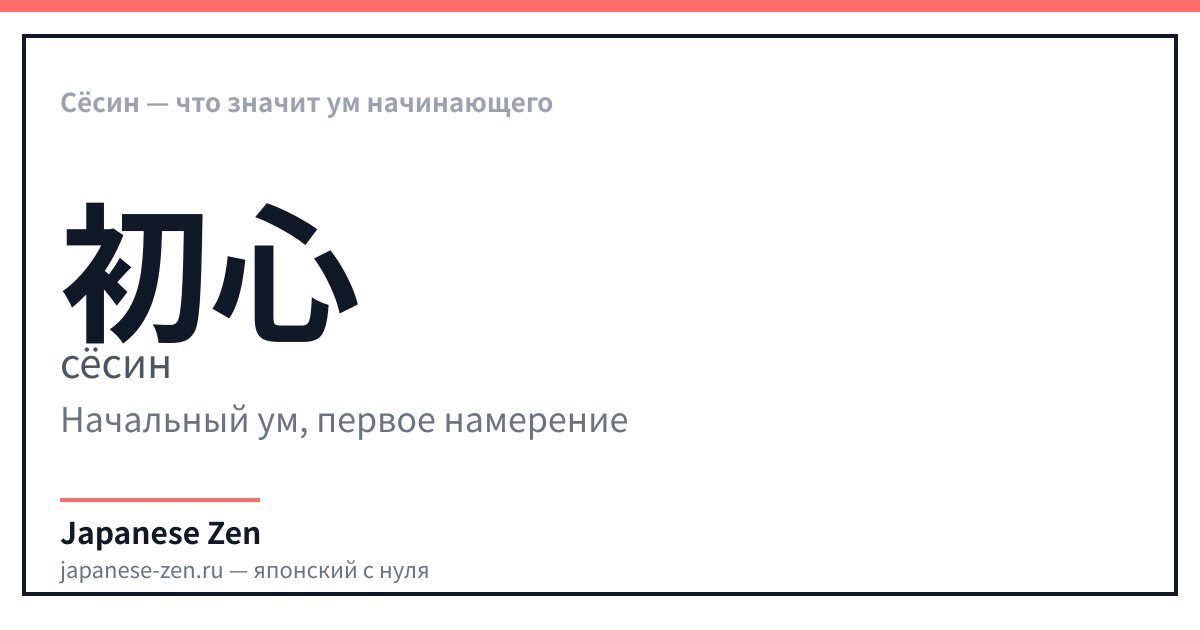
A concept with a rare fate: for six hundred years in Japan it was applied mainly to actors, and it gained worldwide fame through Californian listeners of a Japanese monk who recorded his lectures on tape.
What "shoshin" means
Shoshin is an attitude in which experience does not get in the way of seeing. A beginner has no ready-made answers: he does not know that "this is not how it's done," and therefore notices what a master long ago stopped seeing. The word is composed of 初 "first, initial" and 心 "heart-mind," and in everyday Japanese it means rather "original intention" — the reason a person once took up a task. Hence the derivative 初心者 (shoshinsha) — "beginner," a completely ordinary word: it labels the sticker on a learner driver's car and the beginner's section in any manual.
| Japanese | Reading | Translation |
|---|---|---|
| 初心 | shoshin · shoshin | Beginner's mind, first intention |
| 初心者 | shoshinsha · shoshinsha | Beginner, novice |
| 初心忘るべからず | shoshin wasuru bekarazu · shoshin wasuru bekarazu | "Do not forget the beginner's mind" — Zeami's formula |
| 心 | kokoro · kokoro | Heart, mind, soul |
| 素直 | sunao · sunao | Open, without prejudice |
What is lost in the translation "beginner's mind"
"Beginner's mind" is the standard English rendering of the Japanese 初心 (shoshin), but it can mislead: in English it sounds like "inexperience," that is, a deficiency. In Japanese, 初心 is not a deficiency in any of its senses. For Zeami it is rather "the memory of what you were like when you could do nothing"; for Suzuki, it is "a mind in which there are many possibilities, not few." A more precise rendering would be "an unlearned gaze." In everyday usage, 初心 is generally translated as "original intention": "to return to shoshin" means to remember why you started.
The character 心 — a heart that is also a mind
心 — значение: heart, mind, spirit — онъёми: シン — кунъёми: こころ、-ごころ — 4 штрих(ов). 心 (shin, kokoro) — "heart, mind, soul." A pictogram of the heart muscle with its chambers: four strokes, three of which are dot-flourishes. One of the most frequently occurring characters in Japanese vocabulary about states of being.
Why 心 is both "mind" and "heart" and "intention"
In European languages, reason and feeling are separated into different words; in Japanese (as in Chinese) they are held by a single character, 心. Therefore 初心 is correctly translated as "beginner's mind," "first heart," and "original intention" — all three meanings are present in the character at once, and it is the translator, not the Japanese speaker, who has to choose between them. The second character, 初, consists of 衤 "clothing" and 刀 "knife": to cut fabric — that is, to make the first cut with which a thing begins. 初 is not included in our set of copybook characters, so here it can only be examined, while 心 can be practiced.
Write 心 along the guides: three flourishes around a hook — a character that looks simpler than it is to write.
Two sources: Zeami and Shunryu Suzuki
The formula 初心忘るべからず belongs to Zeami Motokiyo (c. 1363–1443) — an actor, playwright, and theorist of Noh theater. In his treatise "Kakyō" ("The Mirror of the Flower," 1424) he analyzes it in detail. An actor has several "beginner's minds": the one he had in his youth; the one that appears at each new stage of mastery; and the one needed in old age. To forget any of them means to stop. Zeami is speaking not of spiritual practice but of the professional growth of a performer, who would otherwise freeze in a once-found manner.
- Zeami, 15th century: the "beginner's mind" is the actor's working principle. Do not forget how unskilled you were, so as to see where to go next.
- The Zen Buddhist line: shoshin as the absence of fixed ideas — akin to the concept of mushin, "no-mind," and with no direct connection to Zeami.
- Shunryu Suzuki (1904–1971), a priest of the Soto school, came to San Francisco in 1959. "Zen Mind, Beginner's Mind" was compiled from his talks and published in 1970, near the end of his life.
- The first sentence of the book — "in the beginner's mind there are many possibilities, in the expert's mind there are few" — is the shoshin that the Western reader knows.
- Steve Jobs, who read Suzuki, helped the concept enter the lexicon of the product industry — from there it returned to the web as the "shoshin principle."
What of shoshin remained in Japan, and what the West added
For a Japanese person, 初心 is first of all an everyday word: "shoshin ni kaeru," to return to one's original intention, is said by a graduate at a class reunion and by an employee in his tenth year at a company. Zeami's proverb is known to a schoolchild as a saying, not as philosophy. The Western line turned shoshin into a method: deliberately taking the beginner's position in order to unblock thinking. This is a working technique, but attributing it entirely to the Zen tradition is inaccurate — Suzuki is talking about the practice of sitting, not about creativity in a meeting.
Where shoshin works in ordinary work
- A master who once a year takes up the exercise of the first day — a standard practice in kendo and calligraphy: the basic movement checks what excess has accumulated.
- A developer explaining a system to a new person and, midway through the explanation, realizing that half the decisions no longer have reasons.
- A translator who rereads a familiar text pretending to see it for the first time: that is how you find the places that are "clear" only to someone who already knows the answer.
- Returning to shoshin in Japanese everyday life: "why did I go into this profession at all" — a question asked not in a crisis but on a regular basis.
What people wrongly say about shoshin
- "Shoshin is an ancient Zen teaching." The concept 初心 is old, but the well-known formulation about the beginner's mind comes from a 1970 book compiled from lectures for Americans. Zeami is five hundred years older, but he was talking about theater.
- "It means being naive." On the contrary: for Zeami, shoshin is available only to one who has already walked the path and remembers its beginning. A beginner does not actually possess shoshin — he is simply a beginner.
- "Shoshin and mushin are the same thing." Mushin (無心) — "no-mind," the absence of deliberation in the moment of action, a term of budo and Zen. Shoshin is about one's attitude to one's experience. They overlap but do not coincide.
- "It is enough to decide to look at everything with fresh eyes." In Japanese usage, shoshin is tied to a task one has been engaged in for years. Without that background, a "fresh eye" is simply ignorance of the subject, and it reveals nothing.
FAQ
- What does "shoshin" mean?
- Shoshin is the "beginner's mind": the gaze of a person who has not yet learned how things are supposed to be done, and therefore sees the subject as a whole. In everyday Japanese it means the original intention, the reason one once took up a task.
- How is "shoshin" written in kanji?
- 初心, read しょしん. The first character 初 means "first, initial," the second 心 means "heart, mind, soul." From the same word is formed 初心者 (shoshinsha) — "beginner," a completely ordinary designation for a novice.
- Who first formulated the principle of shoshin?
- Zeami Motokiyo, actor and theorist of Noh theater, in treatises of the 15th century: 初心忘るべからず — "do not forget the beginner's mind." He was speaking of the professional growth of a performer, not of spiritual practice.
- What does the book "Zen Mind, Beginner's Mind" have to do with it?
- Through it the whole world learned the concept. The book was compiled from the talks of Shunryu Suzuki, a priest of the Soto school who worked in San Francisco; it was published in 1970. This is a line separate from Zeami, though their spirit is akin.
- How does shoshin differ from a beginner's inexperience?
- In that it presupposes experience. Shoshin is the master's ability to look as if he were not yet a master. A true beginner has no choice, so his state is not considered shoshin — it is simply ignorance.
- How do you say "I am a beginner" in Japanese?
- "Watashi wa shoshinsha desu" — 私は初心者です. The word 初心者 is neutral and used everywhere: in a sports club, in a language school, on a learner driver's sticker. There is no need to apologize for it.
Sources
Updated: 2026-09-05