Satori — what the word means and what it is not
Satori (悟り, さとり) — "realization, insight": in Zen Buddhism this is the name for the experience in which a person sees things as they are, without the usual padding of explanations. The word itself is ordinary: a Japanese speaker will use the verb 悟る about finally understanding something about themselves. It was the Western tradition of retelling that turned satori into a sudden flash and a final reward for meditation.
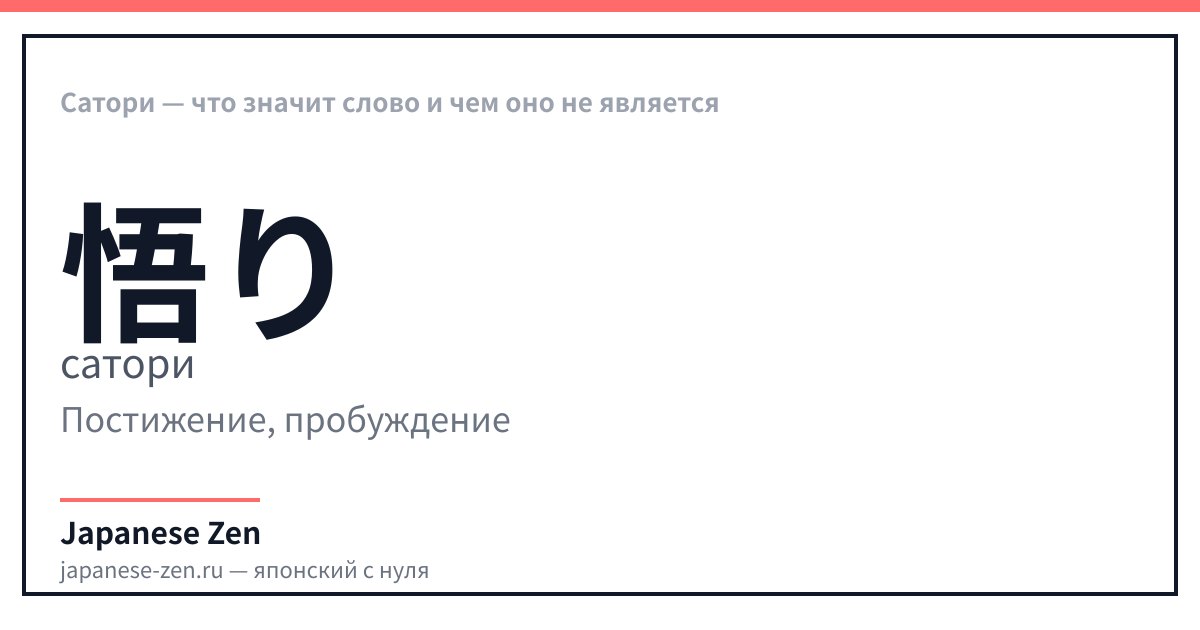
In English texts, the word "satori" almost always comes with a flash of light and a completed path. In Japanese it is a verb that can calmly be said about a person who has realized that arguing further is pointless.
What "satori" means
悟り is a verbal noun from 悟る "to realize, to become aware, to grasp mentally." In Buddhist terminology it is awakening: a direct understanding of the nature of things, opposed to 迷い — delusion, confusion. In ordinary speech the verb is alive too: 悟る will be said about a person who has understood something about themselves and stopped fussing. Hence an important detail: a Japanese speaker hears in the word not a special effect, but precisely an understanding that has been reached.
Satori and kenshō: what's the difference
A related term is 見性 (kenshō) — "seeing one's own nature." In the Rinzai school, kenshō usually refers to the first recognition, while satori is a broader concept, for the experience of awakening in general. There is no strict distinction: different teachers and different texts arrange these words in their own way.
| Japanese | Reading | Translation |
|---|---|---|
| 悟り | satori · satori | Realization, awakening |
| 悟る | satoru · satoru | To realize, to become aware |
| 迷い | mayoi · mayoi | Confusion, delusion — the opposite of satori |
| 座禅 | zazen · zazen | Seated meditation |
| 公案 | kōan · kōan | A paradox task for a student |
| 見性 | kenshō · kenshō | Seeing one's own nature |
The character 悟: heart and "I"
On the left of the character is 忄 — a compressed form of 心 "heart, mind," and on the right is 吾 "I." The result is an image that is easy to remember: an understanding that has reached one's own heart. The character is read sato- in the verb 悟る and go in compounds like 覚悟 (kakugo) "resolve, readiness for the worst" — a word that appears in anime far more often than satori itself.
悟 — значение: enlightenment, perceives, discern, realize, understand — онъёми: ゴ — кунъёми: さと.る — 10 штрих(ов). 悟 — "to realize, to become aware": on the left the heart 忄, on the right 吾 "I," ten strokes.
Write 悟 along the guides: first the left heart part, then 吾 on the right.
How satori is viewed within Zen itself
The two main Japanese Zen schools look at this differently, and the difference is practical: it determines what a student does in the morning in the hall.
| School | What they do in practice | How they view satori |
|---|---|---|
| Rinzai | work with kōans — tasks that cannot be solved by reasoning, and regularly report to the teacher | a breakthrough is possible and awaited; the experience is verified by the teacher, not by the student themselves |
| Soto | shikantaza — "just sitting": no task, no goal, with attention to posture and breathing | practice and awakening are not separate: sitting is not a means to obtain satori, it is already it |
Why in the monastery they don't talk about it aloud
Talk about one's own experience is not encouraged in Zen circles: telling about satori is considered a sure sign that the person is occupied with themselves, not with practice. The assessment remains with the teacher, and he usually cools enthusiasm — an experience without changed behavior does not count.
Where Japanese people encounter this word today
- In everyday life: 悟った — "it clicked," usually with a shade of "understood and accepted."
- In the expression さとり世代 "satori generation" — in the 2010s this was the name for young people who do not strive for money and career.
- In the name of the yōkai 覚 (satori) — a mountain creature from old collections that reads a traveler's thoughts.
- In anime and games the word is assigned to monk characters, but far more often the related 覚悟 "resolve" is heard.
- In temple announcements about zazen classes — there it is almost always paired with practice, not with a result.
What satori does not promise
- "Satori is a flash after which a person changes forever." In Soto school texts, awakening is more a property of practice itself than an event with a date.
- "It is the goal of meditation." Dōgen insisted on the opposite: sitting for a result is already a miss.
- "Satori and nirvana are the same thing." Nirvana is a general Buddhist concept and about something else; satori belongs to the Zen vocabulary.
- "It is given for years of effort." Neither time nor seniority guarantees anything, and teachers warn about this in advance.
FAQ
- What does "satori" mean?
- Realization, insight. In Zen Buddhism this is the name for the experience of awakening — a direct understanding of the nature of things. In ordinary Japanese speech the verb 悟る simply means "it clicked, I got it," without any mysticism.
- How is "satori" written in kanji?
- 悟り, read さとり. The character 悟 consists of the heart 忄 on the left and 吾 "I" on the right, ten strokes. The same character appears in the word 覚悟 (kakugo) — "resolve, readiness for the worst."
- How does satori differ from kenshō?
- Kenshō (見性) — "seeing one's own nature," in the Rinzai school this usually refers to the first recognition. Satori is a more general word, about the experience of awakening in general. There is no hard boundary between the terms; teachers arrange them differently.
- Can one attain satori alone at home?
- No one forbids sitting at home, and many temples advise starting exactly that way. But verification of the experience in the Zen tradition lies with the teacher: self-assessment of one's own insight is considered unreliable by definition.
- How did the word enter Western culture?
- Through books about Zen from the mid-20th century and through the Beats, who read them voraciously. From there came the image of instant illumination — in Japanese monastic texts the emphasis is rather on many years of practice.
- How is "satori" pronounced in Japanese?
- Three short, even syllables: sa-to-ri. There is no stress in the English sense, the vowels are not drawn out, the "r" is light, closer to a single tap of the tongue. English "satori" with stress on the second syllable already sounds different.
Sources
Updated: 2026-09-05