Japanese Philosophy — What Kinds There Are and How They Differ
Japanese philosophy is not a single doctrine but an umbrella under which readers stack four different layers: Buddhist schools (including Zen), the Shinto cult of kami, Confucian ethics of service, and aesthetic categories like wabi-sabi and yūgen. They have different texts, different centuries, and different purposes, and confusing them is like treating a monastic rule, a village festival, and a book of good manners as one volume.
No Japanese university teaches "Japanese philosophy" as a single course — and not because it doesn't exist. It's just that under this word lie four different things: salvation, ritual, social order, and taste.
What Japanese Philosophy Is Made Of: Four Layers and One School
Japanese philosophy in search queries is usually a set of beautiful words: ikigai, wabi-sabi, kintsugi, satori, bushido. The words are real, but their origins differ. Some came from Buddhist schools, some grew out of Shinto, some are the Confucian heritage of mainland China reworked in the Edo period, and some are not philosophy at all but categories of taste assembled by philologists of the 18th–20th centuries. Below is a map: twelve concepts, each with its own layer and its own page.
| Concept | Kanji | Layer | What It's About |
|---|---|---|---|
| Ikigai | 生き甲斐 | modern usage | that which makes it worth getting up in the morning; the Western "four-circle diagram" has nothing to do with Japanese usage |
| Kintsugi | 金継ぎ | craft | repairing ceramics with lacquer and gold; this technique was made into philosophy long after the craftsmen who invented it |
| Wabi-sabi | 侘寂 | aesthetics | a taste for the understated, simple, and worn; traces of time as a virtue of the object |
| Yūgen | 幽玄 | aesthetics | hidden depth: that which can only be hinted at, not shown in full |
| Mono no aware | 物の哀れ | aesthetics | a response to what is happening now and will soon end; the concept was reconstructed by Motoori Norinaga |
| Satori | 悟り | Buddhism, Zen | awakening, direct understanding of things; in the Rinzai school it is reached through koans, and the "sudden flash" is a Western addition |
| Shoshin | 初心 | Noh theater and Zen | beginner's mind: the view of one who does not yet know how to do it "correctly" |
| Zanshin | 残心 | budo | the alertness that remains after a strike; without it, no point is awarded in kendo |
| Way of the Warrior | 武士道 | Confucian heritage | the samurai ethics of service, written down mainly when there was no one left to fight |
| Gaman | 我慢 | everyday life and Buddhism | to endure with dignity and without complaint; a word from the Buddhist vocabulary that moved into everyday norms |
| Ganbaru | 頑張る | everyday life | to try to the utmost; the most common verb of encouragement — and the flip side of overwork culture |
| Seiza | 正座 | etiquette | "correct sitting" on the knees: not an idea but a bodily norm of politeness |
By What Criterion These Layers Are Distinguished
Buddhism answers the question "how to escape the circle of suffering" and relies on sutras translated from Chinese: the Tendai and Shingon schools arrived in the 9th century, amidism and Zen (Rinzai and Soto) in the 12th–13th. Shinto answers the question "how to properly deal with the kami" and relies not on a treatise but on ritual and place. The Confucian heritage is about hierarchy and duty; under the Tokugawa, Zhu Xi's Neo-Confucianism functioned almost as state ideology, and bushido grew precisely from there. Aesthetic categories are the fourth layer: they describe not the world but perception. Academic philosophy of the 20th century stands apart — the Kyoto School of Nishida Kitaro, which tried to speak with the European tradition in its own language.
Kaizen
Kaizen (改善, "change for the better") is consistently the fifth item in any list of "ancient Japanese wisdom" — and that is a dating error of about a thousand years. The word itself is ordinary; it appears in prewar dictionaries meaning "improvement." It became the doctrine of continuous small improvements after the war, in manufacturing: American industrial training programs, William Edwards Deming's lectures on statistical quality control, and the Toyota Production System. The book by Masaaki Imai in 1986 made "kaizen" a mass international term. This is a management practice with a known address and date, not a legacy of monks.
Where to Start If You're Reading About This for the First Time
- Satori — because through it Zen is most clearly understood: not "calm" but a break from the habitual way of thinking. From satori it's easy to move to zazen and to how Rinzai differs from Soto.
- Mono no aware — the oldest of the aesthetic categories and the most honest: it shows how an 18th-century philologist assembled the concept from literary material, and why it doesn't work without The Tale of Genji.
- Wabi-sabi — because it is the prime example of how a Japanese category of taste turned into an interior style in the West. Useful as a vaccine against the rest.
- Way of the Warrior — because bushido is usually presented as an ancient code, though it is a late armchair compilation of peacetime, and Hagakure and The Book of Five Rings contradict each other.
- Ikigai — because it is the most recent and most distorted case: the Japanese word is everyday, but its worldwide fame came through a diagram drawn by a non-Japanese.
Kanji That Run Through the Whole List
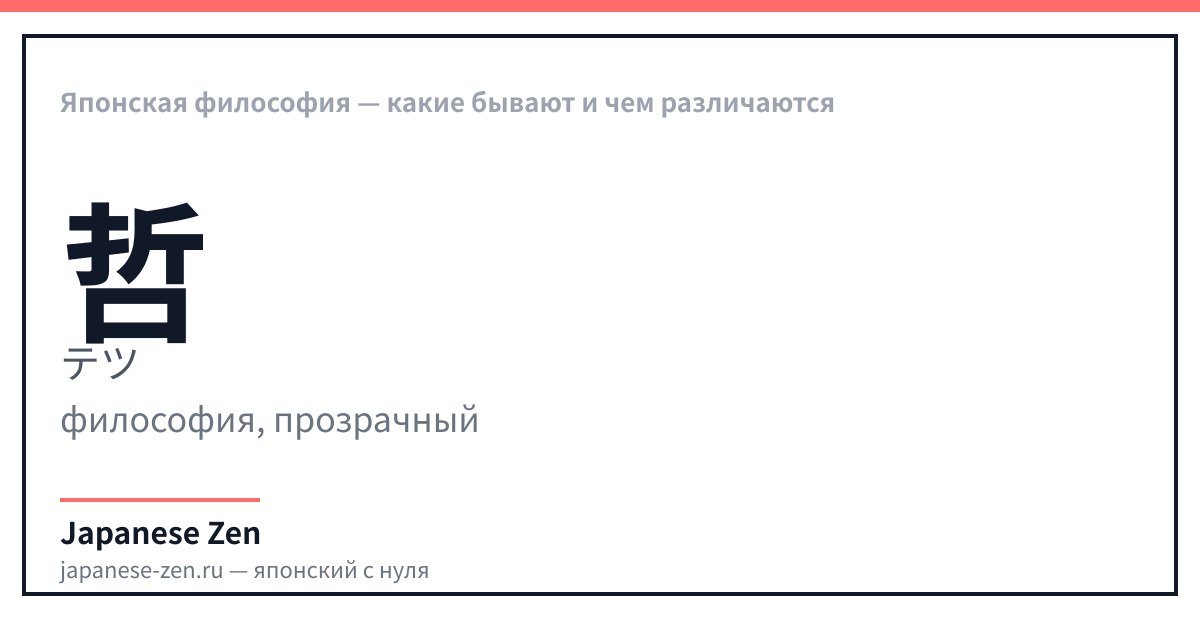
哲 — значение: philosophy, clear — онъёми: テツ — кунъёми: さとい、あきらか — 10 штрих(ов). 哲 (tetsu) — "insight, wisdom." On top 折 "to break, analyze," below 口 "mouth": to analyze aloud in order to understand. Together with 学 "study" it gives 哲学 — the word "philosophy," assembled by the Japanese in the 19th century to translate the Western term.
| Japanese | Reading | Translation |
|---|---|---|
| 哲学 | tetsugaku · tetsugaku | Philosophy |
| 禅 | zen · zen | Zen — a school of Buddhism |
| 神道 | shintō · shintō | Shinto, the way of the gods |
| 武士道 | bushidō · bushidō | Way of the warrior |
| 美学 | bigaku · bigaku | Aesthetics |
| 無常 | mujō · mujō | Impermanence of all things |
Why 道 Appears More Often Than Any Other Character
The character 道 is read "dō" in compounds and "michi" on its own, and means both road and teaching. It appears in 武士道 (way of the warrior), 茶道 (way of tea), 華道 (way of flowers), 書道 (way of writing), 神道 (way of the gods), and 柔道 (the gentle way). The logic is the same in every case: an activity becomes a way when it acquires not only a result but also a training order — from imitating a model to one's own style. That is why in Japanese descriptions of a craft the word that translators are forced to render as "way" is heard so often.
道 — значение: road, street, district, journey, course — онъёми: ドウ、トウ — кунъёми: みち、いう — 12 штрих(ов). 道 (dō, michi) — "road, way, teaching." On the left 辵 — "to go along a road," on the right 首 "head": an ancient image of movement with the head turned forward. The very character from bushido, sadō, and judo.
Write 道 along the guides — the character without which no Japanese "way" is complete.
Where These Concepts Are Visible in Anime
- Mushishi — almost every episode is built around accepting impermanence: Ginko does not defeat the mushi but finds a way to coexist with them. This is closer to the Buddhist 無常 than to a morality of victory.
- Rurouni Kenshin — a direct argument with bushido: the hero remains a swordsman while refusing to kill, and the series honestly shows what this costs him.
- Demon Slayer — Tanjiro's training explains zanshin better than any definition: danger does not end with the strike.
- One-Punch Man — a parody of ganbaru: the hero dutifully trained "as one should" and was rewarded with boredom instead of meaning.
- Grave of the Fireflies — mono no aware without a single word about mono no aware; the film rests entirely on that intonation.
- Your Name — the Shinto concept of musubi is stated directly on screen, through the words of Mitsuha's grandmother.
- Fullmetal Alchemist: Brotherhood — the "law of equivalent exchange" is presented as the physics of the world, but works as a Confucian idea of mutual obligation.
FAQ
- What is Japanese philosophy and what does it consist of?
- Japanese philosophy is a general name for four different layers: Buddhist schools, including Zen; the Shinto cult of kami; Confucian ethics of service; and aesthetic categories like wabi-sabi. The academic Kyoto School of the 20th century stands apart.
- Which Japanese thinkers are known outside Japan?
- Dōgen — founder of the Soto school and author of Shōbōgenzō. Motoori Norinaga — the philologist who assembled the concept of mono no aware. Nishida Kitaro — founder of the Kyoto School. And Suzuki Daisetsu, who explained Zen to an English-speaking audience.
- Are Zen and Shinto the same thing?
- No, and they are not even neighboring things. Zen is a school of Buddhism that came from China in the 12th–13th centuries, with texts, monasteries, and the practice of sitting. Shinto is a local cult of the kami, which has no founder, no dogma, and no scripture.
- What does "kaizen" mean?
- Kaizen (改善) literally means "change for the better." As a doctrine of continuous small improvements, it is a postwar manufacturing practice: American industrial training programs, Deming's lectures, the Toyota system. It is not an ancient philosophy, though it is sold as one.
- Why are kanji needed for these concepts at all?
- Because the written form shows the composition of the concept. 残心 — "remaining heart," 初心 — "first heart," 物の哀れ — "the aware of things." The kanji restore the literal meaning that translations usually hide behind a beautiful phrase.
- Which concept is best to start with?
- With satori: it is the easiest way to understand how Zen differs from everyday "calm." Then mono no aware as the oldest aesthetic category, and wabi-sabi as the most illustrative example of Western embellishment.
Sources
Updated: 2026-09-05