The Way of the Warrior — What Lies Behind Talk of Bushido
The Way of the Warrior is the English translation of 武士道 (bushido), where 武士 means "warrior" and 道 means "way." Behind it lie not the laws of medieval Japan but several texts from different periods: Edo-era writings, a swordsman's treatise, and Nitobe Inazo's 1900 book written in English for a Western readership. The tidy code of seven virtues was assembled after the fact, when the samurai as a class no longer existed.
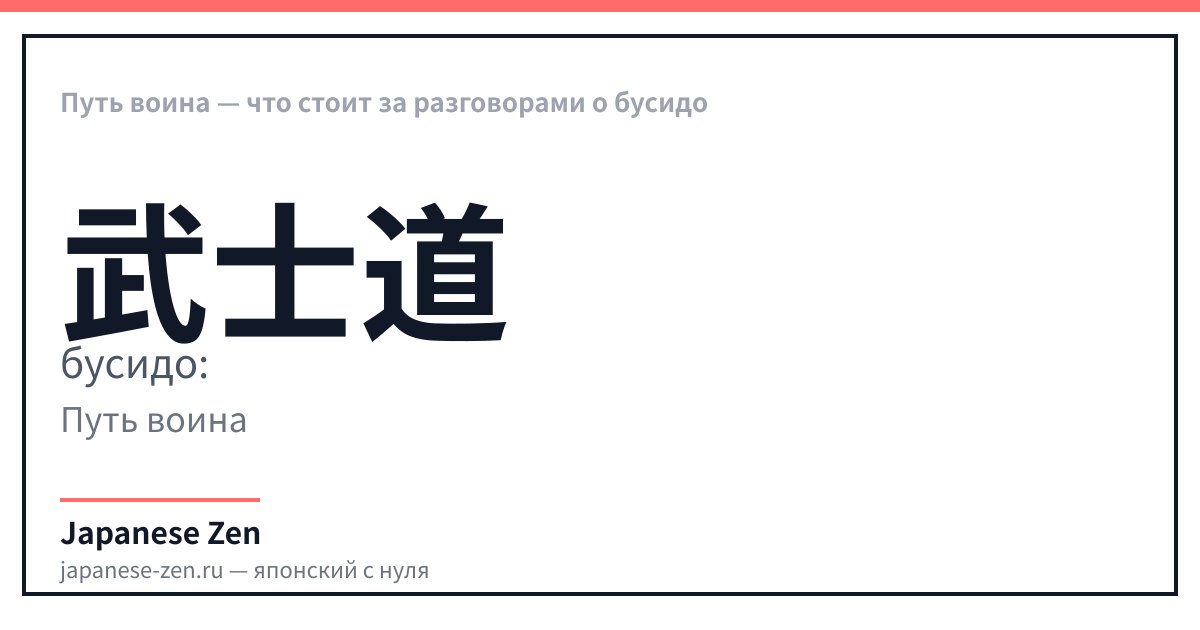
The phrase "the way of the warrior" is usually spoken as if there were a scroll where everything is written down. There is no scroll: there are scattered texts, some of them written in peacetime by people who had never been in battle.
What "the way of the warrior" means
The word usually translated this way is 武士道: 武士 "bushi, warrior" plus 道 "way, road, teaching." In Japanese, the character 道 regularly means not a route but an occupation to which one devotes one's life: 茶道 "the way of tea," 書道 "the way of writing." So 武士道 is not a code but a name for an idea of how a warrior should behave. But the English phrase is broader than one term: it stands for several Japanese words at once.
What Japanese words this is called by
| Word | Reading | What it is about |
|---|---|---|
| 武士道 | bushidō | the ethics of the warrior class: loyalty, duty, attitude to death |
| 武道 | budō | modern martial "ways" — judo, kendo, aikido, kyudo; formed in the 20th century |
| 兵法 | heihō | the martial art and strategy; what Miyamoto Musashi called his craft |
| 武者修行 | mushashugyō | wandering to hone one's skill, duels in other schools |
| Japanese | Reading | Translation |
|---|---|---|
| 武士道 | bushidō · bushidō | The way of the warrior |
| 武士 | bushi · bushi | Warrior, a person of the warrior class |
| 道 | michi · michi | Way, road |
| 侍 | samurai · samurai | Samurai, a warrior in service |
| 武道 | budō · budō | Martial arts as a "way" |
| 兵法 | heihō · heihō | Martial art, strategy |
The character 士: who the "warrior" is in the spelling 武士道
士 is a short character of three strokes meaning "serving man." It is not about muscles: the same character writes 力士 "sumo wrestler," 弁護士 "lawyer," and 博士 "doctor of science." What they share is the status of a person occupied with a profession. The first character of the compound, 武, is responsible for the military; together you get "a man of service with weapons."
士 — значение: gentleman, scholar, samurai — онъёми: シ — кунъёми: さむらい — 3 штрих(ов). 士 — "serving man, specialist": three strokes, the top horizontal longer than the bottom. It appears in 武士 "warrior" and 力士 "sumo wrestler."
Write 士 along the guides: the top stroke is longer than the bottom — this is what distinguishes it from the similar 土 "earth."
When the code itself appeared
The word 武士道 itself is recorded in texts of the early 17th century — that is, when wars in the country had ended and the warrior class was left without work. Then came two and a half centuries of peace: samurai served as officials, and discussions of proper warrior conduct were written precisely because the practice no longer existed. Individual houses and schools had their own instructions, but a single body of rules never existed in any era.
"Hagakure" and "The Book of Five Rings" — different books about different things
"Hagakure" (1716) is the recorded reflections of Yamamoto Tsunetomo, a former samurai from Saga who was never in battle and spent his last years as a recluse; the book was not published in his lifetime and circulated in manuscript copies. "The Book of Five Rings" (1645) is a treatise by the swordsman Miyamoto Musashi on the technique and strategy of dueling; it contains almost no reflections on loyalty to a lord. To mix them into one "code" is like gluing a monk's diary to a fencing manual.
Nitobe Inazo and the book written in English
The term became world-famous thanks to the book "Bushido: The Soul of Japan," which Nitobe Inazo published in 1900 directly in English and for a Western readership. Nitobe was a Quaker Christian, studied in the USA and Germany, never experienced samurai practice, and explained bushido through categories familiar to Europe — chivalry, honor, duty. The seven virtues that are listed in every retelling today come largely from there, not from medieval instructions.
What was added in the West and what came back to Japan
The book was translated into Japanese, and the image assembled for foreigners returned home as a national tradition. In the 1930s it was actively used by military propaganda: loyalty and readiness to die proved convenient material. It is from this layer, not from the era of warring provinces, that the solemn tone with which "the way of the warrior" is retold in motivational books grows.
What is repeated about the way of the warrior in vain
- "It is an ancient written code." There was no single text; the word is recorded only from the 17th century, and the tidy system from 1900.
- "A samurai was obliged to disembowel himself at the first failure." Seppuku is a judicial and ceremonial procedure with reasons and rules, not a reflex.
- "The way of the warrior and the way of the samurai are different things." These are two translations of the same word 武士道; the choice depends on the translator.
- "Modern budo continues bushido." Judo, kendo, and aikido took shape in the 19th–20th centuries as sport and education, not as the heritage of a class.
FAQ
- What does "the way of the warrior" mean?
- It is the translation of the word 武士道 (bushido): 武士 — warrior, 道 — way. It is the name for an idea of proper conduct of the warrior class — loyalty, duty, and attitude to death. There is no single body of rules behind it.
- How is "the way of the warrior" written in kanji?
- 武士道, read ぶしどう. The character 武 is responsible for the military, 士 for the serving man, 道 for the way. The same 道 appears in 茶道 "the way of tea" and 書道 "the way of writing."
- Did a single code of the way of the warrior exist?
- No. Individual houses and schools had their own instructions, but there was no common obligatory body. The word 武士道 appears in texts of the 17th century, and the familiar list of virtues was assembled at the turn of the 19th and 20th centuries.
- How does "Hagakure" differ from "The Book of Five Rings"?
- "Hagakure" is the recorded reflections of Yamamoto Tsunetomo on service and death, 1716. "The Book of Five Rings" is a treatise by Miyamoto Musashi on combat technique and strategy, 1645. The first is about mindset, the second about craft.
- Who was Nitobe Inazo?
- A Japanese scholar and diplomat, author of the book "Bushido: The Soul of Japan" (1900). He wrote it in English for a Western audience, explaining bushido through chivalric concepts, and it was this retelling that spread throughout the world.
- How does the way of the warrior differ from modern budo?
- 武士道 is the ethics of a class that disappeared in the Meiji era. 武道 refers to the educational and sporting disciplines of the 20th century: judo, kendo, kyudo, aikido. They share the character 道, but there is no direct continuity.
Sources
Updated: 2026-09-05