Ikigai — what the word means and what four circles have to do with it
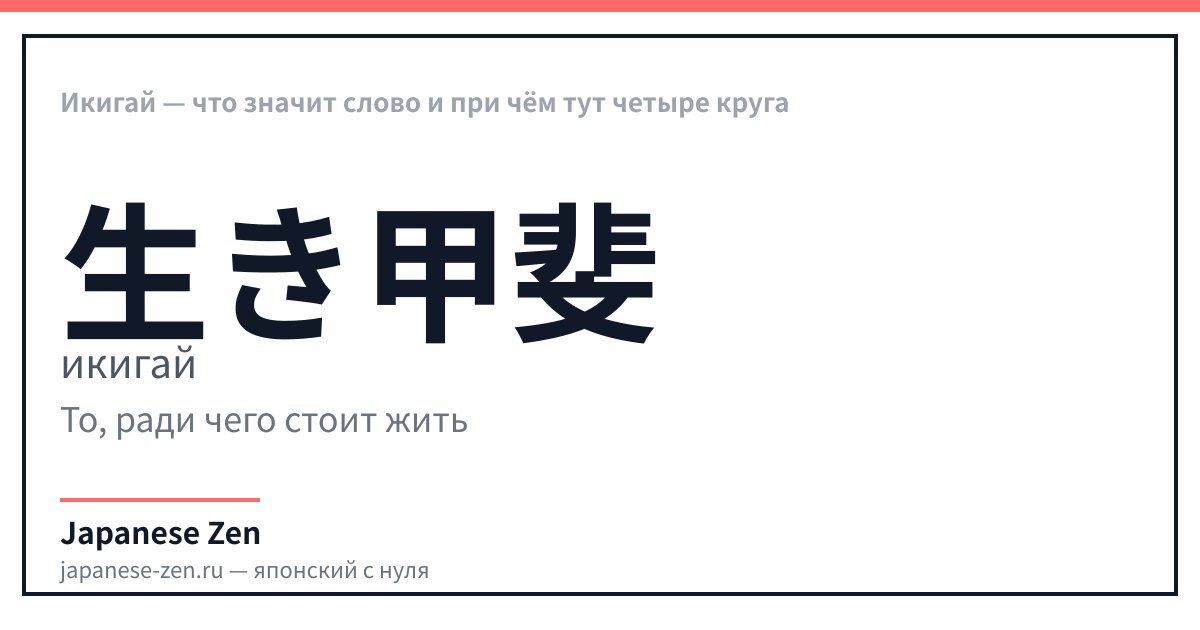
Ikigai (生き甲斐, いきがい) — "that which makes getting up in the morning worthwhile": an everyday Japanese word for what gives life flavor. It doesn't have to be work — people call their grandchildren, their vegetable garden, or a Saturday choir their ikigai. The diagram of four intersecting circles that the West uses to find a life's calling has nothing to do with the Japanese word: it was put together in an English-language blog in 2014.
In the English-speaking web, ikigai has become a scheme for finding your dream job. In Japanese, you can hear the word from an eighty-year-old neighbor who will say her ikigai is the tomatoes in her garden bed, and she won't draw any diagram.
What the word "ikigai" means
The word is made up of 生き "life, the way one lives" and 甲斐 "worth, return, that which justifies effort." Together they give "that which makes life worth living" — without any pathos: 甲斐 also lives in everyday phrases like 作り甲斐 "a thing that is a pleasure to make." Japanese dictionaries define ikigai briefly: that which gives a person a sense of joy and meaning in life. Neither size nor profitability is specified for this "something," so a grandchild, a job, and a Saturday choir all qualify equally.
How to translate ikigai into English without losing the meaning
"Meaning of life" sounds too solemn: in English it's about destiny and the final result, while 生き甲斐 is about what makes it worth getting up today. The closest is "that which keeps you going" or "what you live for." In Japanese surveys about the older generation, the word stands as an ordinary term: 生きがいを感じる — "to feel that you are not living in vain."
| Japanese | Reading | Translation |
|---|---|---|
| 生き甲斐 | ikigai · ikigai | That which makes life worth living |
| 生きる | ikiru · ikiru | To live |
| やりがい | yarigai · yarigai | Reward from a task, what makes it worth doing |
| 趣味 | shumi · shumi | Hobby, pastime |
| 生きがいを感じる | ikigai o kanjiru · ikigai o kanjiru | To feel that you are not living in vain |
The spelling 生き甲斐: why it is so long
The first character 生 is one of the most heavily loaded in the language: it is about life, birth, and all living things, and it is read differently depending on the word. Then comes the kana tail き, and 甲斐 is an old combination meaning "return, worth"; the same spelling is borne by the historical province of Kai, the birthplace of Takeda Shingen.
生 — значение: life, sincere, birth — онъёми: セイ、ショウ — кунъёми: い.きる、い.かす、い.ける、う.まれる、うま.れる、う.まれ、うまれ、う.む、お.う、は.える、は.やす、き、なま、なま-、な.る、な.す、む.す、-う — 5 штрих(ов). 生 — "life, to live, to be born": a basic N5 character, from which both 生き甲斐 and the verb 生きる "to live" begin.
Why ikigai is more often written in kana
The character 斐 is rare and is not on the everyday jōyō kanji list, so in newspapers, books, and signs the word is usually printed as 生きがい. The form 生き甲斐 remains more formal and is more often found in headlines and on covers — which is partly why internet illustrations love it so much.
Write 生 along the guides — five strokes, with which the word "ikigai" itself begins.
How ikigai looks in ordinary Japanese life
In Japanese daily life, this word sounds mundane: it is said about what keeps a person energized day after day. There is no procedure for "finding your ikigai" — rather, a person one day notices that this is it.
- A retiree from a village says his ikigai is his garden beds: the seedlings require getting up early, and that suits him.
- A grandmother calls her grandchildren her ikigai — the most common answer in surveys of the older generation.
- A craftsman who has been making noodles for forty years speaks of ikigai as the work of his hands, not as a mission.
- A woman after retirement finds her ikigai in a choir group at the community center.
- A schoolchild can say this about a club activity — it won't sound pompous.
Where the four-circle diagram came from
The diagram of four circles — "what you love," "what you are good at," "what the world needs," "what you are paid for" — was not invented in Japan. In 2011, Spanish author Andrés Zuzunaga drew such a diagram about "purpose," and in 2014 British blogger Marc Winn overlaid the Japanese word on it. In Japanese books about ikigai, including the most famous ones, this picture is absent: they talk about the small things of everyday life, not about the intersection of circles where a dream job awaits.
Ken Mogi: ikigai and "the Japanese meaning of life"
Ken Mogi (茂木健一郎) is a Japanese neuroscientist whose book about ikigai came out in English in 2017 and largely shaped the Western conversation about the word as "the Japanese meaning of life." He describes five pillars: start small, release yourself, maintain harmony with those around you, enjoy the little things, be here and now. He has no diagram, but he does have a direct caveat: ikigai does not have to bring money and does not have to be work.
What people get wrong about ikigai
- "Ikigai is an ancient system for finding your calling." The word is old, the system is not: the diagram is younger than the smartphone.
- "Ikigai is necessarily connected to work." In Japanese surveys, people more often name family, hobbies, and socializing, not profession.
- "You have one ikigai for life." The word is calmly used in a plural sense: today it's grandchildren, a year later it's ceramics.
- "Ikigai brings money." Being paid is not part of the Japanese definition at all — it was added by the Western circle "what you are paid for."
FAQ
- What does the Japanese concept ikigai mean?
- Ikigai is "that which makes life worth living": 生き "to live" plus 甲斐 "worth, return." It refers to an activity or connection that makes you want to get up in the morning. It can be work, or it can be a garden or grandchildren.
- How is "ikigai" written in kanji?
- The full spelling is 生き甲斐, read いきがい. In newspapers and books, 生きがい is more common: the character 斐 is rare and is not on the jōyō kanji list, so the second part is usually written in kana.
- Where did the four-circle diagram come from?
- From the English-language internet. Spanish author Andrés Zuzunaga published a diagram about purpose in 2011, and British blogger Marc Winn in 2014 labeled it with the word "ikigai." Japanese sources have no such diagram.
- What is Ken Mogi's book about ikigai and the Japanese meaning of life?
- Ken Mogi is a Japanese neuroscientist; his short book about ikigai came out in English in 2017 and spread through Western motivational reading lists. He describes five pillars of everyday life and separately notes that ikigai does not have to bring income.
- Do you need to specially search for your ikigai?
- In Japanese usage — no: it is not a problem with a solution, but a name for what a person already has. The question "how to find ikigai" appeared together with Western books and workshops, not in Japanese everyday life.
- How is "ikigai" correctly pronounced?
- Four even syllables i-ki-ga-i, all the same length and without stressed emphasis. An English pronunciation with strong stress on one syllable sounds different — in Japanese the word is pronounced almost monotonously, without emphasis on any syllable.
Sources
Updated: 2026-09-05