Japanese Gods — What They Are and How They Differ
Japanese gods are the kami of the Shinto pantheon: from great deities like Amaterasu and Susanoo, born directly from the body of the progenitor Izanagi, to gods of luck, patrons of individual crafts and rivers. They all share one thing — they are all kami, and the hierarchy between the 'chief god' and the 'spirit of a roadside stone' is conditional.
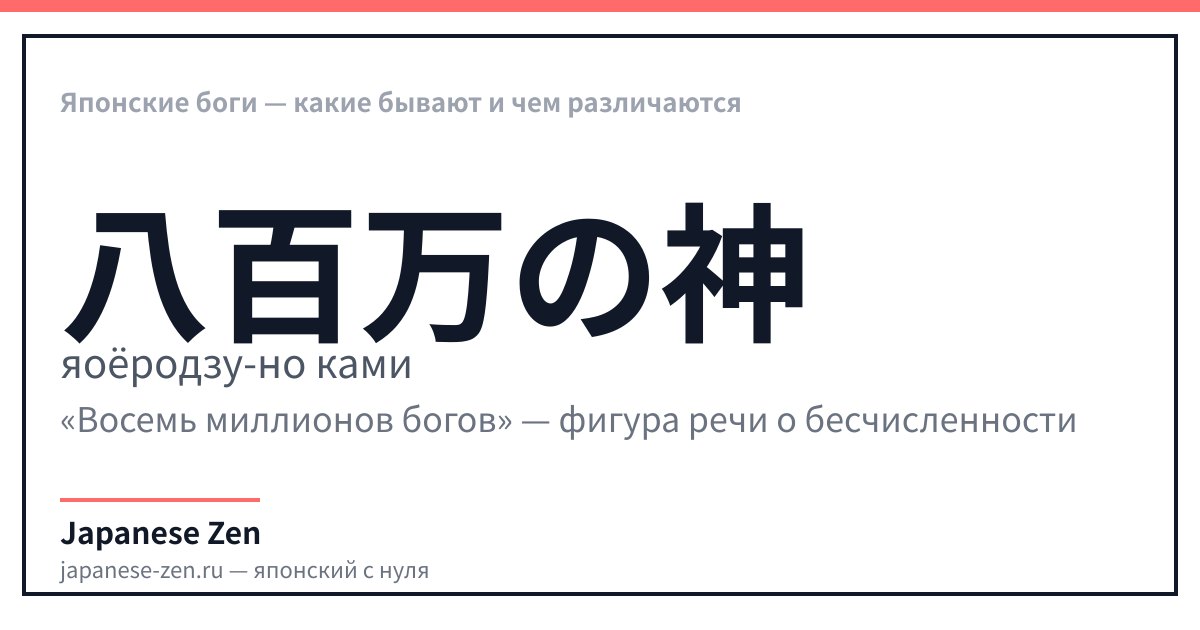
Japanese gods have no single Olympus with a schedule of duties. Some rule the elements, others live in a specific tree, and still others appear in the chronicles only once and never resurface — and all of them are equally 'gods'.
What Japanese gods are there
| God | Kanji | Known for |
|---|---|---|
| Amaterasu | 天照大神 | sun goddess, head of the pantheon |
| Susanoo | 須佐之男 | storm god, slayer of the serpent Yamata no Orochi |
| Tsukuyomi | 月読 | moon god, the most reclusive of the three main children |
| Izanagi and Izanami | 伊邪那岐・伊邪那美 | creator gods, created the Japanese islands |
| Raijin | 雷神 | god of thunder with drums on his back |
| Fujin | 風神 | god of wind, companion of Raijin |
| Inari | 稲荷 | deity of rice and prosperity, master of fox-spirits (kitsune) |
| Hachiman | 八幡神 | god of war and protection, patron of samurai clans |
| Ebisu | 恵比須 | god of fishermen and merchants, one of the Seven Gods of Fortune |
Heavenly and earthly: what's the difference
Gods are conventionally divided into heavenly (amatsukami) — those who originally lived on Takamagahara, the Plain of Heaven, and earthly (kunitsukami) — those who rule on earth, often through their descendants. A separate category is ujigami, patron gods of a specific clan or village: there are thousands of them across the country, and most never make it into the chronicles.
Where to start understanding
- Amaterasu — the formal head of the pantheon; starting with her makes it easiest to understand the kinship structure among the gods.
- Susanoo — the only god with a full heroic narrative: exile, feat, redemption.
- Izanagi and Izanami — the progenitors; their story conveniently connects to all the others.
- Raijin and Fujin — the most recognizable pair in art: they were depicted together on screens for centuries.
- The Seven Gods of Fortune — if you want not heroics but cozy mythology about luck and prosperity.
Numbers and signs: why there are 'eight million' gods
| Japanese | Reading | Translation |
|---|---|---|
| 八百万の神 | yaoyorozu no kami · yaoyorozu no kami | 'Eight million gods' — a figure of speech for countlessness |
| 神様 | kamisama · kamisama | God, deity (polite form) |
| 天津神 | amatsukami · amatsukami | Heavenly gods |
| 国津神 | kunitsukami · kunitsukami | Earthly gods |
| 氏神 | ujigami · ujigami | Clan patron god |
Why 八 in this idiom is read differently
八 (hachi, 'eight') in the phrase 八百万 is read differently — や (ya) — a rare case where a number in an idiom loses its usual reading for the sake of the phrase's rhythm. Such exceptions are best memorized as whole units rather than derived by rules.
八 — значение: eight — онъёми: ハチ、ハツ — кунъёми: や、や.つ、やっ.つ、よう — 2 штрих(ов). 八 — 'eight': a simple sign of two diverging strokes, originally a pictograph of division into two parts.
Write 八 along the guides — one of the first numerals learned in Japanese.
God names that anime turned into techniques
- 'Naruto' — god names are given to techniques and seals: Amaterasu, Susanoo, Tsukuyomi — all three are already used as abilities of the Uchiha clan.
- Ōkami — the entire video game is built around Amaterasu in the form of a wolf, traveling across a mythological map of Japan.
- 'Noragami' — the plot is directly about how the cult of minor, unknown patron gods works.
- 'Inari, Konkon, Love' — a story about a girl who exchanged abilities with a fox-messenger of the god Inari.
FAQ
- How many Japanese gods are there in total?
- The phrase 'eight million' (八百万の神) is not a census but an image of countlessness: a mountain, a tree, a clan ancestor, or a natural phenomenon can be a god. No exact catalog exists.
- Who is the most famous?
- Amaterasu, the sun goddess and formal ancestress of the Japanese imperial line. Next in recognition are Susanoo, the storm god, and Inari, patron of rice and foxes.
- How is this related to the Japanese language?
- The kanji 神 (kami) appears in dozens of everyday words — from 神社 (shrine) to 神様 (polite address to a god). God names also help memorize rare, non-standard kanji readings.
- Where should I start?
- With Amaterasu and Susanoo — this pair is connected by one myth and introduces the entire pantheon structure at once: who is related to whom and who is responsible for what.
- How are Japanese god names used in anime?
- Most often, god names are given to techniques and abilities of characters, not to the gods themselves as heroes — a notable example is 'Naruto', where the names Amaterasu, Tsukuyomi, and Susanoo are used for combat seals.
Sources
Updated: 2026-08-29