Gods — who they are in Japanese mythology
The gods of Japanese mythology are kami, a category so broad that it includes great heavenly gods like Amaterasu and the spirit of a roadside stone. There is no single hierarchy: each has their own domain — the wind god Fujin, the moon god Tsukuyomi, and the role of 'god of death' is blurred among several figures at once.
Ask who in Japanese mythology is 'the god of something specific,' and you'll usually find that two or three gods from different eras and texts claim that role. The pantheon has no official roster.
What the word 'gods' really hides
'Gods of Japanese mythology' is a vague collective name for kami: from the great heavenly deities of the Kojiki to the nameless guardian spirits of a single village. There is no unified power structure like the Greek pantheon with Zeus at its head — Amaterasu is formally the senior, but not an all-powerful ruler of all others.
- Moon god: Tsukuyomi — the least conspicuous of Izanagi's three main children.
- Wind god: Fujin — a demon with a bag of winds on his back, constant partner of Raijin.
- 'God of death': the role is blurred — Izanami rules the land of the dead Yomi, while the later, Buddhist-origin judge of the dead Enma (閻魔) passes judgment on souls.
- Gods, spirits, and yokai at once — three different categories that people still confuse in everyday life: gods (kami) are recorded in chronicles, spirits (yurei) are deceased humans, yokai are not necessarily either.
Why the chronicles only know the top of the pantheon
The 8th-century chronicles record only the top of the pantheon — the gods important for justifying imperial authority. The vast majority of the 'eight million kami' never made it into written sources: they are local ujigami, known only within a single village or shrine.
Where they came from: two ways to be born a god
Most gods appeared in one of two ways. Some were born to Izanagi and Izanami during the creation of the world — gods of mountains, rivers, wind, fire. Others emerged from the body and belongings of Izanagi himself when he purified himself after his trip to Yomi: that's how Amaterasu, Tsukuyomi, and Susanoo came into being all at once. This isn't the story of one god, but literally a moment of mass birth of the pantheon in a single chronicle episode.
Why Olympus is a bad analogy
In adaptations, gods are often arranged into a clear hierarchy modeled on the Greek Olympus — with a king of gods and subordinates. The source barely describes such strict levels of power: a god's status is determined more by the number of shrines dedicated to them than by a formal title.
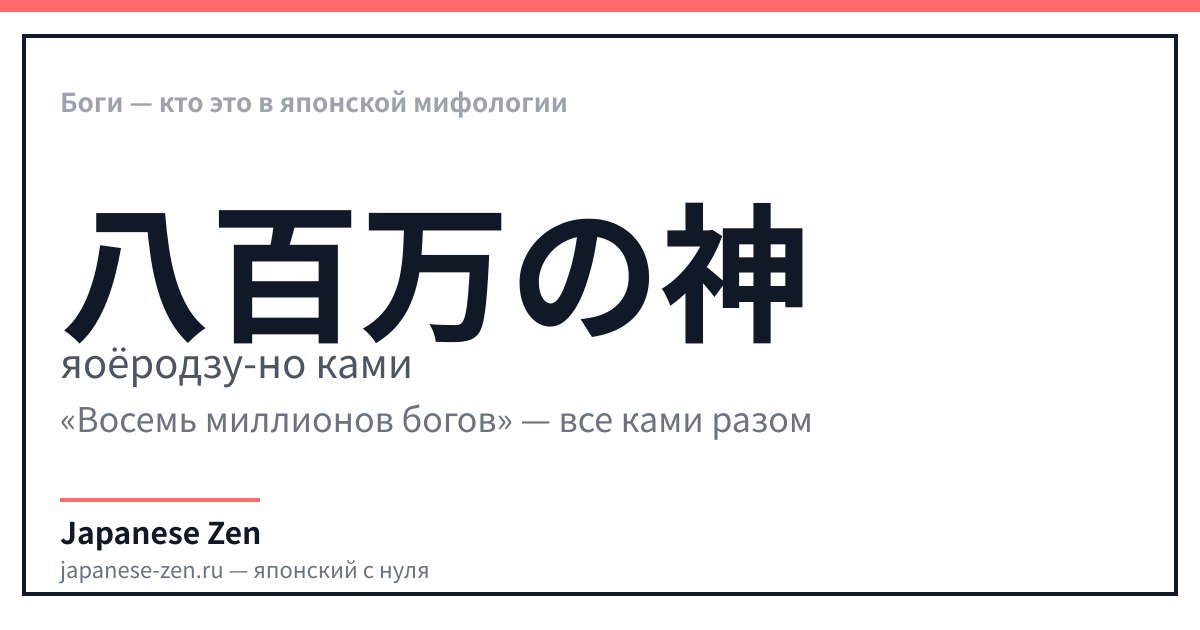
八百万の神 — 'eight million gods'
| Japanese | Reading | Translation |
|---|---|---|
| 八百万の神 | yaoyorozu no kami · yaoyorozu no kami | 'Eight million gods' — all kami at once |
| 神様 | kamisama · kamisama | God, deity (polite) |
| 祭神 | saijin · saijin | The god to whom a specific shrine is dedicated |
| 閻魔 | Enma · Enma | Judge of the dead, of Buddhist origin |
| 神々 | kamigami · kamigami | Gods (plural) |
How to read it and why the number is symbolic
八百万の神 is read やおよろずのかみ: 八百万 literally means 'eight hundred tens of thousands' — that is, eight million, a hyperbolic number for 'countless multitude.' In everyday speech, it's simpler to say 神々 (kamigami) — just 'gods' in the plural, without the pathos of an exact number.
神 — значение: gods, mind, soul — онъёми: シン、ジン — кунъёми: かみ、かん-、こう- — 9 штрих(ов). 神 — 'god, spirit': on the left is the altar 示, on the right is lightning 申. An ancient image of divine power descending from heaven.
Write 神 along the guides — the key character of the entire pantheon.
Japanese gods in 'Noragami' and games
- 'Noragami' — the plot revolves around how small, obscure gods fight for shrines dedicated to them and for people's attention.
- 'Naruto' — the names of major gods (Amaterasu, Susanoo, Tsukuyomi) go to techniques, not directly to characters.
- Ōkami — the entire video game is told from the perspective of Amaterasu in the form of a wolf.
- Fate/Grand Order — introduces several Japanese gods as playable guardian spirits.
Why a blurred hierarchy is convenient for a screenwriter
The blurred hierarchy of Japanese gods is convenient for storytelling: you can introduce a new, little-known patron god of anything, and it won't contradict the canon — there are formally infinitely many free 'vacancies' in the pantheon.
Where to go to see their shrines
- Ise Jingu — the shrine of Amaterasu, the spiritual center of all Shinto.
- Izumo Taisha — the shrine of Okuninushi, where, according to belief, all the gods of the country gather every October.
- Yasaka Shrine — the shrine of Susanoo in Kyoto.
- Practically any Shinto shrine is dedicated to a specific kami — often local and nameless to the rest of the country.
FAQ
- Who are the Gods in Shinto?
- Kami is a collective name for any divine force, from great heavenly gods like Amaterasu to the spirit of a roadside stone. There is no unified hierarchy among them, unlike the Greek pantheon.
- What are the gods of Japanese mythology responsible for?
- Each has their own domain: Tsukuyomi — the moon, Fujin — the wind, Inari — rice and prosperity. The role of 'god of death' is blurred between Izanami, who rules Yomi, and the Buddhist judge of the dead, Enma.
- How do you say 'eight million gods' in Japanese?
- 八百万の神 (yaoyorozu no kami) — 'eight million gods,' an image of countlessness. In everyday speech, it's simpler to say 神々 (kamigami) — just the plural of 'god.'
- Which anime is closest to the theme of Japanese gods?
- Most closely — in 'Noragami,' where the plot is directly about the lives of small, obscure gods. In 'Naruto,' the names of major gods are more often used for combat techniques rather than characters.
- Where in Japan are the gods worshipped?
- In Shinto shrines — there are tens of thousands of them across the country, and almost each one is dedicated to a specific kami. The largest are Ise Jingu (Amaterasu) and Izumo Taisha (Okuninushi).
- Are kami gods or spirits?
- Kami are not divided into 'gods' and 'spirits' as strictly as in the European tradition: the same word covers both a great deity and a humble patron of a river or tree.
Sources
Updated: 2026-08-29