Amaterasu — who is she in Japanese mythology
Amaterasu (also written 'Amaterasu' in Russian texts) is the sun goddess and the eldest of Izanagi's children, the formal ancestor of the Japanese imperial line. She was born from his left eye during his purification after visiting the land of the dead. She is famous for the myth of hiding in a cave and plunging the world into darkness — lured out by laughter and a mirror.
The main goddess of the Shinto pantheon spends most of her only major myth not fighting, but sitting sulking in a cave. Perhaps that is why Japanese mythology is easier for those who expect from gods not heroic deeds, but human reactions.
Who is Amaterasu: the sun, the mirror, and the imperial line
Amaterasu Ōmikami is the sun goddess, the eldest and most revered of Izanagi's children. She was born from his left eye when he washed in a river, purifying himself after an unsuccessful trip to the land of the dead, Yomi. According to legend, the imperial dynasty of Japan descends from her through her grandson Ninigi — hence Amaterasu's central place in State Shinto.
- Sphere of influence: the sun, light, fertility, and the rightful order in the world of the gods.
- Symbol: the mirror Yata no Kagami — one of the three sacred imperial regalia.
- Family: daughter of Izanagi, elder sister of Tsukuyomi (moon god) and Susanoo (storm god).
- Main shrine: Ise Jingū, the inner shrine Naikū in Mie Prefecture.
Who recorded this myth in the 8th century and why
The Kojiki (712) and Nihon Shoki (720) tell the story of Amaterasu almost identically, differing only in details. These are state chronicles commissioned by the court: the myth of the solar goddess-ancestor directly justified the divine origin of imperial power.
The myth of the cave: how the sun disappeared from the world
Her younger brother Susanoo, banished from the heavens for his violent temper, decided to say goodbye to his sister before leaving — and caused havoc: he destroyed her rice fields, defiled the harvest hall, and finally threw a flayed horse into the weavers' workshop. One of the maidservants died of fright, and Amaterasu, horrified, hid in the Heavenly Rock Cave Ama-no-Iwato, sealing the entrance with a boulder. The world plunged into darkness: without the sun, the seasons stopped, and evil spirits multiplied. The eight hundred myriad gods gathered at the cave and devised a plan: they hung a mirror and jewels at the entrance, and the goddess Ame-no-Uzume began a lewd dance that caused uproarious laughter from the crowd. Intrigued by the noise (for she thought she was the only source of light), Amaterasu slightly opened the rock — and saw her own radiant reflection in the mirror, mistaking it for another, brighter deity. While she was admiring herself, the strongman Ame-no-Tajikarao pulled her out, and light returned to the world.
A detail lost in short retellings
In adaptations, the myth is often condensed to 'the goddess hid — they lured her out,' omitting a key detail: it was not force or pleas that worked, but curiosity and vanity. Amaterasu came out not because she was forced, but because she was afraid of missing a spectacle more interesting than her own grief — a psychologically plausible twist rare in mythologies.
天照大神: heaven, light, and 'great deity'
| Japanese | Reading | Translation |
|---|---|---|
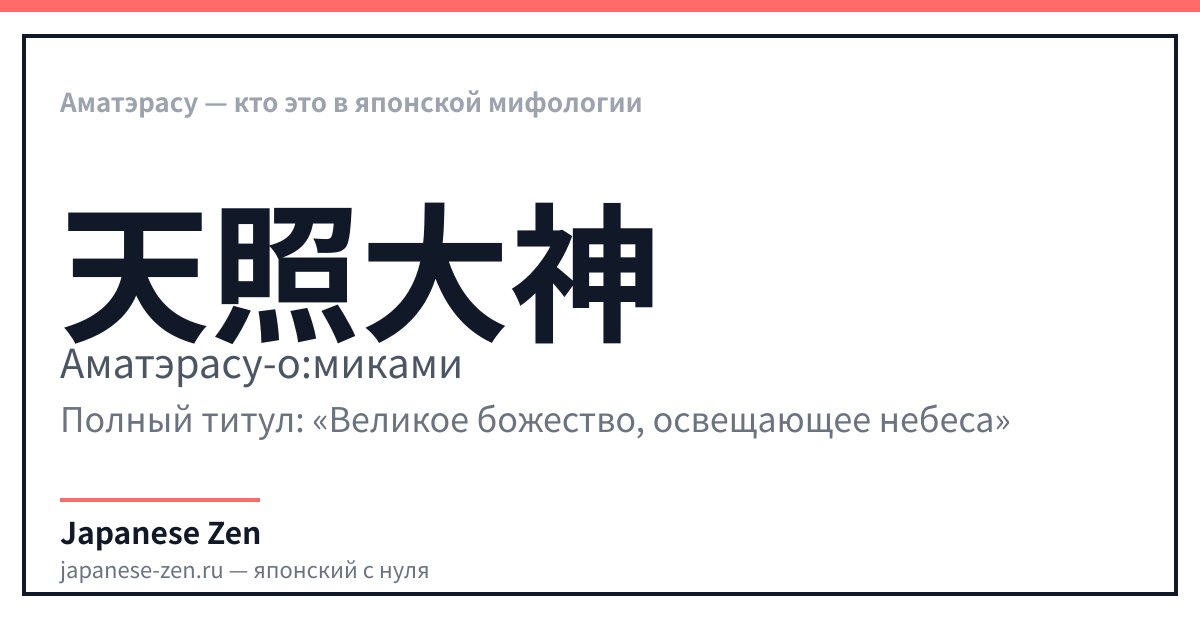
| 天照大神 | Amaterasu Ōmikami · Amaterasu Ōmikami | Full title: 'Great deity illuminating the heavens' |
| 太陽 | taiyō · taiyō | Sun |
| 天岩戸 | Ama-no-Iwato · Ama-no-Iwato | Heavenly Rock Cave from the main myth |
| 鏡 | kagami · kagami | Mirror |
| 伊勢神宮 | Ise Jingū · Ise Jingū | Main shrine of Amaterasu |
Amaterasu or Amaterasu — how to write it correctly in Russian
天照大神 is read Amaterasu Ōmikami: 天 'heaven', 照 'to shine, illuminate', 大神 'great deity' — an honorific prefix added in chronicles to the names of the most significant kami. The Kojiki contains a longer variant of the name, while the Nihon Shoki has several alternative writings of the same syllables with different characters: a common practice for texts where reading was primary and writing secondary.
神 — значение: gods, mind, soul — онъёми: シン、ジン — кунъёми: かみ、かん-、こう- — 9 штрих(ов). 神 — 'god, spirit', the second element of the title 'Ōmikami'. The same character appears in 神道 (Shinto) and 神話 (myth).
Write 神 along the guides — learn the stroke order of this key Shinto character.
Amaterasu in Naruto, Ōkami, and Fate
- Naruto — 'Amaterasu' here is the name of the black, inextinguishable flames of Itachi and Sasuke: the writers took the name of the sun goddess for a technique that cannot be extinguished, just as daylight cannot be extinguished.
- Ōkami (2006) — Amaterasu herself appears as a playable heroine in the form of a white wolf, traveling through a Japan stylized in ink wash.
- Fate/Grand Order — Amaterasu appears as one of the guardian spirits in the Japanese story arc.
- Nobunaga the Collector and other historical fantasies often introduce her as an off-screen patron of the protagonist.
Why the goddess of light gets the darkest powers
The name of the main goddess of light in pop culture is more often given not to bright forces, but to the most destructive ones — black flames, doomsday weapons. The calculation is simple: the name should sound like the highest, indisputable power, and the reputation of 'the main deity of the pantheon' works better than any explanation of the ability.
Ise Jingū and other places where she is worshipped
- Ise Jingū (Inner Shrine, Naikū) — the main shrine of Amaterasu and the spiritual center of all Shinto; it is rebuilt every 20 years in the Shikinen Sengū ceremony.
- Thousands of branch shrines of Amaterasu Ōmikami Jinja across the country — from small rural shrines to large urban complexes.
- The Kannamesai festival in Ise every October — offering the first rice harvest to the goddess.
- The sunrise on January 1 (Hatsuhinode) — many Japanese people specifically greet the first dawn of the year as a symbolic greeting to Amaterasu.
FAQ
- Who is Amaterasu in Shinto?
- The sun goddess, eldest daughter of Izanagi, and the central figure of the Japanese pantheon. According to myth, the imperial line of Japan descends from her through her grandson Ninigi — hence her special state status.
- What is Amaterasu responsible for?
- For the sun, light, and the rightful order among the gods. Her retreat into the cave in the main myth stops the cycle of day and night — a symbol that without her, the world literally darkens.
- What characters is Amaterasu written with?
- The full title is 天照大神 (Amaterasu Ōmikami): 'heaven' + 'to shine' + 'great deity'. The shortened form of the name is simply 天照 without the honorific prefix 大神.
- Where does Amaterasu appear in anime and games?
- Most often the name appears not as a character, but as the name of an ability — for example, the inextinguishable black flames in Naruto. As a playable character, the goddess appears in the video game Ōkami.
- Where is Amaterasu worshipped in Japan?
- The main shrine is Ise Jingū in Mie Prefecture, the spiritual center of all Shinto. In addition, thousands of branch shrines dedicated to her are scattered across the country.
- Is Amaterasu a god or a spirit?
- A kami, which is closer to 'god' in the Western sense, but without a clear boundary: Japanese tradition does not separate gods and spirits as strictly as European tradition. Amaterasu is the highest and most revered deity of the Shinto pantheon.
Sources
Updated: 2026-08-29