Osu (押忍) in Karate — What It Means and When It's Said
What does osu mean in karate? It's a martial greeting and a sign of agreement — 押忍 (osu): it's used to greet, to answer "understood" or "yes sir!", to show readiness and respect for the sensei. It's most often heard in kyokushin dojos and in some Japanese university clubs, while in aikido, judo and kendo it's usually not said.
The question "what does osu mean in karate" usually comes up after a first visit to a dojo: there, for everything — from greetings to responding to a sensei's remark — people say the same short word. Let's look at what lies behind the kanji 押忍, why it is often written "Oss!", and why saying "osu" outside the tatami isn't always appropriate.
What "osu" means and where it's said
押忍 (osu) in the dojo replaces several English phrases at once: it's a greeting, "understood", "yes sir!", and simply a sign of readiness. It's used to respond to a sensei's command, to agree with a remark, to greet seniors when entering and leaving the hall. Osu is most often heard in kyokushin and related full-contact schools, as well as in Japanese university sports clubs and cheer groups (応援団), where short set shouts are part of the culture in general, not just karate.
Why it's not said in aikido, judo and kendo
In aikido, judo and kendo, osu is usually not used — there, more elaborate forms of politeness are kept: "hai" instead of "osu" in response to a command, the usual "onegaishimasu" before training. There's a theory that historically osu was used in pre-war schools that trained judo and kendo practitioners, and it only later became attached to karate. There's no consensus among budo historians on this.
Why it's written "Oss!"
押忍 is read おす — "osu", but the final "u" after the voiceless "s" is almost inaudible in conversational Japanese: the vowel is reduced, and the word sounds more like "oss" than "o-su" syllable by syllable. That's why it's often spelled "Oss!" — a fairly accurate rendering of how it's actually pronounced in the dojo, not a distortion.
押忍 — the kanji pull in different directions
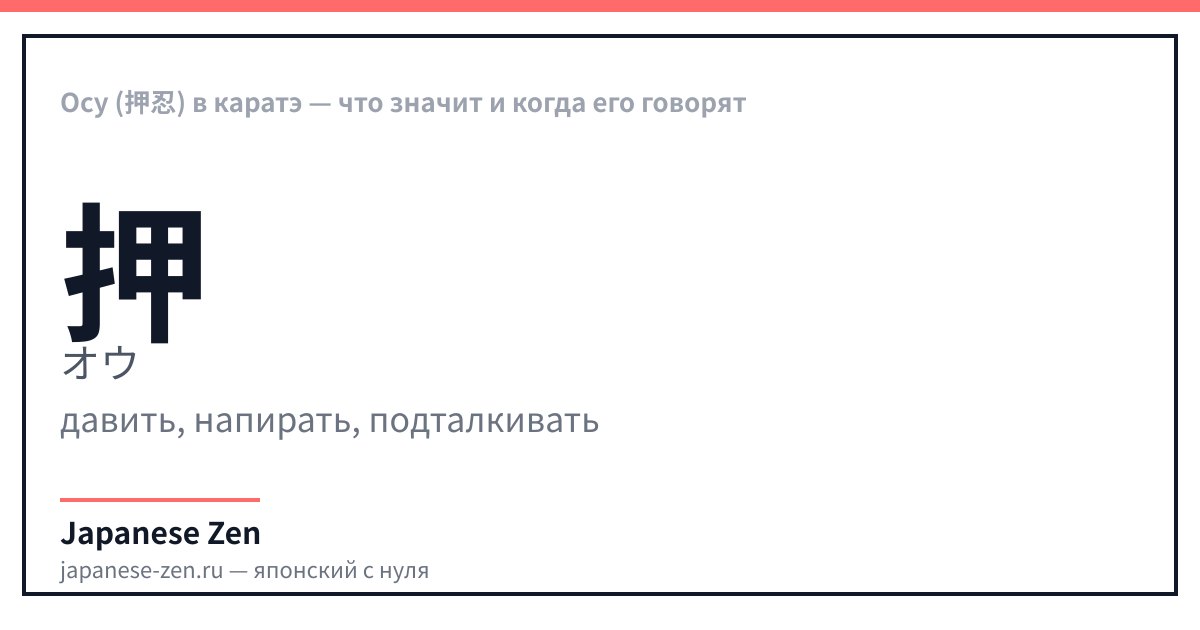
押 — значение: to press, to push, to push forward — онъёми: オウ — кунъёми: お.す、お.し-、お.っ-、お.さえる — 8 штрих(ов). 押 — "to press, to push": the first character in the word 押忍 (osu). The same root is in the ordinary verb 押す "to push, to press", which has nothing to do with martial arts.
押忍 is usually analyzed as 押す "to press, to push" plus 忍ぶ "to endure, to hold back" — giving something like "to push forward and endure, not retreat". This is an interpretation based on the meaning of the kanji, not a proven history of the word: the expression itself has several versions of origin, and they diverge. According to the best-known version, it's a contraction of the greeting おはようございます (ohayō gozaimasu, "good morning"), which was shortened in pre-war budo schools to "osu" and only later received the kanji 押忍 retroactively.
| Japanese | Reading | Translation |
|---|---|---|
| 押忍 | osu · osu | Greeting and sign of agreement in the dojo |
| 押す | osu · osu | Ordinary verb "to push, to press" |
| 忍ぶ | shinobu · shinobu | To endure, to hold back, to hide |
| 忍耐 | nintai · nintai | Patience, endurance |
| 失礼します | shitsurei shimasu · shitsurei shimasu | Polite "excuse me" when entering or leaving |
| お願いします | onegaishimasu · onegaishimasu | "Please" — standard phrase before training |
Osu — not for everyday Japanese speech
Dictionaries record osu as a greeting exchanged by young men in informal settings — a short, slightly rough, club word. In ordinary conversation, especially in an office, you won't hear it: there, the usual "konnichiwa" and "ohayō gozaimasu" are used.
Write 押 along the guides — the character "to press, to push" that begins the dojo "osu".
When osu is appropriate and when it isn't
- When entering and leaving the dojo — a general exchange of greetings.
- In response to a command or explanation from the sensei — instead of "yes, understood".
- When a partner before a match checks your readiness to begin.
- After a remark — as a sign that you heard and accepted it.
- At line-up at the beginning and end of training, along with a bow.
What to answer to "osu"
The simplest answer is the same — "osu": it's a universal response used in the dojo to almost any remark from a senior or a partner. Outside the dojo, especially with strangers, it's better not to use osu: there, an ordinary polite greeting is more appropriate.
FAQ
- What does "os" mean in karate?
- "Os" is a colloquial shortening of the word "osu", written with the kanji 押忍. In the dojo it replaces several phrases at once: a greeting, agreement, "understood", a sign of readiness for training. It's most often heard in kyokushin karate.
- How is "osu" written in Japanese?
- 押忍, read おす. 押 — "to press, to push", 忍 — "to endure": together they give the common interpretation "to push forward and endure", though the exact origin of the word remains disputed — there are several versions, and dojos retell them differently.
- Can you say "osu" to Japanese people in everyday life?
- Better not. Osu is a short, slightly rough greeting of men's clubs and dojos, not a common word: in ordinary conversation, especially with strangers, it sounds out of place. In an office or on the street, people don't greet each other that way.
- Do they say "osu" in aikido and judo?
- Usually not: there, "hai" is more often used in response to a command and "onegaishimasu" before training. Osu has become most firmly established in karate, especially kyokushin and related full-contact schools.
- Why is it written "Oss!" instead of "osu"?
- Because of vowel reduction: the final "u" after the voiceless "s" is almost not pronounced in Japanese speech, so 押忍 sounds closer to "oss" than to "o-su" syllable by syllable. The spelling "Oss!" reflects exactly this pronunciation.
Sources
Updated: 2026-09-14