Kata in Karate — What It Is and Why You Repeat the Same Movements
Kata in karate is a pre-learned sequence of strikes, blocks, and stances against imaginary opponents: it is repeated from session to session until the technique becomes automatic. The analysis of how a movement works in real combat is called bunkai (分解). Kata differ by school: Shotokan, Goju-ryu, and other styles have different names and even different kanji for the word "kata."
From the outside, kata in karate looks like a solo dance with an invisible partner, and the question "why repeat the same thing" sounds fair. In reality, it is a way to bring technique to automaticity and pass it on to the next generations without textbooks. Let's break down what bunkai is, why the word "kata" itself is written with different kanji in different martial arts, and what the Tokyo Olympics have to do with it.
What Kata Is and Why It Is Repeated
Kata is a pre-learned sequence of strikes, blocks, stances, and movements against one or more imaginary opponents. The student repeats the same sequence dozens and hundreds of times, honing not only the strike but also breathing, balance, and transitions between stances. The analysis of how each movement of a kata is applied in a real situation is called bunkai (分解) — "decomposition, analysis": the same movement can conceal a strike, a throw, or an escape from a grab.
- 平安 (Heian) — five basic kata of the Shotokan school; in other schools, such as Shito-ryu and Wado-ryu, the same kanji are read as Pinan.
- 鉄騎 (Tekki) — another name that Shotokan introduced instead of the Okinawan Naihanchi.
- 抜塞 (Bassai) — an old Okinawan kata; the name by kanji is often interpreted as "to break through a fortress."
- 観空 (Kanku) — also a renaming by Funakoshi: before him, the kata was called 公相君 (Kusanku), after either a Chinese envoy or a military rank.
- 三戦 (Sanchin) — one of the main kata of the Goju-ryu and Uechi-ryu schools, going back directly to the South Chinese roots of these styles.
Kata at the Olympics
At the 2020 Summer Games in Tokyo, which were held in 2021 due to the pandemic, karate was included in the Olympic program for the only time — with two disciplines, kata and kumite. In Paris in 2024, karate was no longer in the program: the organizers chose breaking. It is also not in the Los Angeles 2028 program.
型 or 形: Why "Kata" Is Written Differently
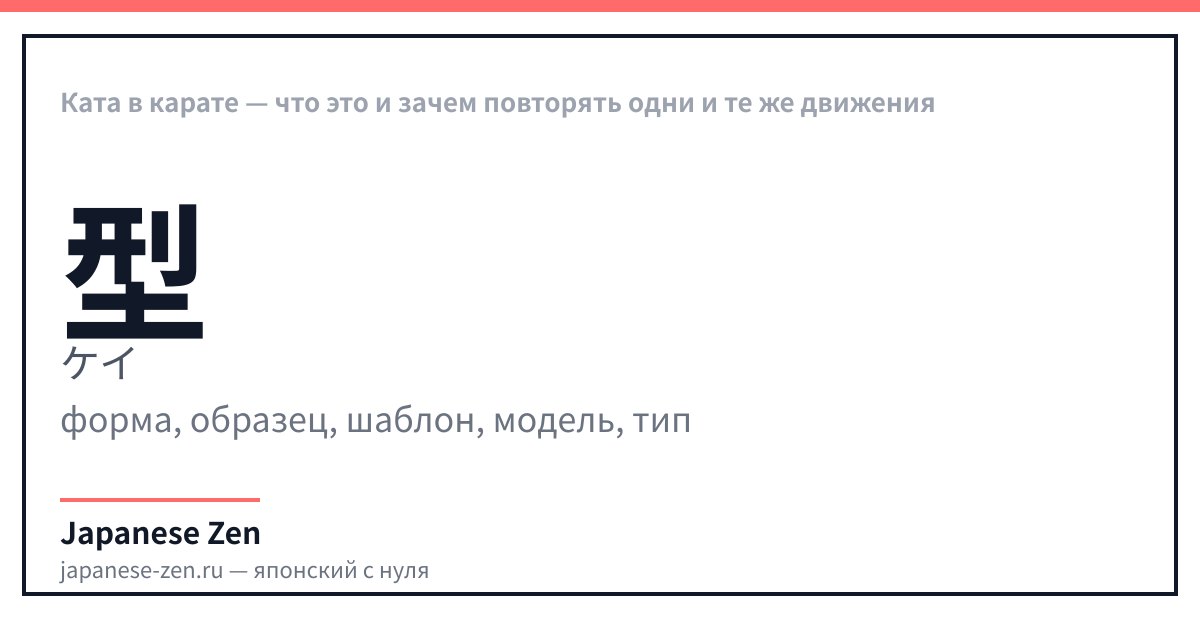
型 — значение: form, pattern, template, model, type — онъёми: ケイ — кунъёми: かた、-がた — 9 штрих(ов). 型 — "form, pattern": a stable template that sets the norm not only for karate techniques. The same character is in 血液型 (blood type) and 典型 (typical example).
| Japanese | Reading | Translation |
|---|---|---|
| 型 | kata · kata | A learned form — this is how the word is written in many karate schools |
| 形 | kata · kata | The same word with a different kanji — this is how it is written in judo, kendo, and JKF rules |
| 分解 | bunkai · bunkai | Analysis of a technique from kata |
| 演武 | enbu · enbu | A demonstration performance with kata or weapons |
| 組手 | kumite · kumite | Sparring, as opposed to solo kata |
| 平安 | heian · heian | The name of the basic kata of the Shotokan school |
So Which Kanji Is Correct
There is no single rule. The competition regulations of the Japan Karate Federation (JKF) call the competitive discipline 形 — the same kanji as in judo and in the official name of kendo kata, 日本剣道形. At the same time, many dojo and individual karate schools habitually write 型, and dictionaries record both variants as equivalent for karate. So "型 is karate, and 形 is judo and kendo" is an oversimplification: in practice, the choice of kanji depends more on the specific organization than on the martial art.
Write 型 along the guides — the character for form and pattern, from which the word "kata" is made in many karate schools.
Kata Is Not a Dance or an Exam Formality
- "Kata is a dance or showing off." Every movement of a kata has an applied analysis — bunkai — and in the dojo it is precisely through kata that technique is transmitted, which is difficult to consolidate with sparring alone.
- "Kata are only needed for belt exams." They are indeed tested at exams, but they are trained primarily for the sake of the technique itself — stances, transitions, breathing — and not for a formal checkmark.
Kata Beyond a Single Dojo
- "Kata exist only in karate." Formal complexes under a similar name are practiced in judo — for example, 投の形 (throwing forms), in kendo — 日本剣道形, and in iaido, where all training is built on kata against an imaginary opponent.
- "All karate styles have the same kata." Even kata with the same name differ in different schools in the depth of stances, the angle of the arms, and the interpretation of bunkai — schools themselves warn about this on their websites.
FAQ
- What is kata in karate?
- Kata is a pre-learned sequence of strikes, blocks, and movements against imaginary opponents. The student repeats it again and again to bring technique, breathing, and balance to automaticity, and the analysis of the application of each movement is called bunkai.
- How many kata are there in karate?
- It depends on the style. In Shotokan, there are traditionally 26 kata. In Goju-ryu, usually 12 are counted — eight classical ones inherited from Higaonna Kanryo, and several later ones.
- Why are kata needed in karate if there is sparring?
- Sparring tests reaction and tactics here and now, while kata consolidates the technique itself — stances, transitions, breathing — in a form that can be repeated many times without the risk of injury and without a partner. One does not replace the other: dojos usually train both in parallel.
- How does kata differ from kumite?
- Kata is a solo learned form against an imaginary opponent, kumite (組手) is sparring with a live partner according to the rules of a specific school or federation. In competitions, these are two separate disciplines with different judging.
- How is "kata" written in kanji?
- Most often 型 or 形 — both are read as "kata" and mean "form, pattern." The choice of kanji depends not on the martial art but on the specific school or federation: for example, in the rules of the Japan Karate Federation, 形 is used for competitions.
Sources
Updated: 2026-09-14