Mempo — the samurai armor mask: why it has a mustache and a grimace
Mempo (面頬) is a protective mask for the lower part of the face in Japanese armor, usually from the cheekbones to the chin, with an open mouth for breathing. Such a mask was made fearsome: with a horsehair mustache and a fierce grimace, to frighten the opponent and at the same time protect one's own face. In addition, the mempo held the cord that tied the helmet under the chin — without support, the knot would quickly come undone.
Mempo has simpler and more complete relatives — hoate, somen, hambo — and each covers its own area. Let's look at how they differ, why a hole was left under the chin of the mask, why mempo has nothing in common with the theatrical hannya mask, and what the kanji 面 from the word "omoshiroi" — "interesting" — has to do with it.
Mempo is not the only mask of Japanese armor
Mempo (面頬) is a general Japanese word for protective face plates in armor, the most recognizable of which covers the face from the cheekbones to the chin. Dictionaries list two readings — めんぽう and めんぽお, both sound equally long and are romanized as menpō.
How mempo differs from somen and hambo
- Hoate (頬当) — an earlier and simpler predecessor: a plate that covered only part of the face.
- Mempo in the narrow sense — a mask from the cheekbones to the chin: the most recognizable form of face protection in late medieval armor.
- Somen (総面) — a mask covering the entire face, like a theatrical one: it restricted vision more than others and was therefore less common.
- Hambo (半頬) — a shortened version covering the cheeks and chin; a separate throat strip, tare, was often attached to it for neck protection.
Why mempo was made fearsome and what held the helmet cord
Mempo had two tasks at once: to protect the face from a blow and to serve as support for the cord that tied the kabuto helmet under the chin — without the mask, this knot would quickly come undone.
Why the mask was given a fierce expression
A horsehair mustache was attached around the mouth of the mask, and the face itself was given an angry grimace — this was meant to intimidate the opponent even before the clash in battle. The mouth was usually left open: it was easier to breathe and give commands in the heat of the fight.
A small hole was often made under the chin of the mask. Its purpose was practical: sweat that accumulated over long hours of battle under the helmet and mask would drain out through it.
Mempo in museum displays and why it is not a hannya mask
Sets of Japanese armor with mempo masks are kept in museum collections, including the Tokyo National Museum and the digitized e-Museum collection — there they are shown together with the helmet and the body of the armor as a single set.
Mempo and the Noh theater mask are different things
Mempo is not the same as the hannya mask from Noh theater. Hannya depicts a woman whose jealousy turned her into a demon, and serves only on stage, with no protective function. Mempo is part of combat gear made of metal or leather, made specifically for protection.
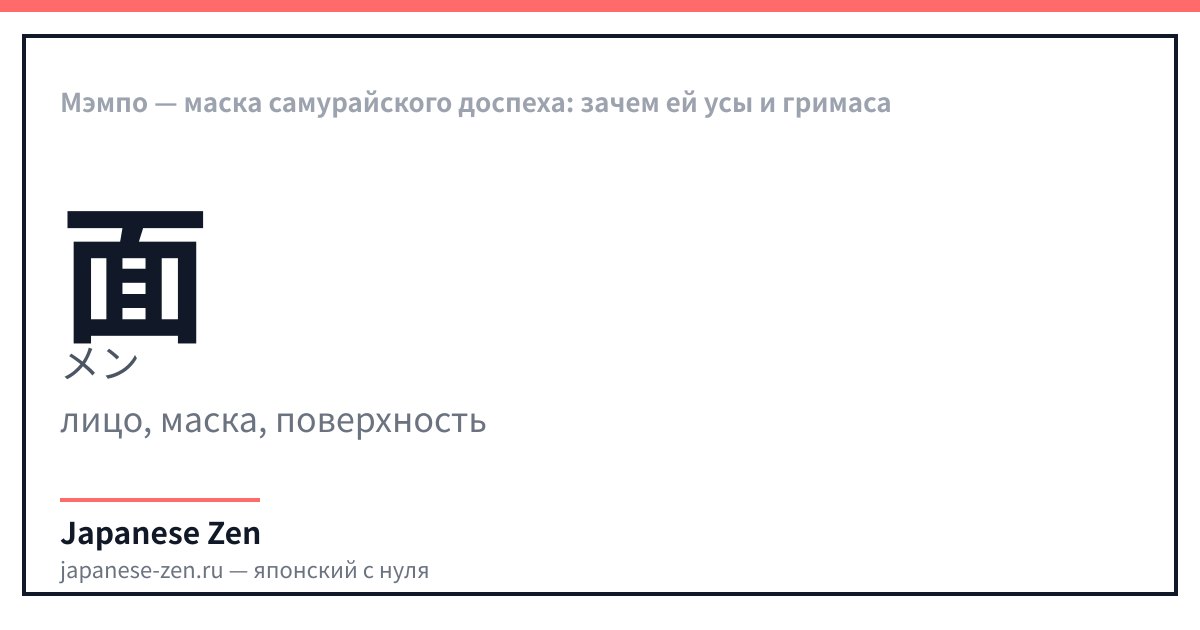
面 — the sign of "face" that also hides in "interesting" omoshiroi
面 — значение: face, mask, surface — онъёми: メン、ベン — кунъёми: おも、おもて、つら — 9 штрих(ов). 面 — "face, mask, surface": the first character in the word 面頬 (mempo). The same kanji is in お面 (omen, mask) and in 面白い (omoshiroi, "interesting").
面頬 breaks down into 面 "face" and 頬 "cheek". 面 has several readings: メン (men) in compound words, おも (omo) and つら (tsura) — more colloquial words for "face". The same character is used to write お面 (omen) — any mask in general, and 仮面 (kamen) — a mask as an object.
Why "interesting" in Japanese is literally "white face"
面白い (omoshiroi, "interesting, funny") literally reads as "face + white". A popular story explains this with the myth of Amaterasu: when the goddess emerged from the cave, the faces of those gathered supposedly "turned white" with joy in the light. This is a folk etymology known since the 9th century; how the word actually arose is debated by scholars.
| Japanese | Reading | Translation |
|---|---|---|
| 面頬 | menpō · menpō | protective mask for the lower part of the face in armor |
| お面 | omen · omen | mask, face — any, not just combat |
| 仮面 | kamen · kamen | mask as an object, including figuratively |
| 面白い | omoshiroi · omoshiroi | interesting, funny |
| 頬 | hō · hō | cheek |
| 能面 | nōmen · nōmen | Noh theater mask — theatrical, not combat |
Write 面 along the guides — the "face" character from the word "mempo".
FAQ
- What is mempo?
- Mempo (面頬) is a protective mask for the lower part of the face in Japanese armor, usually from the cheekbones to the chin. Besides protection, it held the cord that tied the helmet under the chin and gave the warrior a fearsome appearance.
- Why does a samurai mask have a mustache?
- A horsehair mustache was attached around the mouth to enhance the menacing impression even before the clash in battle. The rest of the mask's decoration served the same purpose: it was meant to look fiercer than the opponent's living face.
- How does mempo differ from a Noh theater mask?
- Mempo is part of combat gear, a metal or leather face plate with a practical protective function. Noh theater masks, including hannya, are theatrical props with no protection: they depict characters from plays and do not serve as armor.
- What types of samurai armor masks are there?
- From simple to full: hoate covered only part of the face, mempo in the narrow sense — from the cheekbones to the chin, and hambo — a shortened version with throat protection. Somen covered the entire face, like a theatrical mask, though it greatly restricted vision.
- How was the mask attached to the helmet?
- The mask was tied under the chin with its own cords, and at the same time it held the cord of the kabuto helmet itself, which secured it to the head: without the mask's support, the knot under the chin would come undone noticeably faster in battle.
- How is "mempo" written in Japanese?
- 面頬, in dictionaries it appears both as めんぽう and as めんぽお — both variants sound equally long. 面 means "face", 頬 means "cheek": together — "that which covers the face and cheeks".
Sources
Updated: 2026-09-15