O-yoroi — the armor of the mounted archer: how it is built
O-yoroi (大鎧, "great armor") is the heavy box-like armor of the Japanese mounted archer of the Heian–Kamakura period (9th–14th centuries). The torso is covered by a rigid cuirass, the shoulders by broad o-sode plates that served as a shield, and the whole set is laced together with the colored odoshi lacing. By various estimates it weighed about 27–30 kg and was designed specifically for shooting from horseback, not for close combat on foot.
O-yoroi was not made for comfort but for one specific task — shooting a bow from horseback while the hands are occupied. When combat shifted to the ground, this same armor became more of a burden than protection.
What o-yoroi is and how it is built
O-yoroi (大鎧, "great armor") is the heavy box-like armor of the Japanese mounted archer of the Heian–Kamakura period (9th–14th centuries). The torso is protected by a rigid cuirass (dō), from which four skirt plates (kusazuri) hang, and the shoulders are covered by broad rectangular o-sode plates — they also served as a shield against arrows while the hands were occupied with the bow. The kabuto helmet is fitted with curved fukikaeshi plates and a long neck guard (shikoro). The whole set is joined by odoshi lacing, whose pattern and color often distinguished a particular clan or warrior.
What it was worn for
- Dō — a rigid box-like body of joined plates, fastened at the side.
- Kusazuri — four skirt plates; one of them, the waidate, separately covers the right side for convenience in mounted archery.
- O-sode — large shoulder plates that could replace a shield when needed.
- Kabuto — a helmet with a shikoro neck guard and often a maedate crest.
- Odoshi — lacing that joins the small kozane plates; its colored pattern served as an identifying mark.
Why o-yoroi gave way to lighter armor
Dō-maru and tosei-gusoku: armor for foot combat
| Feature | O-yoroi | Dō-maru / tosei-gusoku |
|---|---|---|
| Who wore it | High-ranking mounted archer | Foot soldier, later any fighter with a spear or arquebus |
| Weight | by various estimates, about 27–30 kg | noticeably lighter thanks to a one-piece close-fitting construction |
| Body construction | rigid box, fastened at the side | flexible shell wrapped around the body |
| When it prevailed | Heian–Kamakura, 9th–14th centuries | Muromachi–Edo, from the 15th century onward |
When combat shifted from mounted archery to close foot fighting — especially with the rise of mass infantry armies in the Sengoku period (15th–16th centuries) — the heavy box-like armor became more of a hindrance than protection. The dō-maru, originally the armor of common foot soldiers, wrapped around the body and fastened at the side, proved more practical; the 16th-century tosei-gusoku ("modern-style armor") was already designed with firearms and mass infantry combat in mind. By that time o-yoroi itself remained mainly a ceremonial and status armor for high-ranking commanders.
Where it can be seen today
Few authentic o-yoroi survive, and almost all of them are held in Japanese museums and temple collections. Besides the Tokyo National Museum, these are shrines to which armor was donated as offerings for centuries: the largest such collection is at Oyamazumi Shrine on Omishima Island.
大鎧 — "great armor": great compared to what
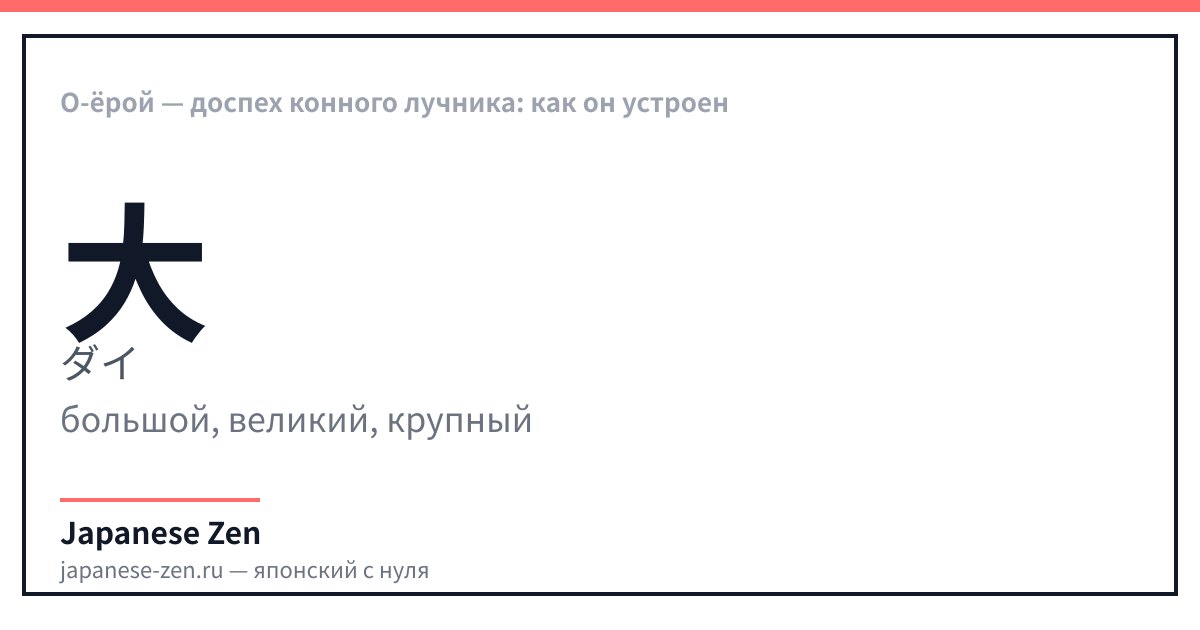
大 — значение: big, great, large — онъёми: ダイ、タイ — кунъёми: おお-、おお.きい、-おお.いに — 3 штрих(ов). 大 — "big, great": the first character in 大鎧 (ōyoroi, "great armor"). The second character of the compound, 鎧 "armor", is not in the kanji database.
| Japanese | Reading | Translation |
|---|---|---|
| 大鎧 | ōyoroi · ōyoroi | Armor of the mounted archer |
| 鎧 | yoroi · yoroi | Armor |
| 兜 | kabuto · kabuto | Helmet |
| 縅 | odoshi · odoshi | Lacing that joins the armor plates |
| 胴 | dō · dō | Torso, cuirass of the armor |
| 大袖 | ōsode · ōsode | Large shoulder plates |
How it is read and what it literally means
大鎧 is read おおよろい: 大 — "big", 鎧 — "armor". The name is literal and without metaphor — unlike many budo terms, here the characters simply describe the size and type of the object, with no second layer of meaning.
Trace 大 along the guides — three strokes that begin the word "o-yoroi".
O-yoroi in anime and games
Where anime and games mix up the eras
Anime and games almost always dress samurai in armor in the style of tosei-gusoku — lighter, closer to the silhouette of 16th-century Sengoku armor — even when the story is set in the Heian or Kamakura period, when o-yoroi was what was worn. The difference is visible at a glance: the massive rectangular o-sode of o-yoroi versus the compact shoulder guards of later armor.
- In samurai video game series, o-yoroi armor is sometimes included among a character's equipment as a recognizable historical silhouette — with the caveat that the game is often set several centuries after the real period of its mass use.
- Illustrations for the Tale of the Heike (Heike monogatari) are the most reliable visual source for how o-yoroi looked in practice, unlike stylizations in modern popular culture.
FAQ
- What is o-yoroi?
- O-yoroi (大鎧, "great armor") is the heavy box-like armor of the Japanese mounted archer of the Heian–Kamakura period. The rigid cuirass, broad o-sode shoulder plates, and kabuto helmet with a neck guard were designed specifically for shooting a bow from horseback, not for close combat on foot with bladed weapons.
- How does o-yoroi differ from a katana?
- O-yoroi is armor, and a katana is a weapon: comparing them directly is meaningless, they do not replace each other and were used at the same time. A more apt comparison is with the later dō-maru and tosei-gusoku armors that replaced it when combat became foot-based and close-range.
- How is "o-yoroi" written in kanji?
- 大鎧, read おおよろい. 大 — "big", 鎧 — "armor". The name is literal: without metaphor or hidden meaning, simply a description of the size and type of armor of a mounted warrior — unlike many budo terms, where the characters carry a second, philosophical layer of meaning and metaphor.
- What was o-yoroi used for?
- As the combat armor of a mounted archer in the Heian and Kamakura periods: the box-like shape and broad shoulder plates protected the warrior while both hands were occupied with the bow. By the Sengoku period, when combat became foot-based and close-range, the armor survived mainly as ceremonial and status wear.
- How much did o-yoroi weigh?
- By various estimates, about 27–30 kg — noticeably more than the later dō-maru and tosei-gusoku armors designed for foot combat. The exact figure depends on the specific surviving example: there was no single standard weight for all o-yoroi in historical sources.
- Where can o-yoroi be seen today?
- Authentic examples are kept in Japanese museums and temple collections: at the Tokyo National Museum and at Oyamazumi Shrine on Omishima Island. Armor was donated there to the deities as offerings for centuries — after victories important to a clan or to the whole country.
Sources
Updated: 2026-09-10