Kabuto — the samurai helmet: how it is assembled and what the horns mean
Kabuto (兜) is a Japanese samurai helmet assembled from several parts: the bowl hachi, the neck guard shikoro, the side flares fukigaeshi, and often a large forehead ornament — the maedate. The bowl was riveted from metal plates or forged as a single piece, and the horns and crescents on the helmets of famous commanders served not only as protection but also as identification marks on the battlefield.
In a kabuto, the history of its owner can be read part by part: the shape of the bowl reveals the era, and the forehead ornament reveals the owner himself, whether it is the crescent of Date Masamune or the deer antlers of Honda Tadakatsu. Let's break down the structure of the helmet, why it is still displayed at home on Children's Day, and what a horned beetle and the expression "to take off one's helmet" have to do with it.
What parts make up a kabuto and what each is called
The bowl of the kabuto — the hachi — was made of metal or leather, less often of wood. The metal bowl was either riveted from several curved plates or forged as a single piece and coated with black lacquer to protect it from Japanese humidity. Helmets whose rivet heads protruded as noticeable "stars" are called hoshi-kabuto, while later ones with flat hidden rivets are called suji-kabuto.
What the parts of the helmet are called
| Part | In Japanese | Purpose |
|---|---|---|
| Bowl | 鉢 (hachi) | main protection for the head, made of riveted plates or a single forging |
| Neck guard | 錣 (shikoro) | covers the neck and back of the head, attached to the lower edge of the bowl |
| Side flares | 吹返 (fukigaeshi) | the ends of the neck guard turned outward at the cheeks — protection for the area not covered by the bowl |
| Forehead ornament | 前立 (maedate) | horns, crescents and other signs on the forehead, often in the form of paired kuwagata "horns" |
The crescent of Date Masamune, the antlers of Honda Tadakatsu and the sign of Naoé Kanetsugu
The helmet of Date Masamune is a black lacquered suji-kabuto of 62 plates with a gilded crescent on the forehead: today it is one of the most recognizable images of the Sengoku period.
Side fittings are not the same as a forehead ornament
The commander Honda Tadakatsu had on his helmet not a forehead ornament but side fittings in the shape of deer antlers: they were made not from real antler but from layered paper held together with black lacquer.
On the helmet of the commander Naoé Kanetsugu is a large kanji 愛, "love", amid a cloud pattern. Historians disagree on what it meant: one version says it was the Buddha Aizen Myōō, patron of warriors; another says it was the Shinto-Buddhist deity Atago Gongen. There is no consensus, but both versions agree that it was not about love in the usual sense but about a warrior patron deity.
Kabuto on Children's Day, the horned beetle and the expression "to take off one's helmet"
On May 5, Children's Day, Japanese families traditionally display armor, a helmet, swords and warrior figurines at home. The custom goes back to the earlier Tango no Sekku festival and is linked to a play on words: "shōbu", the iris, sounds the same as "shōbu" — "warrior spirit". The armor and helmet in this custom are a wish for a boy's health and strength.
"To take off one's helmet" — how a combat gesture became an idiom
The expression 兜を脱ぐ, "to take off one's helmet", means to admit defeat or the superiority of an opponent — like "to throw in the towel" or "to take off one's hat". In old times, taking off one's helmet in the middle of a battle meant one thing: the warrior surrenders.
The kabutomushi beetle — the Japanese rhinoceros beetle — got its name by the same logic: the pair of horns on the male resemble the forehead ornament of a kabuto helmet.
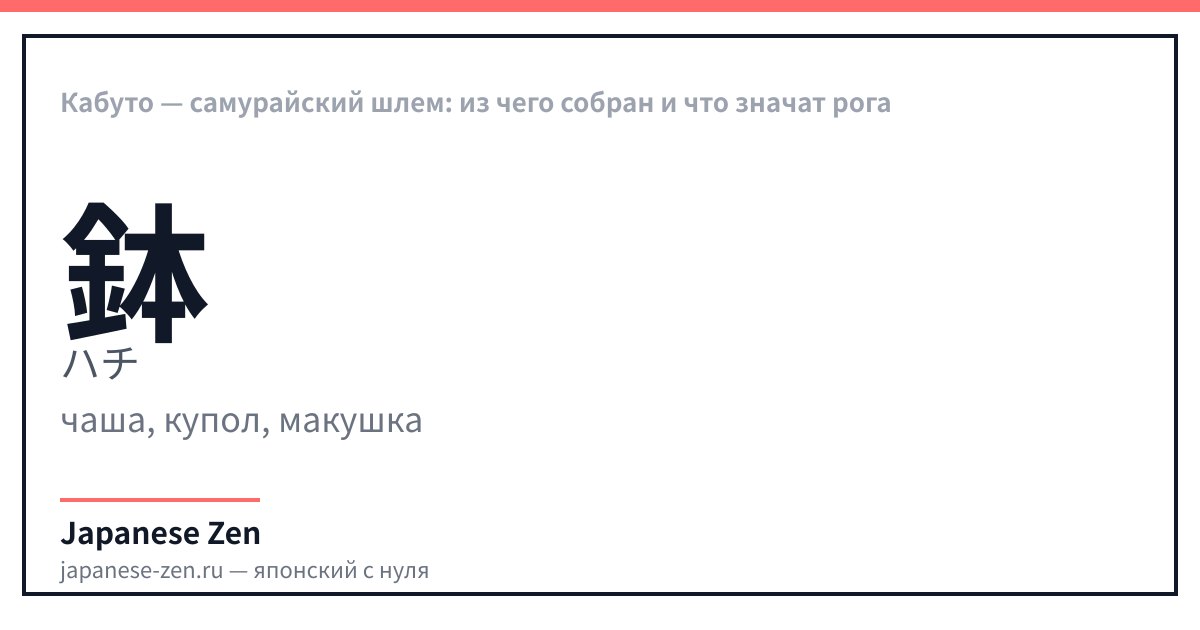
鉢 — the helmet bowl, a bowl and the word hachimaki in one character
鉢 — значение: bowl, dome, crown of the head — онъёми: ハチ、ハツ — 13 штрих(ов). 鉢 — "bowl, dome": the same word is used for the bowl of the kabuto helmet itself, its most important part. The character for "helmet" as a whole, 兜, is a separate kanji, while 鉢 refers specifically to the round protective bowl above the head.
兜 and 鉢 are different characters: 兜 names the helmet as a whole, while 鉢 refers to its dome-shaped base, the hachi itself. 鉢 is read as ハチ (hachi) in most words and as ハツ (hatsu) in certain combinations.
The hachimaki headband and the helmet bowl are related words
鉢巻 (hachimaki, headband) literally means "a wrap around the hachi" — the same word used for both the rounded part of the skull and the bowl of a helmet. The same image of a "bowl" links three different things: tableware, the shape of the head and the protective bowl of a kabuto.
| Japanese | Reading | Translation |
|---|---|---|
| 兜 | kabuto · kabuto | samurai helmet |
| 鉢 | hachi · hachi | bowl; helmet bowl |
| 鉢巻 | hachimaki · hachimaki | headband |
| 前立 | maedate · maedate | forehead ornament on a helmet |
| 兜を脱ぐ | kabuto o nugu · kabuto o nugu | to admit defeat, to surrender |
| 兜虫 | kabutomushi · kabutomushi | rhinoceros beetle, named after the shape of the helmet |
Write 鉢 along the guides — the character for "bowl", from which the kabuto helmet is assembled.
FAQ
- What is a kabuto?
- Kabuto (兜) is a Japanese samurai helmet assembled from several parts: the bowl hachi, the neck guard shikoro, the side flares fukigaeshi and, often, a large forehead ornament. The shape of the bowl and the ornaments changed from era to era.
- What parts make up a samurai helmet?
- The main parts are the bowl hachi (the base, made of riveted plates or a single forging), the neck guard shikoro for protecting the neck, the side flares fukigaeshi at the cheeks and the forehead ornament maedate, often in the form of paired kuwagata horns.
- Why are there horns on a samurai helmet?
- Horn-shaped ornaments — part of the forehead ornament maedate or side fittings — served primarily as identification marks: by the silhouette of the helmet, allies could recognize a commander on the battlefield from afar, and the unusual appearance also intimidated the enemy.
- What helmet did Date Masamune have?
- A black lacquered suji-kabuto of 62 plates with a gilded crescent on the forehead — one of the most recognizable images of the entire Sengoku period. The crescent served as the commander's personal identification mark on the battlefield.
- Why is a helmet displayed on Children's Day?
- The custom goes back to the Tango no Sekku festival and a play on words: "shōbu" (iris) sounds the same as "shōbu" — "warrior spirit". Armor and a helmet in the house on May 5 are a wish for a boy's health, strength and resilience for the future.
- How is "kabuto" written in Japanese?
- 兜, read as かぶと. The bowl of the helmet, however, is called by a separate character — 鉢 (hachi), "bowl": the same word is used for tableware, the rounded part of the head, and even the hachimaki headband that is wrapped around it in battle.
Sources
Updated: 2026-09-15