Date Masamune — who he was and what he is famous for
Date Masamune was a Japanese daimyo of the late Sengoku period (1567–1636), ruler of the northeast of the country and founder of Sendai. Nicknamed the "One-Eyed Dragon of Oshu" for the right eye he lost to smallpox in childhood, he subdued his neighbors within a few years but arrived too late for the division of the country and submitted to Toyotomi Hideyoshi in 1590. In 1613 he sent an embassy through Mexico to Rome — a rare opening to the wider world for Japan of that era.
If Date Masamune had been born ten years earlier, school textbooks might speak not of three unifiers of Japan but of four. He became the strongest daimyo of the northeast just as Toyotomi Hideyoshi forbade daimyo to wage war on one another — and ended up not a conqueror but a vassal. After that he built Sendai and looked far beyond his neighbors: in 1613 his own ship sailed to Mexico and then on to Rome.
Who Date Masamune really was
Date Masamune (伊達政宗, 1567–1636) was a daimyo of northeastern Japan, known as the "One-Eyed Dragon of Oshu" (独眼竜, dokuganryū) for the right eye he lost to smallpox in childhood. At 17 he took over the Date clan and within a few years crushed his neighbors, including the Ashina clan at Suriagehara in 1589. But he arrived too late for the division of the country: when he joined the siege of Odawara in 1590, Hideyoshi had already banned daimyo from waging wars on their own, and as punishment he stripped Masamune of part of his conquests. At Sekigahara in 1600 he sided with Tokugawa Ieyasu, and from 1601 he built Sendai. His helmet with a golden crescent is one of the most widely reproduced images of the Sengoku era.
| Year | Event |
|---|---|
| 1567 | Born at Yonezawa Castle; lost sight in his right eye after smallpox in childhood |
| 1584 | At 17 inherited power in the Date clan from his father, Date Terumune |
| 1589 | Crushed the Ashina clan at Suriagehara — became the strongest daimyo of the Tohoku region |
| 1590 | Arrived too late for the siege of Odawara; Hideyoshi stripped him of part of his conquered lands as punishment |
| 1600–1601 | Northern front at Sekigahara on Ieyasu's side; from 1601 built Sendai |
| 1613 | Sent the ship San Juan Bautista with the Keicho embassy to Mexico and Europe |
| 1636 | Died; buried in the Zuihoden mausoleum |
What he did in the years of peace
The main unexpected storyline in Masamune's biography is the Keicho embassy. In 1613 he built the galleon San Juan Bautista and sent his vassal Hasekura Tsunenaga across the Pacific on it. Hasekura reached Mexico, then crossed the Atlantic to Spain and obtained an audience with the Pope in Rome, where he was baptized. Hasekura returned to Japan only in 1620 and found a different country: the shogunate had already begun to eradicate Christianity, and Masamune himself almost immediately banned it in his domains. He was also famous as a gourmet: he set up a government miso manufactory in Sendai to supply his troops, laying the foundation of the local culinary tradition.
Name and kanji: 伊達政宗
The full name 伊達政宗 is read だてまさむね (Date Masamune) and splits into the clan name 伊達 (Date) and the personal name 政宗 (Masamune). Date is not a meaningful combination: the characters 伊 and 達 were chosen for the sound of the place name Date in Mutsu Province, which an ancestor of the clan received as a fief in the 13th century. This is ateji — writing for sound, not meaning. The personal name is more meaningful: 政 means "rule," 宗 means "head of the clan," a character passed down through several generations of the Date house (Tanemune, Harumune, Terumune). His father chose the name "Masamune" in honor of the ninth head of the clan, who was considered the restorer of the house, hoping for the same success for his son.
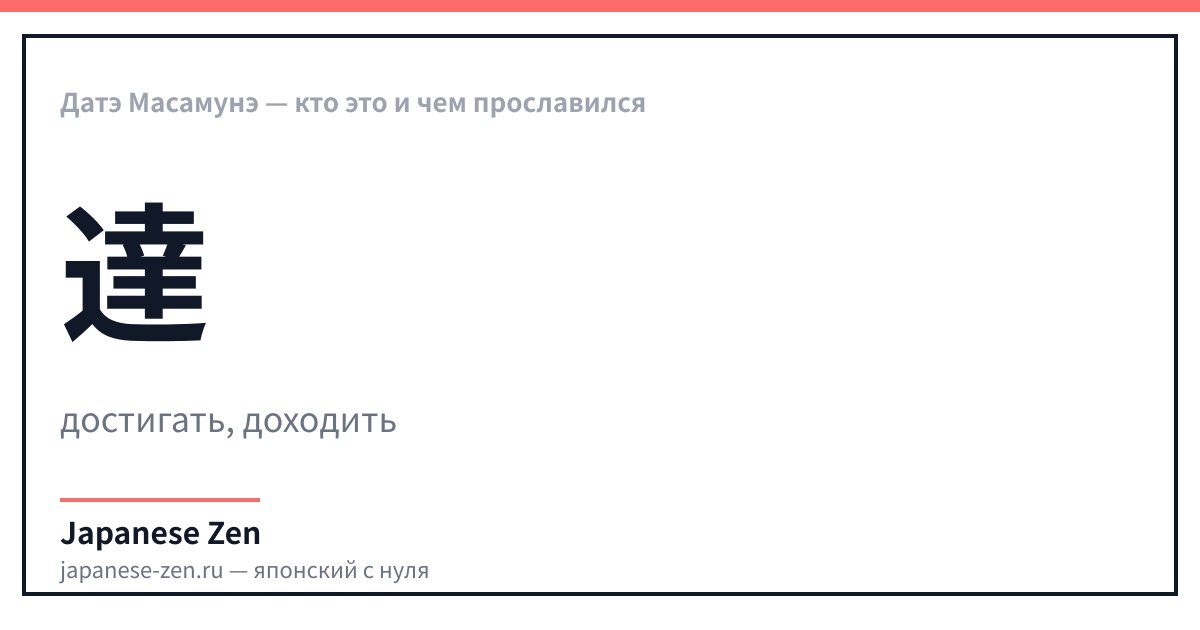
達 — значение: to reach, to arrive — онъёми: タツ、ダ — кунъёми: -たち — 12 штрих(ов). 達 — "to reach, to arrive": 12 strokes. The same character appears in the plural suffix -tachi (私達, watashitachi, "we") and in the word 伊達者 (datemono, "dandy") from the story of Masamune's army's armor.
Where the nickname One-Eyed Dragon came from
In 1593, when Masamune's army passed through Kyoto on its way to Hideyoshi's Korean campaign, the townspeople were struck by the deliberately luxurious armor of his samurai. From then on, dandies came to be called 伊達者 (datemono) — using the same characters as the commander's surname: 伊達 in the sense of "showy, refined" is read the same way, だて. This is a rare case of a historical figure's surname becoming a common noun: usually such words honor scholars or inventors, not commanders and their wardrobes.
| Japanese | Reading | Translation |
|---|---|---|
| 伊達政宗 | Date Masamune · Date Masamune | Name of the page's subject |
| 独眼竜 | dokuganryū · dokuganryū | The nickname "one-eyed dragon" — for the eye lost in childhood |
| 伊達者 | datemono · datemono | Dandy, fop — a word that entered the language thanks to Masamune's army |
| 三日月 | mikazuki · mikazuki | Crescent moon — the emblem on Masamune's helmet |
| 慶長遣欧使節 | Keichō ken'ō shisetsu · Keichō ken'ō shisetsu | The Keicho embassy — the 1613–1620 mission to Mexico, Spain and Rome |
| 城 | shiro · shiro | Castle — Sendai Castle became Masamune's residence |
Listen to the name of the daimyo of Sendai and the words of his era.
Date Masamune in anime, manga and games
- Sengoku Basara (Capcom) — Masamune is one of the two main characters of the series, alongside Sanada Yukimura: he fights with six swords at once, three in each hand, and liberally sprinkles his speech with English phrases like "Let's party!"
- Samurai Warriors (Sengoku Musou, Koei Tecmo) — playable from the very first installment: in early releases he fought with paired blades, in later ones with a saber and pistols.
- Nobunaga no Yabou ("Nobunaga's Ambition," Koei) — a playable daimyo in the long-running strategy series, but, as in history, he enters the game later than most rivals.
- Nioh (Team Ninja) — in the first story expansion, "Dragon of the North," a secondary character with secret plans around Sekigahara; in later DLC he becomes an ally of the protagonist.
- "One-Eyed Dragon Masamune" (独眼竜政宗) — not an anime but a 50-episode NHK historical drama from 1987 starring Ken Watanabe in the lead role: it still holds the record for the highest average ratings among taiga dramas.
What the games added to him
Masamune's six swords and English catchphrases in Sengoku Basara are Capcom's fantasy: the real commander used an ordinary sword and certainly did not mix English words into his speech. The conspiracy with a supernatural undertone around Sekigahara in Nioh is also fiction, though it rests on a real fact: before the battle, Masamune did indeed play a double game and waited to see who would win.
Truth and fiction about the One-Eyed Dragon
Popular culture almost always depicts Masamune with a black eyepatch over his right eye — but in portraits made during his life and after his death, as well as on the statue in his mausoleum, both eyes are open. According to legend, Masamune himself ordered that he be portrayed with both eyes seeing, believing that this was how he would appear in the afterlife. The eyepatch is entirely an invention of modern artists, not a detail he himself wore.
Another widely repeated episode is how Masamune, late for the siege of Odawara, appeared before an enraged Hideyoshi in the white robes of a condemned man, showing his readiness to accept execution, and thereby softened his anger. The story is beautiful and is often repeated even in serious publications, but it is a late anecdote from the family chronicles of the Date house, not a record by a contemporary of the events.
The Keicho embassy to Rome itself has also grown a version: that Masamune was actually trying to secure military support against the Tokugawa shogunate through Catholic Spain. Certain documents of the era do hint at negotiations for an alliance, but this remains a hypothesis of historians, not a proven conspiracy plan.
- Truth: the victory over the Ashina at Suriagehara in 1589 and the belated participation in the siege of Odawara with the loss of part of his lands. Also documented are the northern front at Sekigahara in 1600, the construction of Sendai from 1601, and the Keicho embassy of 1613–1620 — they are confirmed by the chronicles of the era.
- Fiction of popular culture: the black eyepatch — according to legend, Masamune himself ordered that he be painted with both eyes seeing.
- Late anecdote: the white robes of a condemned man before Hideyoshi at Odawara — a story from later chronicles of the Date house, not confirmed by contemporaries of the events.
- A version, not a fact: the secret purpose of the embassy to Rome — to secure Spain's military support against the shogunate.
FAQ
- Who was Date Masamune?
- Date Masamune was a Japanese daimyo of the late Sengoku period (1567–1636), ruler of the northeast of the country and founder of Sendai. Nicknamed the "One-Eyed Dragon of Oshu," he subdued neighboring lands but arrived too late for the division of the country and submitted to Toyotomi Hideyoshi in 1590, later siding with Tokugawa Ieyasu.
- What is Date Masamune famous for?
- Date Masamune is famous as the strongest daimyo of the Tohoku region, the founder of Sendai and the organizer of the Keicho embassy: in 1613 he equipped the ship San Juan Bautista, on which his vassal Hasekura Tsunenaga reached Mexico, Spain and Rome.
- How is the name Date Masamune written in Japanese?
- 伊達政宗, read だてまさむね. 伊達 (Date) is the clan name, written for the sound of a place name rather than for meaning; 政宗 (Masamune) is the personal name made of the characters for "rule" (政) and "head of the clan" (宗), given in honor of a celebrated ancestor.
- Was Date Masamune a real person or a legend?
- Date Masamune was a real historical figure; his rule is documented in detail in the chronicles of the era. It is his posthumous reputation that has grown legends: the black eyepatch, the white robes of a condemned man before Hideyoshi, and the secret purpose of the embassy to Rome are later accretions, not facts of his biography.
- Why is Date Masamune so popular in games?
- Date Masamune is one of the two main characters of Sengoku Basara, playable in Samurai Warriors and Nobunaga no Yabou, and also in Nioh. In 1987, a 50-episode NHK historical drama, "One-Eyed Dragon Masamune," was made about him, starring Ken Watanabe.
- When did Date Masamune live?
- Date Masamune lived from 1567 to 1636: he spent his youth in wars to unify northeastern Japan, and his mature years as ruler of Sendai under the Tokugawa shogunate. He outlived Tokugawa Ieyasu by four years and died in 1636.
Sources
Updated: 2026-09-11