Toyotomi Hideyoshi — who he was and what he is famous for
Toyotomi Hideyoshi was a Japanese military commander and statesman of the Sengoku period (1537–1598), the second of the three unifiers of the country after Oda Nobunaga. The son of a peasant or an ashigaru, he rose to the posts of kampaku and taikō: he could not become shogun because he did not belong to the Minamoto clan. In 1590, by taking Odawara, he completed the unification of Japan, but he failed in two invasions of Korea and died in 1598, leaving power to his young son.
If Nobunaga broke the old order and Ieyasu built it up again, Hideyoshi walked the most improbable path between them: from a field commander with no lineage at all to the de facto ruler of the country. His biography reads almost like a tall tale, and some episodes really were invented by later storytellers. Below is what the documents of the era confirm and what the Edo period added.
Who Toyotomi Hideyoshi really was
Toyotomi Hideyoshi (豊臣秀吉, 1537–1598) was a military commander and statesman, the second of the three unifiers of Japan in the Sengoku period. He was born into a simple peasant family (according to another version, an ashigaru, a foot soldier) in Owari Province and had neither a surname nor the right to samurai status by birth. After entering the service of Oda Nobunaga, following Nobunaga's death in 1582 Hideyoshi quickly defeated his rivals and by 1590 subdued the last independent daimyo. He did not become shogun, however: the title traditionally went only to descendants of the Minamoto clan, and Hideyoshi was a peasant's son. Instead he took the post of kampaku — regent to the emperor — and from 1591 bore the title taikō, handing the kampaku post to his nephew Hidetsugu.
| Year | Event |
|---|---|
| 1537 | Born in Owari Province into a peasant family (according to another version, an ashigaru) |
| 1582 | After Nobunaga's death at Honnō-ji, defeated Akechi Mitsuhide at Yamazaki |
| 1583 | Victory at Shizugatake over Shibata Katsuie |
| 1584 | Battle of Komaki and Nagakute with Tokugawa Ieyasu — ended in peace |
| 1585 | Became kampaku — regent to the emperor |
| 1586 | Received the surname Toyotomi from the emperor |
| 1588 | Katanagari edict — confiscation of weapons from peasants |
| 1590 | Siege of Odawara: fall of the Go-Hōjō, unification of Japan completed |
| 1592 and 1597 | Two invasions of Korea — both failed |
| 1598 | Died, leaving power to his five-year-old son Hideyori |
What he did once he reached the top
Besides wars, Hideyoshi reshaped the structure of Japanese society. The katanagari of 1588 confiscated weapons from peasants and secured a monopoly on them for samurai. At the same time came the taikō kenchi — a land survey that determined the income of each domain in koku of rice and tied peasants to the land. Together these measures completed heinō bunri — the separation of the warrior and farming classes, on which the Edo order rested for centuries afterward. And to even claim the post of kampaku, which for centuries had gone only to descendants of the Fujiwara clan, the peasant's son had to be formally adopted into the house of the court nobility Konoe.
Name and kanji: 豊臣秀吉
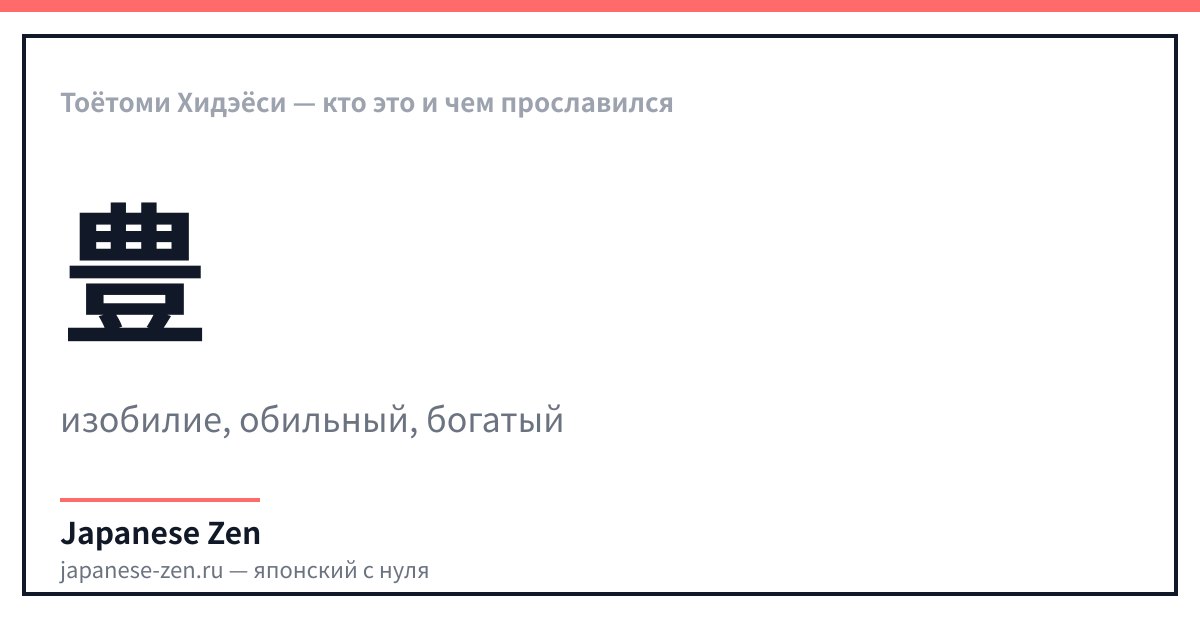
The full name 豊臣秀吉 is read とよとみひでよし (Toyotomi Hideyoshi) and splits into the surname 豊臣 (Toyotomi) and the personal name 秀吉 (Hideyoshi). 豊 means 'abundance, wealth', 臣 means 'vassal, subject': together they form not a blood lineage name but a surname granted by the emperor. 秀 means 'outstanding, excellent', 吉 means 'good fortune': a personal name received long before all titles and honors.
豊 — значение: abundance, abundant, wealthy — онъёми: ホウ、ブ — кунъёми: ゆた.か、とよ — 13 штрих(ов). 豊 — 'abundance, wealth': 13 strokes. The same root is in 豊富 (hōfu, 'abundance'). Together with the character 臣 ('vassal') it formed the surname Toyotomi, which Hideyoshi received from the emperor in 1586 — something like 'prosperous subject', not a blood lineage name but a title gift.
Why he changed so many names
Before 1586 Hideyoshi changed his name twice: in Nobunaga's service he was called Kinoshita Tōkichirō (木下藤吉郎), and from 1568 — Hashiba Hideyoshi (羽柴秀吉). The surname Hashiba (羽柴) incorporated characters from the names of other Nobunaga commanders — Niwa Nagahide (丹羽長秀, the character 羽) and Shibata Katsuie (柴田勝家, the character 柴). The surname Toyotomi replaced Hashiba only in the last twelve years of his life, but it is the one that remained in history textbooks.
| Japanese | Reading | Translation |
|---|---|---|
| 豊臣秀吉 | Toyotomi Hideyoshi · Toyotomi Hideyoshi | Name of the page's subject |
| 関白 | kanpaku · kanpaku | Title of regent to the emperor — not shogun |
| 太閤 | taikō · taikō | Hideyoshi's title after resigning from the post of kampaku |
| 刀狩 | katanagari · katanagari | 'Sword hunt' — the edict of 1588 |
| 城 | shiro · shiro | Castle — Osaka Castle became Hideyoshi's residence |
Listen to Hideyoshi's titles and repeat them aloud.
Toyotomi Hideyoshi in anime, manga and games
- Nobunaga no Yabou ('Nobunaga's Ambition') — Koei's long-running strategy series: Hideyoshi is playable as a daimyo, particularly in scenarios beginning after Nobunaga's death at Honnō-ji.
- Samurai Warriors (Sengoku Musou) — Hideyoshi has been playable since the first games in the series, fighting with a three-section staff and moving with deliberately acrobatic, 'monkey-like' motions — a nod to the nickname Saru.
- Sengoku Basara — from the second game, one of the two main characters alongside Nobunaga: a giant who fights with his bare hands, the complete opposite of the real Hideyoshi, whom contemporaries described as short and slight.
- Nobunaga no Shinobi — a comedic manga and anime about the era of Nobunaga, in which Hideyoshi appears under the name Hashiba (before the granting of the surname Toyotomi) with grotesquely monkey-like facial features.
What games do with his biography
Hideyoshi's contemporary, the Portuguese missionary Luís Fróis, did indeed describe him as a short man who resembled a monkey — this is a documented testimony, not a later invention. But the gigantic stature and the dark storyline around his wife Nene in Sengoku Basara are the authors' fiction: the real Nene outlived her husband by decades and founded Kōdai-ji temple in Kyoto in his memory.
Where legend diverged from the documents
The nickname Saru ('monkey'), which Nobunaga himself supposedly gave Hideyoshi, is so firmly part of the image that it seems like a historical fact, although the stories about it go back to texts of the Edo period, not to documents from his lifetime. Equally late is the story of how the young Hideyoshi warmed his lord's sandals against his chest, which goes back to the Ehon Taikōki of the late 18th century and to more florid retellings later — there is no contemporary evidence for the episode. And the phrase 'if it doesn't sing, I'll make it sing', attributed to Hideyoshi alongside the remarks of Nobunaga and Ieyasu about the same cuckoo, is a device from an essay by the historian Matsura Seizan in the early 19th century, not the commander's actual words.
- True, documented by contemporaries: origins in a simple family, service under Nobunaga, the rout of Akechi Mitsuhide at Yamazaki, the taking of Odawara in 1590, the katanagari and both invasions of Korea.
- Legend, Edo period: the story that it was Nobunaga who nicknamed him Saru — not confirmed by contemporary sources.
- Legend, Edo period: the story of the sandals warmed against Nobunaga's chest — a pretty anecdote from later retellings, not a biographical fact.
- Late literary invention: the phrase 'I'll make the cuckoo sing' — a device of an early 19th-century essayist, not Hideyoshi's actual words.
FAQ
- Who was Toyotomi Hideyoshi?
- Toyotomi Hideyoshi was a Japanese military commander and ruler (1537–1598), the second of the three unifiers of the country. His biography is a rare case of social mobility: the son of a peasant or an ashigaru rose to the posts of kampaku and taikō and in 1590 completed the unification of Japan.
- What is Toyotomi Hideyoshi famous for?
- Toyotomi Hideyoshi defeated Akechi Mitsuhide after Nobunaga's death, unified the country by taking Odawara in 1590, carried out the katanagari — the confiscation of weapons from peasants — and the taikō kenchi land survey. Both invasions of Korea, however, ended in failure.
- How is the name Toyotomi Hideyoshi written in Japanese?
- 豊臣秀吉, read とよとみひでよし. 豊臣 (Toyotomi) is the surname granted by the emperor in 1586, made up of the characters for 'abundance' and 'vassal', while 秀吉 (Hideyoshi) is a personal name literally meaning 'excellent good fortune', given long before all titles.
- Was Toyotomi Hideyoshi a real person or a legend?
- Toyotomi Hideyoshi was a real historical figure; his rule is documented in detail by chronicles and contemporaries. It is his posthumous reputation that became overgrown with legends: the nickname Saru, the story of the sandals and the phrase about the cuckoo appeared in retellings of the Edo period, not during his lifetime.
- Where does Toyotomi Hideyoshi appear in games and anime?
- Toyotomi Hideyoshi appears in the manga and anime Nobunaga no Shinobi under the name Hashiba — before the granting of the surname Toyotomi — as well as in the strategy games Nobunaga no Yabou and the action series Samurai Warriors and Sengoku Basara.
- When did Toyotomi Hideyoshi live?
- Toyotomi Hideyoshi lived from 1537 to 1598: he spent almost his whole life in service and in the wars of the Sengoku period, and in his last decade ruled a unified Japan with the status of taikō and kampaku. He died two years before the Battle of Sekigahara.
Sources
Updated: 2026-09-11