Sen no Rikyū — the tea master who served Nobunaga and Hideyoshi
Sen no Rikyū (1522–1591) was a merchant from Sakai who became a tea master first under Oda Nobunaga and then under Toyotomi Hideyoshi. He pushed the aesthetic of wabicha — tea through simplicity and austerity — to its limit: he shrank the tea room to two or three tatami, and tradition credits him with the low entrance called nijiriguchi. In 1591 Hideyoshi suddenly ordered him to commit seppuku — the reasons remain a matter of debate.
Much of the modern tea ceremony comes down from Rikyū, right down to the low door through which one has to crawl into the room. Let's look at where his later name came from, how his tea room Tai-an differed from Hideyoshi's golden room, and what versions are given as the reason for the sudden order of death.
A merchant from Sakai: family, name, and first teachers
Sen no Rikyū was born in 1522 in the port city of Sakai, into a merchant family with a shop under the sign "Totoya" ("fish shop"), which sold salted fish and kept warehouses. At birth he was called Tanaka Yoshiro; the name Sen came from his grandfather's family nickname, and the Buddhist name Soeki, by which he was known for most of his life, he took as an adult. He began studying tea at seventeen; sources name Kitamuki Dochin as his first teacher, though the version about his study under the master Takeno Jōō is better known.
How a merchant became a man at the ruler's side
From the late 1560s, Rikyū, along with other wealthy merchants of Sakai, served as tea master under Oda Nobunaga, and after Nobunaga's death in 1582 he took the same post under Toyotomi Hideyoshi. The name "Rikyū," by which he is known today, is not a personal name but an honorary lay title. In 1585 it was granted to him by Emperor Ōgimachi — specifically so that a merchant without court rank could formally enter the palace for a tea ceremony in the emperor's honor. Sources interpret the meaning of the title itself differently: sometimes as "quietness that has cast off fame and profit," sometimes as a call to "calm the sharp mind" — there is no single opinion.
What Rikyū changed in the tea room itself
Rikyū pushed the principle of wabicha to its limit — tea through austerity and simplicity: where before him a room of four and a half tatami was already considered cramped, he introduced rooms of three and even two tatami. Tai-an in Yamazaki near Kyoto is the only surviving tea room considered to be the work of Rikyū himself; according to tradition, it was built around 1582 on Hideyoshi's order; today Tai-an is recognized as a National Treasure of Japan.
Why a guest has to crawl into the tea room
Tradition also credits Rikyū with the low entrance called nijiriguchi: one could get into the room only by stooping, leaving one's sword at the entrance, and the guest's rank ceased to matter beyond the threshold. The same principle was continued by the tea bowls of the master Chōjirō: on Rikyū's instructions he made deliberately rough raku ware, without symmetry or the glaze sheen prized in imported Chinese vessels.
For contrast, people often recall the golden collapsible tea room that Hideyoshi had made in 1585. Whether Rikyū took part in its creation is unknown: there are no direct documents, and historians' opinions differ. Two years later, in 1587, Rikyū served as host of the Grand Tea Gathering at Kitano — a huge tea gathering to which Hideyoshi allowed anyone to come, regardless of rank. Planned for ten days, it ended after the first.
A sudden order whose reason sources give differently
In 1591 Hideyoshi, without explanation, ordered Rikyū to commit seppuku. Sources of that time give several versions at once. One is that Rikyū placed his own statue in sandals above the gate of Daitoku-ji temple, forcing visitors, including Hideyoshi himself, to symbolically pass under his feet. Another is that he inflated prices for tea utensils for his own benefit. Political and personal reasons are also named — from a clash of tastes to the envy of courtiers. None of the versions is documented, and historians still have not reached agreement.
What remains of Rikyū's school
Rikyū's legacy was continued through his adopted son Sen Shōan and his grandson Sen Sōtan, whose three sons founded three related tea schools — Omotesenke, Urasenke, and Mushakōjisenke. Matsuo Bashō, in his travel notes "Oi no Kobumi," placed Rikyū's tea work alongside the poetry of Saigyō and the painting of Sesshū — as phenomena of the same nature, despite the difference in centuries and arts.
Films have been made about Rikyū: "The Death of a Tea Master" (千利休 本覚坊遺文, 1989) directed by Kumai Kei, based on the novel by Inoue Yasushi, and "Ask Rikyū" (利休にたずねよ, 2013) directed by Tanaka Mitsutoshi, based on the novel by Yamamoto Ken'ichi. Both films examine his relationship with Hideyoshi and the mystery of the final order.
The character 休 — repose in the name of a man who served two rulers
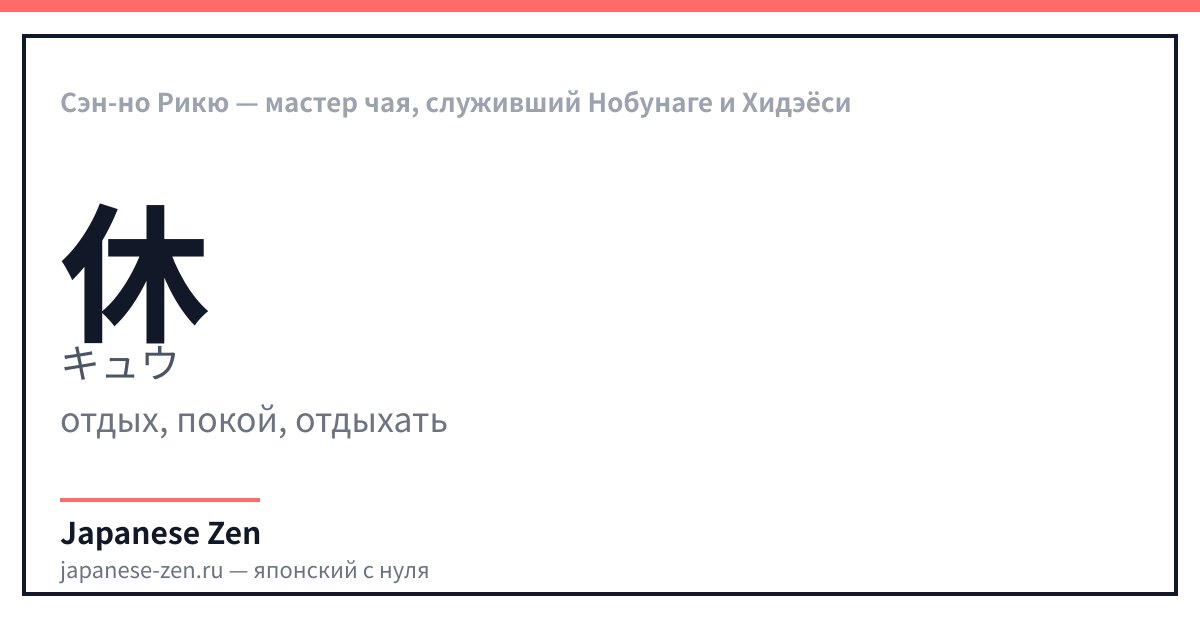
休 — значение: rest, repose, to rest — онъёми: キュウ — кунъёми: やす.む、やす.まる、やす.める — 6 штрих(ов). 休 — the second character in the honorary title "Rikyū": "rest, repose." The same character appears in 休日 (day off) and in the evening greeting お休みなさい ("good night").
千利休 = 千 "thousand" (surname) plus 利休 (利 "benefit, sharpness" plus 休 "repose") — the title "Rikyū" itself is interpreted differently, but both characters in it are read in familiar ways. 休 is kyū in 休日 (day off) and yasumu in the ordinary verb "to rest." The same character appears in 休憩 (break) and in the evening お休みなさい ("good night").
Why the character 休 means "repose"
Etymological dictionaries explain 休 as the combination of two simple parts: on the left, the simplified character for "person" 亻, on the right, "tree" 木. The result is an image of a person leaning against a tree in the shade — a clear way to show "rest" without a single phonetic element in the character's composition.
| Japanese | Reading | Translation |
|---|---|---|
| 休日 | kyūjitsu · kyūjitsu | Day off |
| 休憩 | kyūkei · kyūkei | Break, rest |
| お休みなさい | oyasumi nasai · oyasumi nasai | Good night |
| 千利休 | Sen no Rikyū · Sen no Rikyū | The master's full name |
| 茶道 | sadō · sadō | The way of tea — the tea ceremony |
| 侘び茶 | wabicha · wabicha | The tea style of simplicity |
Trace 休 along the guides — the character of "repose" that stands in the name of the man who changed the tea ceremony.
FAQ
- Who was Sen no Rikyū?
- Sen no Rikyū (1522–1591) was a merchant from Sakai who became a tea master under Oda Nobunaga and then under Toyotomi Hideyoshi. He pushed the aesthetic of wabicha — tea through simplicity and austerity — to its limit, and in 1591, on Hideyoshi's order, he committed seppuku.
- What did Sen no Rikyū change in the tea ceremony?
- He reduced the tea room to two or three tatami, commissioned deliberately rough raku ware from the master Chōjirō, and turned the approach to the tea room, the roji garden, into part of the ceremony itself. Tradition also credits him with the low entrance called nijiriguchi.
- Why did Hideyoshi order Rikyū to commit seppuku?
- The exact reason is unknown. Sources give versions — from Rikyū's statue above the gate of Daitoku-ji temple, which was considered an insult, to inflated prices for tea utensils and personal dislike — but none of them is documented.
- What is wabicha?
- A style of tea ceremony built on simplicity and austerity of setting: a cramped room, rough utensils, a minimum of decoration. Rikyū pushed this style to its limit and made it the basis of the modern tea tradition.
- Which tea schools trace their lineage to Rikyū?
- The three Senke schools: Omotesenke, Urasenke, and Mushakōjisenke. They were founded by the sons of Rikyū's grandson, Sen Sōtan, who continued the line through the master's adopted son Sen Shōan.
- How is the name "Sen no Rikyū" written in kanji?
- 千利休, read as せんのりきゅう. 千 is the surname ("thousand"), 利休 is the honorary title granted by the emperor in 1585; scholars differ on its interpretation.
Sources
Updated: 2026-09-15