Dango — dumplings on a skewer: mitarashi, hanami, and the proverb about flowers
Dango (団子) are balls made from rice flour mixed with water, boiled or steamed, and often threaded several to a bamboo skewer. What sets dango apart from mochi is the raw material: mochi is pounded from whole steamed grains of glutinous rice, while dango is shaped from flour — jōshinko from regular rice or shiratamako from glutinous rice. The best-known kinds are mitarashi dango in sauce and the three-colored hanami dango.
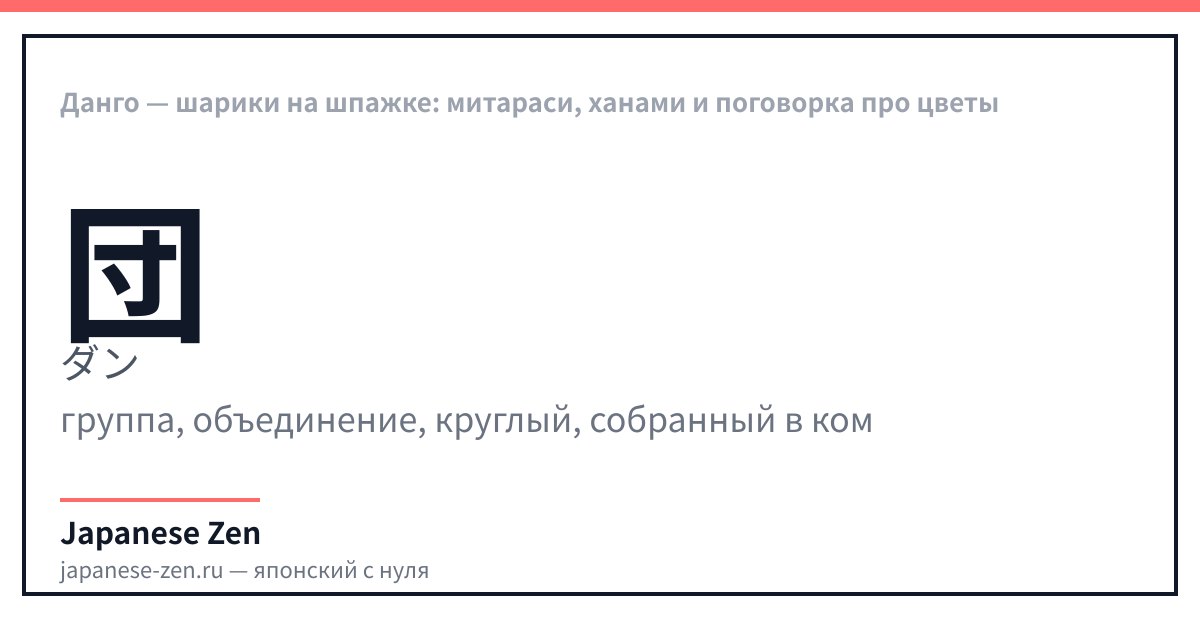
Dango is not one sweet but a whole family of balls on a skewer, each kind with its own flour, sauce, and occasion. Let's look at how dango differs from mochi, why in Tokyo a skewer usually holds four balls while in Osaka it holds five, and what the proverb "dango over flowers" means. We'll also find out why the character 子 in 団子 is read "go" rather than "ko".
What dango is made from, if the rice isn't pounded
Dango is not made the way mochi is: rice flour — jōshinko (上新粉) from regular, non-glutinous rice or shiratamako (白玉粉) from glutinous mochigome — is kneaded with water or boiling water, shaped into balls, and boiled or steamed. Mochi, by contrast, is pounded from whole steamed grains of glutinous rice with no flour at all — that is the main difference between the two sweets. Japanese reference works do not draw a strict line between them, though: there are dango made from glutinous rice, and mochi-like sweets made from flour.
The skewer and the number of balls
The finished balls are most often threaded three to five to a bamboo skewer, lightly grilled, or dipped in sauce. In the past dango was also eaten as a substitute for staple food in lean years, and it became a sweet treat for outings and tea only much later, once sugar grew cheaper in the cities.
Mitarashi, hanami dango, and what dango is not
The different kinds of dango differ not so much in shape as in the sauce or the occasion for which they are eaten.
| Kind | In Japanese | What it is |
|---|---|---|
| Mitarashi dango | みたらし団子 | dango with no sweetness in the dough, lightly grilled and coated in a thick sauce of soy sauce and sugar; the name is connected with Shimogamo Shrine in Kyoto |
| Hanami dango | 花見だんご (三色団子) | three balls on one skewer — pink, green, and white; eaten during cherry-blossom viewing |
| Kushidango | 串団子 | a general word for any dango on a skewer — three to five balls, dusted outside with kinako soybean flour, coated with green zunda paste made from crushed edamame, or left as is |
Why these are not dango: ohagi and botamochi
Ohagi and botamochi are sweets that are easy to mistake for dango at a glance, but they are made differently: the glutinous rice is not pounded to a uniform mass but lightly mashed, leaving some grains whole, and then coated outside with anko or soybean flour. In terms of raw material this is closer to mochi than to flour-based dango — just with half-processing rather than full processing of the grain.
Four balls in Kanto, five in Kansai
In Tokyo and the rest of Kanto a skewer most often holds four dango, while in Kansai it holds five, and both numbers have their explanations. One links the Kanto count to the Edo-period four-mon coin: dango once cost five mon, and when a coin worth exactly four mon came into circulation, sellers adjusted the number of balls to match it. The Kansai count of five is linked to the custom of Shimogamo Shrine: five dango on a skewer symbolized a person's head and four limbs — they were offered in place of a paper doll in a purification rite.
"Dango over flowers": the proverb 花より団子
花より団子 is read "hana yori dango" — literally "dango rather than flowers" or "dango matters more than flowers." It is said of a person who values practical benefit above beauty and elegance: for example, someone who comes to view the cherry blossoms but looks first and foremost at the food. The proverb is not a condemnation — it is more a good-natured observation of how rarely aesthetics win out over appetite.
三色団子 at hanami
At spring outings people eat three-colored hanami dango: three balls on a skewer — pink, green, and white — symbolize blooming cherry blossoms, fresh greenery, and snow not yet melted. In some regions the same dango are roasted at a bonfire during the New Year rite of sagichō at other times of year.
How a ball became a "group": the readings of the character 団
団 — значение: group, association, round, gathered into a lump — онъёми: ダン、トン — кунъёми: かたまり、まる.い — 6 штрих(ов). 団 — "group, association," and also "round, gathered into a lump": both meanings suit the word 団子 — a ball shaped from many grains of flour.
Two on'yomi readings — ダン and トン
The character 団 has two on'yomi readings and no kun'yomi at all. The usual one is dan: it sounds in 団体 (dantai) "group, organization" and in the word 団子 itself. The rare reading ton survives in only a couple of words, the most common being 布団 (futon): 布 "cloth" plus 団 "gathered into a lump," literally a "quilted sheet."
Why 子 is read "go," not "ko"
The character 子 on its own is read ko and means "child," but when paired with another word this ko is often voiced to go — a common phenomenon in Japanese that linguists call rendaku. The rule works not only here: a voiceless consonant at the start of the second root of a compound word regularly becomes voiced. In 団子 the same rule applied: dan plus ko gave dango.
| Japanese | Reading | Translation |
|---|---|---|
| 団子 | dango · dango | Dango |
| 花より団子 | hana yori dango · hana yori dango | "Dango over flowers" |
| 布団 | futon · futon | Quilted mattress, futon |
| 団体 | dantai · dantai | Group, organization |
| 上新粉 | jōshinko · jōshinko | Flour from regular rice for dango |
| 白玉粉 | shiratamako · shiratamako | Flour from glutinous rice |
Write 団 along the guides — the character for "group," which comes first in the word 団子.
FAQ
- What kind of sweet is dango and what is it made from?
- Dango (団子) are balls of rice flour kneaded with water, boiled or steamed, and usually threaded several to a bamboo skewer. They are made from jōshinko (regular rice flour) or shiratamako (glutinous rice flour), unlike mochi, which is pounded from whole grains with no flour at all.
- How does dango differ from mochi?
- Dango is shaped from rice flour kneaded with water, while mochi is pounded from whole steamed grains of glutinous rice — completely different methods, though the result can look similar. Japanese dictionaries do not draw a strict line between them: too many sweets arise at the meeting point of the two techniques.
- What does the proverb "dango over flowers" mean?
- 花より団子 (hana yori dango) — "dango matters more than flowers": it is said of a person who, while viewing cherry blossoms, thinks first of food rather than the beauty of the scene. The proverb describes a preference for practical benefit over elegance, without condemnation — rather with light irony.
- Why are there sometimes four balls on a skewer and sometimes five?
- In Kanto, including Tokyo, four dango are more often threaded on — according to one version, the number was adjusted to match the Edo-period four-mon coin. In Kansai it is usually five — this is linked to the rite of Shimogamo Shrine, where five dango on a skewer symbolized a person's head and four limbs.
- How is "dango" written in kanji, and why is 子 read "go"?
- 団子, in kana だんご. 団 means "group, association" or "round, gathered into a lump," and 子 on its own is read ko and means "child." In a compound word the ko is voiced to go — a common phenomenon in Japanese that linguists call rendaku.
- What is mitarashi dango?
- Dango with no sweetness in the dough itself: they are lightly grilled on a skewer and coated in a thick sauce of soy sauce, sugar, and starch. The name is connected with Shimogamo Shrine in Kyoto, where such dango were made as an offering at temple festivals.
Sources
Updated: 2026-09-15