Daifuku — Mochi with a Filling: "Great Fortune" or "Full Belly"
Daifuku (大福) is a ball of mochi wrapped in a thin layer around a sweet filling, usually anko bean paste. What sets it apart from plain mochi is precisely the filling: without it, it is no longer daifuku but just a rice cake. The name literally means "great fortune," but the sweet was once called something else — "mochi with a full belly" — and the character was replaced with a more elegant one later, in the Edo period.
Daifuku has a double history: one about the dough and the filling, another about how the not-so-elegant "mochi with a fat belly" turned into the refined "great fortune." Let's look at how tsubuan differs from koshian, where strawberry daifuku came from, and why the character on this page's card is not 福 at all, but "to wrap."
A Thin Layer of Mochi Around a Sweet Filling
Daifuku is mochi, but not just any: a thin sheet of pounded glutinous rice wraps a filling, usually anko bean paste. Plain mochi is more often eaten on its own or in ozoni soup, but daifuku never comes without a filling — that is what distinguishes this sweet from other types of mochi. There are two kinds of anko: tsubuan (粒あん) — a chunky paste with bean particles and skins, and koshian (漉し餡) — strained through a sieve, smooth and uniform; the more expensive and elegant daifuku is usually made with koshian.
豆大福, 草大福 and Other Dough Variations
The daifuku dough itself also varies: in mame-daifuku (豆大福), boiled peas or soybeans are mixed in, and in kusa-daifuku (草大福), crushed yomogi mugwort is added, turning the outer layer green. There is also a salty version, shio-daifuku (塩大福) — an echo of the times when the sweet was not yet made sweet.
From "Full Belly" to "Great Fortune"
Earlier records looked different: 腹太餅 (harabuto-mochi) and 大腹餅 (daifuku-mochi), both meaning roughly "mochi with a full, swollen belly" — so the sweet was named for its generous filling and round shape. The second sounds exactly like today's 大福餅. The character 腹 "belly" is pronounced in its on'yomi the same as 福 "fortune, luck" — fuku. This phonetic coincidence was exploited: over time, "belly" in writing was replaced with the far more elegant "fortune," and the resulting 大福 also came to be associated with 大福長者 — a nickname for a wealthy, lucky person.
Edo, 18th Century: From Salty Filling to Sweet
A sweet with this name was sold in Edo in the 1770s — sources differ on the exact year and the name of the seller, but agree on the essence. The filling was initially salty, and sugar in anko became common only by the end of the 18th century, when it became cheaper. At the same time, during the Kansei reforms, vendors walked the streets of Edo, grilling hot daifuku on the spot over braziers.
Strawberry in Daifuku — a 20th-Century Sweet
Ichigo daifuku — daifuku with a whole strawberry inside the anko — appeared not in ancient times but in the 1980s, during the Japanese economic boom. Sources name several confectioneries where the sweet appeared almost simultaneously, so it has no single inventor: too many shops claim the invention.
Daifuku with Other Fruits
After the strawberry, daifuku with other fruits began to be made on the same principle — grapes, melon, mandarin, persimmon: a whole fruit or a segment is placed inside the anko or instead of it. Of all the variations, the strawberry one remains the most recognizable, probably because of the contrast between the red berry and the white dough.
Why the Daifuku Card Shows the Character for "Wrap"
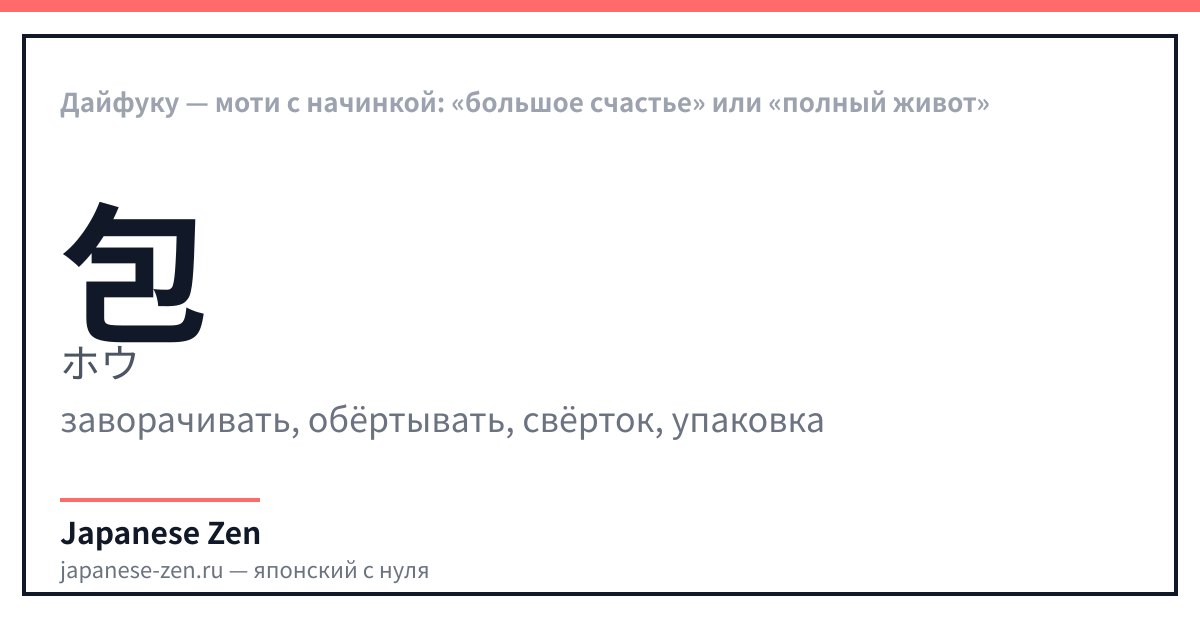
包 — значение: to wrap, to envelop, bundle, package — онъёми: ホウ — кунъёми: つつ.む、くる.む — 5 штрих(ов). 包 — "to wrap, to envelop": it is not part of the word 大福 itself, but it describes the main technique by which it is made — a thin layer of mochi wraps the filling.
The verb 包む (tsutsumu) — "to wrap" — is an ordinary, not festive word: it is also used to describe wrapping a gift in furoshiki or a child in a blanket. Daifuku in this sense is simply a kitchen example: mochi tsutsumu anko, "mochi wraps anko." The characters in the word 大福 themselves read as simply as can be: 大 — "big," 福 — "fortune, luck" — this pair gave the sweet its modern, most elegant of all names.
The Same Character in 包丁 — But a Completely Different Story
In the word 包丁 (hōchō) — "kitchen knife" — the character 包 has nothing to do with "wrapping": it was substituted for another, rarer character 庖 "kitchen." The whole meaning of the word was originally "kitchen worker," that is, simply a cook: it goes back to the legendary Chinese cook Pao Ding from a parable by the philosopher Zhuangzi, who butchered an ox so virtuosically that the movements of his knife became a symbol of mastery. Already in the Japanese Middle Ages, the word 包丁 narrowed to mean "knife," the kind such a cook used.
| Japanese | Reading | Translation |
|---|---|---|
| 大福 | daifuku · daifuku | Daifuku |
| 包む | tsutsumu · tsutsumu | To wrap |
| 包丁 | hōchō · hōchō | Kitchen knife (literally "cook") |
| 粒あん | tsubuan · tsubuan | Chunky bean paste |
| 漉し餡 | koshian · koshian | Strained, smooth bean paste |
| いちご大福 | ichigo daifuku · ichigo daifuku | Strawberry daifuku |
Write 包 along the guides — the character for "wrapping" that explains how daifuku is made.
FAQ
- What is daifuku made from and what is it filled with?
- Daifuku (大福) is a thin layer of pounded glutinous rice mochi wrapped around a sweet filling, usually anko bean paste. The filling is the main difference from plain mochi: without it, it is a different sweet. Daifuku is eaten cold, usually on the day of purchase, before the dough goes stale.
- What does the word "daifuku" mean?
- 大福 literally means "great fortune": 大 — "big," 福 — "fortune, luck." But originally the sweet was called differently — 腹太餅 or 大腹餅, "mochi with a full belly," because of its generous filling and round shape. The character for "belly" is pronounced the same as "fortune" — fuku — and over time one was replaced with the other, more elegant one.
- How does daifuku differ from plain mochi?
- Mochi is simply pounded glutinous rice; it is eaten both plain and in the New Year's soup ozoni. Daifuku is the same mochi but necessarily with a filling inside, most often anko bean paste; without a filling, the sweet is not called daifuku.
- When did strawberry daifuku appear?
- In the 1980s, during the Japanese economic boom. Several confectioneries almost simultaneously began putting a whole berry into the anko — sources do not name a single inventor, as too many shops claim to be first.
- Why does this page's card show the character 包 if it is not in the word "daifuku"?
- 包 means "to wrap" and directly describes how daifuku is made: a thin layer of mochi wraps the filling inside. This character is not part of the word 大福 itself, but the verb 包む ("to wrap") precisely conveys the main technique of this sweet.
Sources
Updated: 2026-09-15