Matcha tea: powdered green tea and why the word is spelled with 'tch'
Matcha is powdered green tea: tencha leaves are grown in the shade, dried without rolling, and ground with stone mills into an ultra-fine powder. Matcha is whisked directly into hot water and drunk together with the leaf itself, rather than brewed and strained like regular tea. In Japanese the word is まっちゃ: the small っ doubles the consonant, and Hepburn romanization writes a doubled 'ch' as 'tch' — hence matcha.
The word 'matcha' now appears on coffee shop boards more often than in conversations about Japanese tradition, but the tea behind the name is quite specific: a special cultivar, special leaf processing, and a special pronunciation. Let's look at how matcha differs from regular green tea, what the city of Uji has to do with it, how usucha differs from koicha, and what the 't' in 'matcha' stands for.
Tencha, millstones, and powder: how matcha is made
Matcha is tencha leaf ground into an ultra-fine powder. Before harvesting, the tea bushes are shaded from direct sunlight for several weeks; the picked leaves are steamed and dried without rolling, then ground with stone mills. Matcha differs from sencha — the most everyday green tea — already at the growing stage: sencha grows in open sun, while the leaf for matcha grows in shade. Because of this, it accumulates more theanine, an amino acid that gives an umami taste, and fewer bitter catechins.
Why matcha isn't brewed but drunk whole
Regular tea is brewed, the infusion is drunk, and the leaf itself is thrown away. With matcha it's different: the powder is whisked with a bamboo chasen directly in a bowl of hot water and drunk together with the entire leaf, leaving nothing behind. That's why the whole leaf ends up in the bowl, not just what managed to transfer into the water during brewing — along with everything the leaf contains, caffeine included.
Usucha, koicha, and Uji: how matcha is prepared and where it's grown
Usucha and koicha are not varieties but two ways of preparing it
In Japanese tea tradition, matcha is prepared in two ways. Usucha, 'thin tea,' is whisked with a large amount of water until a light foam forms. Koicha, 'thick tea,' is kneaded with almost no foam: less water is used, more powder, and a more expensive, less astringent matcha is chosen for it. In the time of Sen no Rikyū, the word 'cha,' simply 'tea,' referred specifically to koicha, while usucha was always specified separately — so central was thick tea considered then.
'Ceremonial' and 'culinary' matcha is not a Japanese distinction
True matcha is ground tencha. In Japan, it is contrasted not with 'varieties' but with food-grade or industrial matcha: cheap powder made from ordinary green tea, sold under the same name for confectionery and drinks. If you compare how much tencha is produced in the country with how much is sold under the name 'matcha,' it turns out that almost 70% of this powder is not true matcha. The familiar Western division into 'ceremonial' and 'culinary' grades is not a Japanese classification but a marketing way to explain the same difference to a foreign buyer.
The birthplace of this leaf processing is the city of Uji in Kyoto Prefecture: shading of bushes was developed there no later than the 16th century, and according to some research, as early as the beginning of the 15th century. It is this that gives matcha its bright green color and rich umami taste. Today, in terms of tencha volume, Uji is surpassed by Kagoshima and Shizuoka prefectures, but at all-Japan tea competitions, Kyoto tea farms receive top awards more often than others.
Why matcha is spelled with 'tch'
In Japanese, 抹茶 is written まっちゃ. The small っ marks a doubled consonant: after 'ma' there is a short pause, and 'cha' starts with a held, tighter 't' — mat-cha, not ma-cha. Hepburn romanization, the most common way of writing Japanese in Latin letters, shows っ by doubling the next consonant, but before 'ch' it writes 't' instead of a second 'c': まっちゃ becomes matcha, just as 一致 (いっち) becomes itchi. The Kunrei system taught in Japanese schools spells the same word mattya. So 'matcha' is not an English approximation: it is the standard romanization, and the 't' stands for exactly the pause the Japanese spelling marks.
Why the main kanji in the name is 'grind,' not 'tea'
In 抹茶, the first character is 抹, 'grind into powder,' not an epithet for tea as a plant: the name emphasizes the method of processing the leaf, not the bush variety. In sencha (煎茶), the most everyday green tea, the first character is 煎, 'brew, steep.' The same contrast is already embedded in the pair of kanji: one tea is ground, the other is brewed.
Kanji 抹 and 茶: what is ground and what is brewed
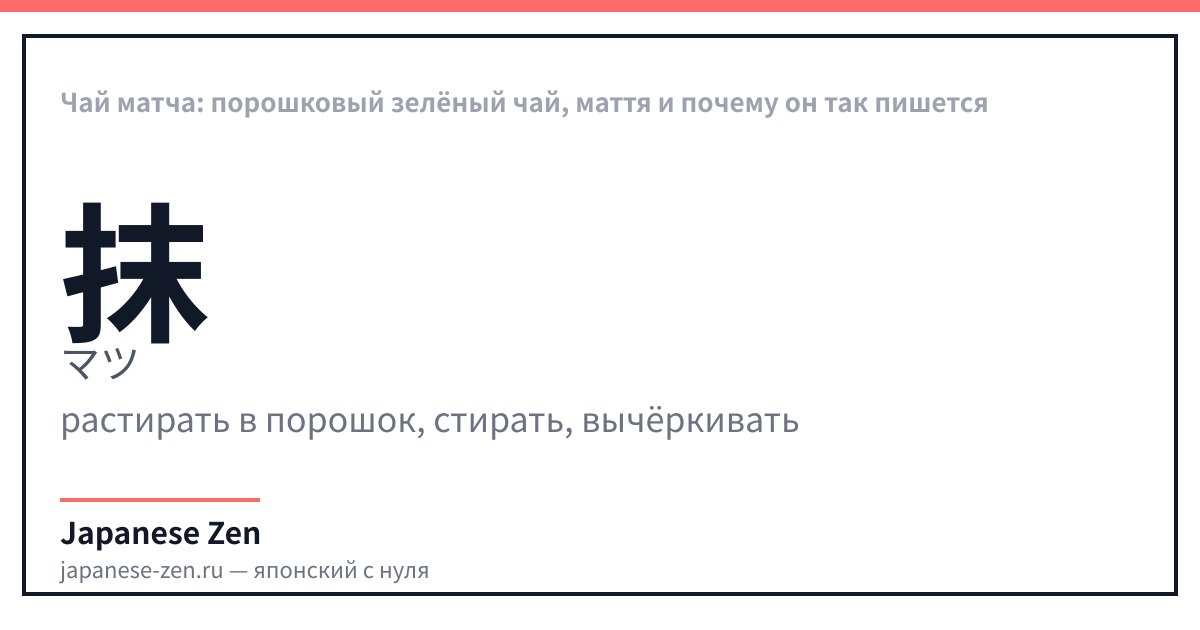
抹 — значение: grind into powder, erase, cross out — онъёми: マツ — 8 штрих(ов). 抹 — 'grind into powder': this same character stands first in the word 抹茶 and indicates not the plant but the method of processing the leaf.
抹 has only one reading — matsu
抹 has no kun reading — only the on reading matsu (マツ). By itself, without a pair, the character almost never appears; it lives in combinations like 抹消 (masshō) 'erase, annul' and 一抹 (ichimatsu) 'a faint trace' of something, literally 'one brushstroke.'
茶 has two readings — cha and sa
The second character, 茶, is commonly read as cha (ちゃ) — as in 茶色 (chairo) 'brown color' or 喫茶店 (kissaten) 'coffee shop' — and in older, literary words as sa (さ), for example in 茶道 (sadō) 'the way of tea.' In 抹茶 itself, cha is used.
| Japanese | Reading | Translation |
|---|---|---|
| 抹茶 | matcha · matcha | Matcha, powdered tea |
| 茶筅 | chasen · chasen | Bamboo whisk for whisking matcha |
| 薄茶 | usucha · usucha | Thin matcha, whisked with foam |
| 濃茶 | koicha · koicha | Thick matcha, kneaded without foam |
| 碾茶 | tencha · tencha | The leaf from which matcha is ground |
| 宇治 | Uji · Uji | City in Kyoto Prefecture, birthplace of shaded tea |
Write 抹 along the guides — the 'grind into powder' character from the word 抹茶.
FAQ
- What kind of tea is matcha?
- Matcha is a powdered green tea made from tencha leaves, which are grown in the shade, dried without rolling, and ground with stone mills. Unlike regular tea, matcha is not brewed but whisked directly in water and drunk together with the entire leaf.
- How does matcha differ from regular green tea?
- The bush for matcha is shaded from the sun before harvesting, which causes the leaf to accumulate more theanine and fewer bitter catechins; the leaf is dried whole and ground into powder rather than rolled, as for regular tea. Moreover, matcha is not brewed or strained: the entire ground leaf is consumed.
- Why is matcha spelled with 'tch'?
- In Japanese, 抹茶 is written まっちゃ, and the small っ doubles the consonant that follows. Hepburn romanization writes a doubled 'ch' as 'tch', so matcha is the standard romanization of the word; the 't' marks the short pause before 'cha'.
- How does usucha differ from koicha?
- Usucha, 'thin tea,' is whisked with a large amount of water until a light foam forms — this is the usual way of serving. Koicha, 'thick tea,' is prepared with almost no foam: less water is used, more powder, and the matcha itself for koicha is chosen to be less astringent and more expensive.
- Is it true that there is 'ceremonial' and 'culinary' matcha?
- This division is common in the West for buyers, but in Japan the classification is different: true matcha is ground tencha, and anything that doesn't correspond to it is called food-grade or industrial matcha. Judging by the comparison of tencha and 'matcha' volumes, almost 70% of the powder sold under this name is just that — cheaper.
- What does the city of Uji have to do with it?
- In Uji, in Kyoto Prefecture, no later than the 16th century, the shading of tea bushes was developed — the growing method that creates the taste and color of true matcha. Today other prefectures lead in production volume, but Kyoto tea farms still most often receive top awards at Japanese competitions.
Sources
Updated: 2026-09-15