The Siege of Osaka — What Happened and How It Ended
The Siege of Osaka was two military campaigns in 1614–1615 by which Tokugawa Ieyasu crushed the Toyotomi house. In winter the sides concluded a truce and filled in the moat; without it the castle could not withstand the summer assault — Hideyori and his mother Yodo-dono died, and Tokugawa power remained unchallenged for centuries to come.
One "siege" in the name is actually two campaigns separated by a winter truce: confusing 1614 with 1615 means missing the outcome. The formal pretext was a dispute over the inscription on a temple bell, but in essence Ieyasu was removing the last power of the Toyotomi line. Let's look at how both campaigns are connected to the moat of Osaka Castle.
What Happened: The Siege of Osaka
The Siege of Osaka (大坂の陣) was two military campaigns, the winter one of 1614 and the summer one of 1615, by which Tokugawa Ieyasu destroyed the Toyotomi house — the last force capable of challenging his power after the victory at Sekigahara. Hideyori, Hideyoshi's son, gathered about 90,000 ronin in the castle, but in winter the sides fought to a draw and concluded a truce, filling in the moat around Osaka. Without the moat the fortress could not withstand a second assault in the summer of 1615: Hideyori and his mother Yodo-dono died, and the castle burned.
- 1598–1603: Hideyoshi dies, and after the victory at Sekigahara Ieyasu receives the title of shogun.
- 1614: a dispute over the inscription on the bell of Hokōji Temple becomes the pretext for war — the winter siege of Osaka begins.
- Early 1615: under the truce the outer moat of the castle is filled in, and the inner one as well.
- Summer 1615, Tennōji: Sanada Yukimura dies in battle; Osaka Castle falls and burns.
- Hideyori and Yodo-dono take their own lives — the Toyotomi house ceases to exist.
Why It Came to This
After Sekigahara the Toyotomi house retained vast domains, and Hideyori remained the legitimate heir of the country's former ruler. The aging Ieyasu wanted to secure his family's future in his lifetime: the pretext was the inscription on the bell of Hokōji Temple — it was seen as a hidden ill wish toward Ieyasu, and that was enough for war.
Name and Kanji: 大坂の陣
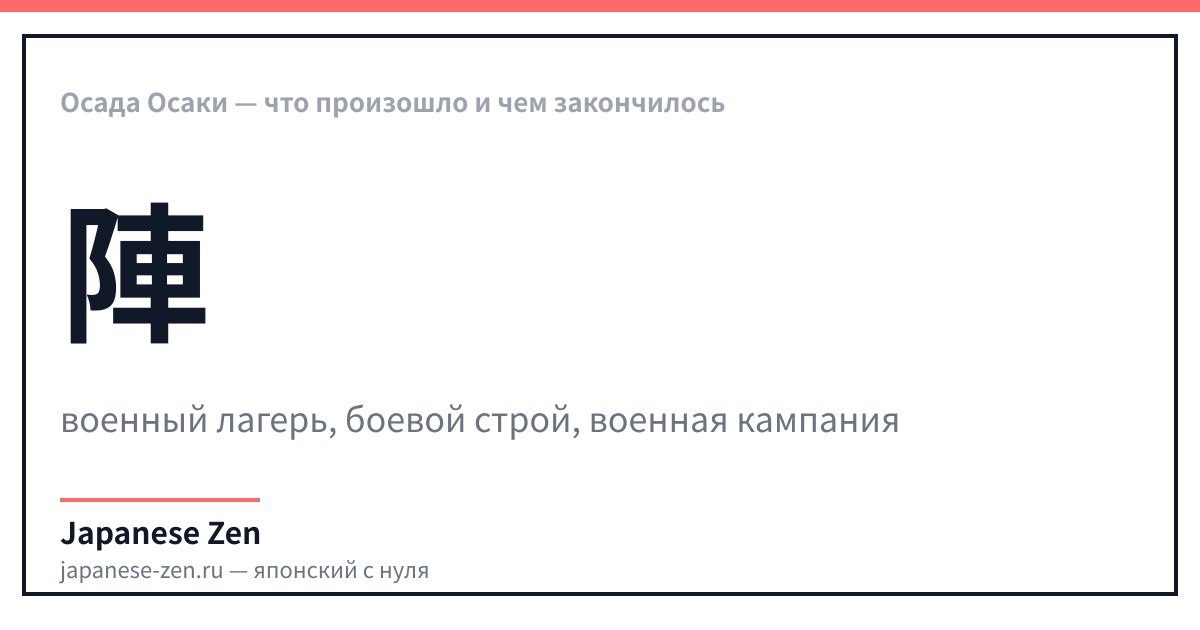
The name 大坂の陣 is read おおさかのじん (Ōsaka no Jin): 大坂 is the old spelling of Osaka, の is the possessive particle, 陣 means "military camp, campaign." The modern 大阪 with the character 阪 became established in the Meiji era. This is usually explained by a bad omen: parts of the old character 坂 were read as "a samurai will rise." The name of the battle kept the old character.
陣 — значение: military camp, battle formation, military campaign — онъёми: ジン — 10 штрих(ов). 陣 — "military camp, battle formation, campaign": 10 strokes, the key meaning is right in the name of the event.
| Japanese | Reading | Translation |
|---|---|---|
| 大坂の陣 | Ōsaka no Jin · Ōsaka no Jin | The common name for both siege campaigns |
| 豊臣秀頼 | Toyotomi Hideyori · Toyotomi Hideyori | Hideyoshi's son, the last head of the Toyotomi house |
| 大御所 | Ōgosho · Ōgosho | An honorary title for a retired shogun — this is what Ieyasu was called |
| 浪人 | rōnin · rōnin | A samurai without a lord — about 90,000 of them gathered on the Toyotomi side |
What the Japanese Call It
The general 大坂の陣 unites both campaigns, but individually they are called differently: the winter one is 大坂冬の陣 (Ōsaka Fuyu no Jin), the summer one is 大坂夏の陣 (Ōsaka Natsu no Jin), with the same kanji for "winter" and "summer" in front. Confusing these two campaigns is the most common mistake.
Listen and repeat the name of the campaign and the military terms.
The Siege of Osaka in Games and on Screen
- Samurai Warriors — the Siege of Osaka concludes the story of almost all the heroes of the series; the spin-off Spirit of Sanada is entirely about the defense of Osaka by the Sanada clan.
- Sengoku Basara 4: Sumeragi — the expansion brings Sanada Yukimura's storyline to the Siege of Osaka, with Hideyori and Yodo-dono as figures of the defense.
- "Sanada Maru" (真田丸, 2016) — an NHK taiga drama about Sanada Yukimura; the climax is the defense of Osaka and the construction of the fortification "Sanada-maru."
What Was Distorted for the Sake of the Plot
The legend that Yukimura at Tennōji nearly killed Ieyasu with a personal blow is a beautiful tale, not a confirmed fact. Another carelessness of the plots is to show the siege as a single assault, without the story of the moat, although it was precisely that which decided the outcome.
FAQ
- What is the Siege of Osaka?
- The Siege of Osaka (大坂の陣) was two campaigns in 1614–1615 by which Ieyasu crushed the Toyotomi house, the last force against his power after Sekigahara. The winter siege ended with a truce and the filling in of the moat, the summer one with the fall of the castle and the death of Hideyori.
- When did the Siege of Osaka take place?
- There were two campaigns: the winter one from the end of 1614, the summer one in 1615. Between them was a truce, during which by agreement the moat around Osaka Castle was filled in. Both campaigns together are called the "Siege of Osaka."
- Who took part in the Siege of Osaka?
- On one side was Ieyasu with an army of many thousands, on the other Hideyori, defending Osaka with about 90,000 ronin, including Sanada Yukimura. His mother Yodo-dono remained in the castle during both campaigns.
- How did the Siege of Osaka end?
- In the summer of 1615 Osaka Castle fell and burned, and Hideyori and his mother Yodo-dono took their own lives. The Toyotomi house ceased to exist, and Tokugawa power remained unchallenged until the Meiji era of 1868.
- What is the Siege of Osaka called in Japanese?
- In Japanese it is 大坂の陣 (おおさかのじん, Ōsaka no Jin), where 陣 means "military camp, campaign." The winter campaign is separately called 大坂冬の陣, the summer one 大坂夏の陣: the same kanji with the addition of "winter" or "summer."
- Which games and series show the Siege of Osaka?
- The Siege of Osaka is shown in the games Samurai Warriors and Sengoku Basara 4: Sumeragi, as well as in the NHK taiga drama "Sanada Maru" (2016). A common device is the episode where Sanada Yukimura nearly kills Ieyasu, although this is only a legend.
Sources
Updated: 2026-09-11