Sanada Yukimura — Who He Was and What He Is Famous For
Sanada Yukimura is the posthumous literary name of the military commander Sanada Nobushige (真田信繁, 1567–1615), a defender of the Toyotomi house during the defense of Osaka. In 1600, he and his father twice repelled the Tokugawa forces at Ueda Castle, and in 1615 he died in an attack on Ieyasu's headquarters at Tennoji. The title "best warrior in Japan" was given to him posthumously.
In his lifetime he was called Sanada Nobushige — no document of the era calls him Yukimura; that name stuck later, in the tales of the following century. His military reputation is real: twice he held a remote castle against an army several times larger than his own. Below is what the chronicles confirm and what was added after Osaka.
Who Sanada Yukimura Really Was
Sanada Yukimura is the name under which the military commander Sanada Nobushige (真田信繁, 1567–1615), second son of the daimyo Sanada Masayuki, entered history. In 1600, father and son shut themselves in Ueda Castle and twice repelled attacks by the army of Tokugawa Hidetada, which vastly outnumbered them — and prevented it from reaching Sekigahara in time. After the defeat of the Western coalition, Nobushige spent fourteen years in exile on Mount Koya, until in 1614 Toyotomi Hideyori called on him to defend Osaka Castle.
| Year | Event |
|---|---|
| 1567 | Born as the second son of the daimyo Sanada Masayuki in the Ueda domain, Shinano Province |
| 1600 | Ueda Castle twice repels the assault of Tokugawa Hidetada; his brother Nobuyuki fights on the Tokugawa side |
| 1600–1614 | Exile on Mount Koya (Kudoyama) after the defeat of the Western coalition |
| 1614 | Winter Siege of Osaka: builds Sanada-maru, repels attacks on the castle |
| 1615 | Summer Siege of Osaka: dies in an attack on Ieyasu's headquarters at Tennoji |
How His Clan Split
While Nobushige and his father held Ueda, his elder brother Sanada Nobuyuki fought on the Tokugawa side — he was married to Komatsuhime, daughter of Honda Tadakatsu and adopted daughter of Ieyasu himself. This division saved the clan: Nobuyuki kept his domains, while the father and younger son were sent not to execution but into exile in Kudoyama.
Name and Kanji: 真田幸村
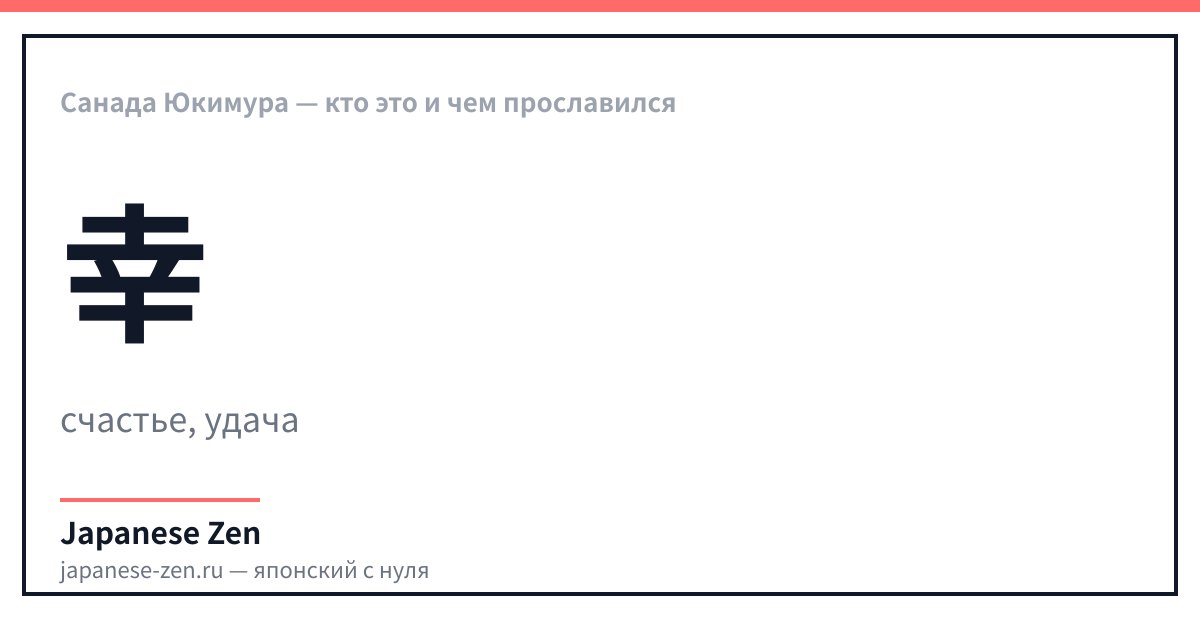
真田幸村 is read さなだゆきむら, but in the letters of Nobushige himself the name 幸村 does not appear even once — historians consider this proven. 真田 (Sanada) is the clan name from the domain in Shinano, 信繁 (Nobushige) is the real personal name: 信 "faith", 繁 "to flourish". The name 幸村 with the kanji 幸 ("happiness") appeared in tales decades after his death and displaced the real name in culture.
幸 — значение: happiness, good fortune — онъёми: コウ — кунъёми: さいわ.い、さち、しあわ.せ — 8 штрих(ов). 幸 — "happiness, good fortune": 8 strokes. This character was not part of Nobushige's real name — it comes from the legendary name "Yukimura". The same kanji appears in 幸せ (shiawase, "happiness") and 幸運 (kōun, "good luck").
Why Fiction Displaced the Real Name
"Yukimura" first appears in the tale "Namba senki" (1672) about the siege of Osaka. From there the name spread through military chronicles and even entered the official "Tokugawa jikki" — that is how the error became established. The exception is the NHK historical drama "Sanada-maru" (2016), where the hero was deliberately called by his real name.
| Japanese | Reading | Translation |
|---|---|---|
| 真田信繁 | Sanada Nobushige · Sanada Nobushige | The real name of the page's hero |
| 真田幸村 | Sanada Yukimura · Sanada Yukimura | The legendary name that took hold in culture |
| 真田丸 | Sanada-maru · Sanada-maru | Fortification at Osaka Castle, 1614 |
| 大坂の陣 | Ōsaka no Jin · Ōsaka no Jin | The Siege of Osaka — Nobushige's last war |
| 日本一の兵 | Nihon-ichi no tsuwamono · Nihon-ichi no tsuwamono | "Best warrior in Japan" — a posthumous nickname |
| 城 | shiro · shiro | Castle |
Listen to both of his names — the real one and the legendary one.
What in His Fame Is Invented
The most persistent invention is the name "Yukimura" itself: he never signed with it. The second is the "Ten Braves of Sanada" (真田十勇士), a band of ninja such as Sarutobi Sasuke from adventure tales of the late Edo and early 20th century: none of them existed. The third is the reputation of "best warrior in Japan" (日本一の兵): according to legend, his enemy Shimazu Tadatsune said this of him after Tennoji — an assessment that entered the chronicles only posthumously. Culture takes the legendary version wholesale: Yukimura is one of the two main characters of Sengoku Basara, playable in Samurai Warriors and in the standalone game Samurai Warriors: Spirit of Sanada (2016), released in the year of the NHK drama "Sanada-maru".
- Fact: the two-time defense of Ueda in 1600, exile on Mount Koya, Sanada-maru, and death at Tennoji in 1615 — confirmed by chronicles of the era.
- Fiction: the name "Yukimura" — a later literary nickname; in life he signed as "Nobushige".
- Fiction: the "Ten Braves of Sanada" — a band of ninja from 19th–20th century tales, all members invented.
FAQ
- Who is Sanada Yukimura?
- Sanada Yukimura is the posthumous literary name of the military commander Sanada Nobushige (1567–1615), a defender of the Toyotomi house during the defense of Osaka. He himself never signed with this name.
- What is Sanada Yukimura famous for?
- For the defense of Ueda Castle in 1600, which delayed the army of Tokugawa Hidetada until the end of Sekigahara, and for the defense of Osaka Castle in 1614–1615, where he died in the final attack on Ieyasu's headquarters.
- How is the name Sanada Yukimura written in Japanese?
- 真田幸村, read さなだゆきむら. But in documents of the era there is no such name: the real name is 真田信繁 (Sanada Nobushige), and "Yukimura" is a literary name from later tales.
- Is Sanada Yukimura a real person or a legend?
- A real person named Sanada Nobushige with a well-documented military career. Legends grew around the name "Yukimura", the band of the "Ten Braves", and the posthumous title "best warrior in Japan".
- In which games and anime does Sanada Yukimura appear?
- Sanada Yukimura is one of the two main characters of Sengoku Basara: both in the game and in the anime adaptation Samurai Kings (2009). He is playable in Samurai Warriors and in the standalone game Spirit of Sanada (2016), and in 2016 the NHK historical drama "Sanada-maru" was made about him.
- When did Sanada Yukimura live?
- From 1567 to 1615: he fought in his youth, spent fourteen years in exile on Mount Koya, and died in 1615 during the defense of Osaka Castle — in the last major war of the Sengoku period.
Sources
Updated: 2026-09-11