Udon Noodles: What They're Made Of and How They Differ from Soba and Ramen
Udon is a thick wheat noodle made from flour, water, and salt, without the alkaline kansui that ramen uses. It is served hot in a dashi broth with soy sauce or cold with a separate dipping sauce. The most famous variety is sanuki udon from Kagawa Prefecture, which has long had its own flour, salt, and soy sauce. What sets udon apart from soba is the flour: buckwheat, not wheat.
Udon, soba, and ramen sit in neighboring bowls at the same noodle shop, but they are made from different doughs and are listed differently on the menu. Let's look at what udon is made from, how its dough differs from ramen's, what the Sanuki region of Shikoku has to do with it, and why the legend of a monk who brought the noodles from China should not be taken as historical fact.
Thick Noodles Without Alkaline Water: What Udon Is Made From
Udon dough is kneaded from wheat flour, water, and salt — without the alkaline kansui water that is added to ramen. Because of this, udon comes out light-colored and softer to the bite, rather than springy and yellowish like ramen. Udon is served both hot, in a dashi-based broth with soy sauce, and cold, with a separate cup of dipping sauce.
Kamaage and Zaru: Hot and Cold Serving Styles
Kamaage udon is served straight from the pot, along with some of the hot water the noodles were boiled in — they are dipped into a separate sauce without being rinsed in cold water. Zaru udon is the opposite: the boiled noodles are chilled, placed on a bamboo tray, and also eaten with a dipping sauce, usually in hot weather.
Udon, Soba, and Ramen in One Table
| Noodle | Dough Ingredients | Thickness and Color | Typical Broth |
|---|---|---|---|
| Udon | Wheat flour, water, salt | Thick, light-colored, no kansui | Dashi with soy sauce, usually light |
| Soba | Buckwheat flour, often with added wheat flour | Thinner than udon, grayish-brown | Dashi with soy sauce, sharper flavor |
| Ramen | Wheat flour with alkaline kansui water | Springy, yellow | Pork, chicken, or fish with soy sauce, miso, or salt |
Kishimen: Udon's Flat Relative
Kishimen is not a separate type of noodle but a variety of udon: wide and flat, at least 4.5 millimeters wide and up to 2 millimeters thick, as defined by Japanese standards. It is the signature noodle of Nagoya, and under the rules of local producers, only kishimen made in Aichi Prefecture can be called true Nagoya kishimen.
Kagawa and Sanuki Udon: Why the Region Became Famous for Noodles
Kagawa, the former Sanuki Province, has long been known for its good wheat flour, salt, soy sauce, and small dried fish (iriko) for broth — in other words, all the ingredients for cheap and accessible udon. An old screen from the Genroku period already shows several udon shops. But Sanuki became known as Japan's udon capital relatively recently: it began to be promoted as a local specialty around the 1960s. By 2009, Kagawa was using more flour for udon than any other prefecture in Japan — more than twice as much as the next region.
The Legend of the Monk Who Brought Noodles from China
One popular legend says that udon was brought to Shikoku by the monk Kukai, who returned from China in the Heian period. The origin of udon in Japan has no single accepted version: Japanese sources list several competing theories about who brought or invented these noodles and when, and none is considered proven. The story of Kukai is a beautiful legend, not a confirmed fact, and should be treated as such.
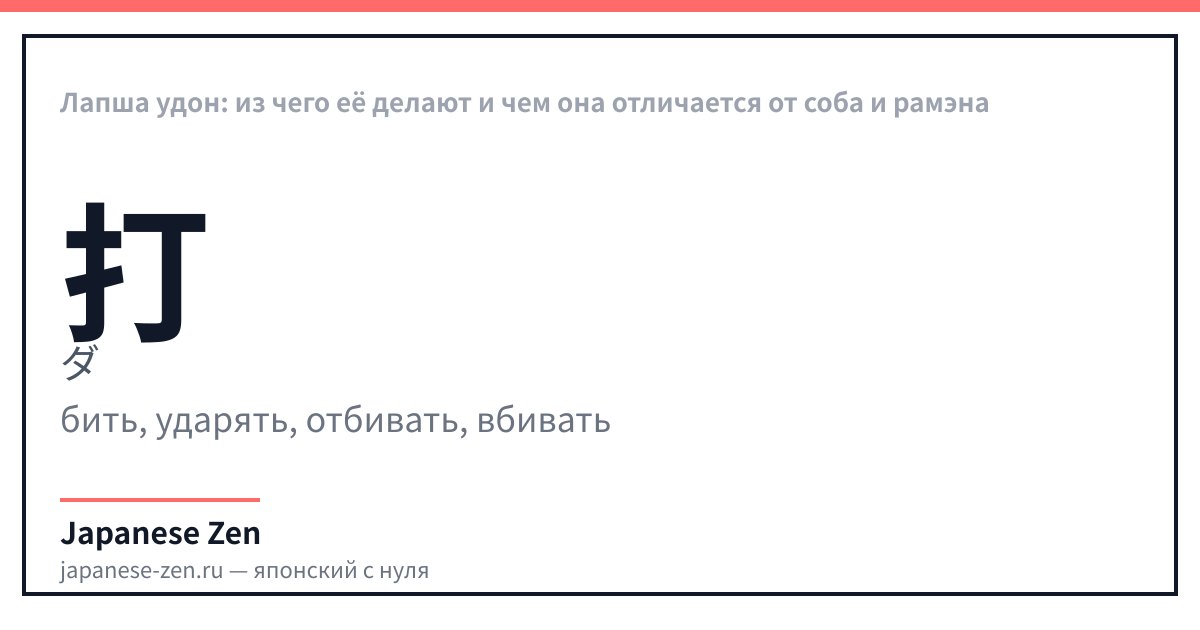
The Kanji 打: How Noodles Are 'Struck' by Hand
打 — значение: to hit, to strike, to beat, to pound — онъёми: ダ、ダース — кунъёми: う.つ、う.ち-、ぶ.つ — 5 штрих(ов). 打 — 'to hit, to strike': in the word 手打ち ('handmade'), it refers to both udon and soba made without a machine.
手打ち (teuchi) is made up of 手 'hand' and 打ち, the form of the verb 打つ (utsu) — 'to hit, to strike.' It refers to noodles that are kneaded, beaten, and cut by hand rather than by machine, and the word applies equally to udon and soba. The on'yomi of 打 is ダ (da), and the kun'yomi is う.つ (utsu).
| Japanese | Reading | Translation |
|---|---|---|
| うどん | udon · udon | Udon |
| 手打ち | teuchi · teuchi | Handmade, without a machine |
| 打つ | utsu · utsu | To hit, to strike |
| 讃岐うどん | sanuki udon · sanuki udon | Noodles from Kagawa, the most famous variety of udon |
| きしめん | kishimen · kishimen | Flat, wide noodles, a variety of udon from Nagoya |
| だし | dashi · dashi | Broth made from seaweed and dried fish |
Trace the character 打 — the 'strike' kanji found in the word for 'handmade.'
Why うどん Is Written in Kana, Not Kanji
The kanji spelling 饂飩 exists but is almost never used: the character 饂 is not among the kanji for everyday writing and was created in Japan specifically for this word. According to one theory, the sound 'udon' itself is the result of a long phonetic drift. The Chinese dish 混飩 (something like a wonton) was written as 餫飩, then 温飩, and finally 饂飩, and the pronunciation changed along with the spelling. Because of this confusion, the simple hiragana spelling has long been established in everyday use.
FAQ
- What is udon made from?
- Udon dough is kneaded from wheat flour, water, and salt, without the alkaline kansui — so the noodles come out light-colored and soft to the bite, rather than springy and yellow like ramen. The thick strips of dough are cut and boiled, then eaten either in hot broth or chilled with a separate dipping sauce in hot weather.
- How does udon differ from ramen?
- The main difference is in the dough: udon is mixed with water and salt, while ramen uses alkaline kansui water, which makes the noodles yellow and springy. The broth is different too: udon usually has a light dashi with soy sauce, while ramen has a richer broth made from pork bones, chicken, or fish.
- How does udon differ from soba?
- Udon is made from wheat flour, while soba is made from buckwheat, often with added wheat flour to bind the dough. As a result, udon is thick and light-colored, while soba is thinner and noticeably darker, with a characteristic nutty flavor that wheat noodles do not have.
- Is it true that the monk Kukai brought udon to Japan?
- This is a beautiful legend, not an established historical fact. The origin of udon in Japan has no single version: sources list several competing theories about who brought or invented these noodles and when. The Kukai legend is only one of them, and the least proven.
- Why is sanuki udon from Kagawa so famous?
- The former Sanuki Province, now Kagawa Prefecture, has long had its own good flour, salt, and soy sauce — that is, all the ingredients for udon close at hand. Nationwide fame came later, around the 1960s, when local noodles began to be promoted as a signature dish, and today Kagawa uses more flour for udon than any other region in Japan.
- How is 'udon' written in kanji?
- The kanji 饂飩 exist, but they are almost never seen in ordinary texts — the character 饂 is not among the everyday kanji and was created in Japan specifically for this word. That is why うどん is almost always written in hiragana, without kanji at all.
Sources
Updated: 2026-09-15