Onigiri: The Rice Triangle, Nori, and the Debate Over the Word "Omusubi"
Onigiri is a ball of rice shaped by hand, usually with a filling inside and a strip of nori on the outside. The shape varies: triangle, ball, or barrel — it depends on the region and the eater's habit. The main difference from sushi is that the rice for onigiri is not seasoned with vinegar; it is simply cooked rice pressed by hand. The dish has a second name, "omusubi," and dictionaries consider both words equivalent.
A bowl of rice has no name of its own, but a ball made from that same bowl has two: "onigiri" and "omusubi." The debate over the difference between them has been going on in Japan for decades, and dictionaries answer it less definitively than it might seem at first glance. Let's look at where the word came from, what the kanji 握 — "to grasp in the fist" — has to do with it, and why scholars long ago stopped calling a two-thousand-year-old rice find an onigiri.
Rice Without Vinegar: How Onigiri Differs from Sushi
Onigiri is made from plain cooked rice, pressed by hand into a ball, and often has a filling hidden inside — a salted plum umeboshi, a piece of salmon, or kombu seaweed. On the outside it is most often wrapped in a strip of nori. It is edible even without a filling: onigiri made from rice alone with salt is called "shiomusubi."
Why It Is Not Sushi
The difference from sushi lies in one step of preparation: the rice for sushi is seasoned with rice vinegar before shaping, while the rice for onigiri remains plain cooked rice without additives. The shape matters little — round nigiri sushi and ball-shaped onigiri are easy to confuse by sight, but not by taste.
- Triangle — the most common shape, especially in stores; according to one theory, it spread from the Kanto region because the peak of such a ball was associated with a guardian spirit.
- Ball — common in Kyushu and throughout the country; by hand it is the hardest to shape evenly.
- Barrel — historically the standard shape for the Kansai region, convenient for bento.
- Round and flattened — more often found in the northeast of the country; this shape is easier to grill without risking the ball rolling away.
Onigiri and Omusubi — One Word or Two Different Ones
Most Japanese explanatory dictionaries see no difference: they call "omusubi" and "握り飯" (nigirimeshi) simply other names for the same rice ball. The history of the word is described as follows: first there was 握飯 (nigiri-ii), then it became 握り飯 (nigirimeshi), and from it, as a softer feminine word, "onigiri" grew. "Omusubi," meanwhile, began as a children's word and a word of court ladies.
What a Survey Showed: 89% vs. 10%
According to a 2013 survey, 89% of Japanese people nationwide said "onigiri," while only 10% said "omusubi." The gap is not uniform across regions: in Kinki and in Kyushu with Okinawa almost everyone says "onigiri," while in Yamaguchi Prefecture in the west of the country, 45% of respondents said "omusubi" — almost as many as "onigiri." One Japanese linguist suggested that "omusubi" sounds a bit more ceremonial and softer — just as in sushi there is "nigiri" but no "musubi."
From a Disputed Find in Ishikawa to Convenience Store Film
In 1987, at the Sugitani Chonobatake excavation on the Noto Peninsula in Ishikawa Prefecture, a charred ball of rice about two thousand years old was found, with traces of human fingers. The discovery was immediately called the "oldest onigiri," but further study showed that the rice was more likely first steamed and then baked — that is, it is closer to the rice wrap temaki than to an ordinary onigiri. Today, scholars call the find differently: "a charred rice ball in the shape of temaki."
From Palace Food to Travel Food
The earliest written mention of a rice ball is a record from 721 in the Hitachi Fudoki, where it is called "握飯" (nigiri-ii). The direct ancestor of today's onigiri is considered to be "tonjiki" — a large oval ball of glutinous rice that was served to guests at court during the Heian period. Later, onigiri became common food for travel and war: rice provides quick energy, and the added umeboshi plum also salts the food, helping to endure the heat. Exactly when onigiri began to be wrapped in nori is debated by historians, but certainly after Japan established mass production of pressed seaweed sheets.
The current look of store-bought onigiri depends on the packaging. The film that keeps nori from getting damp and allows you to wrap the sheet just before eating was invented in the late 1970s by a prepared food shop in Nagano Prefecture. Then convenience store chains refined it: Seven-Eleven released its first versions in the early 1980s, and the familiar method with a central strip in 1986. The idea has not changed since: unwrap in a few motions and immediately feel the crunch of fresh seaweed.
The Character 握: Rice Grasped in the Fist
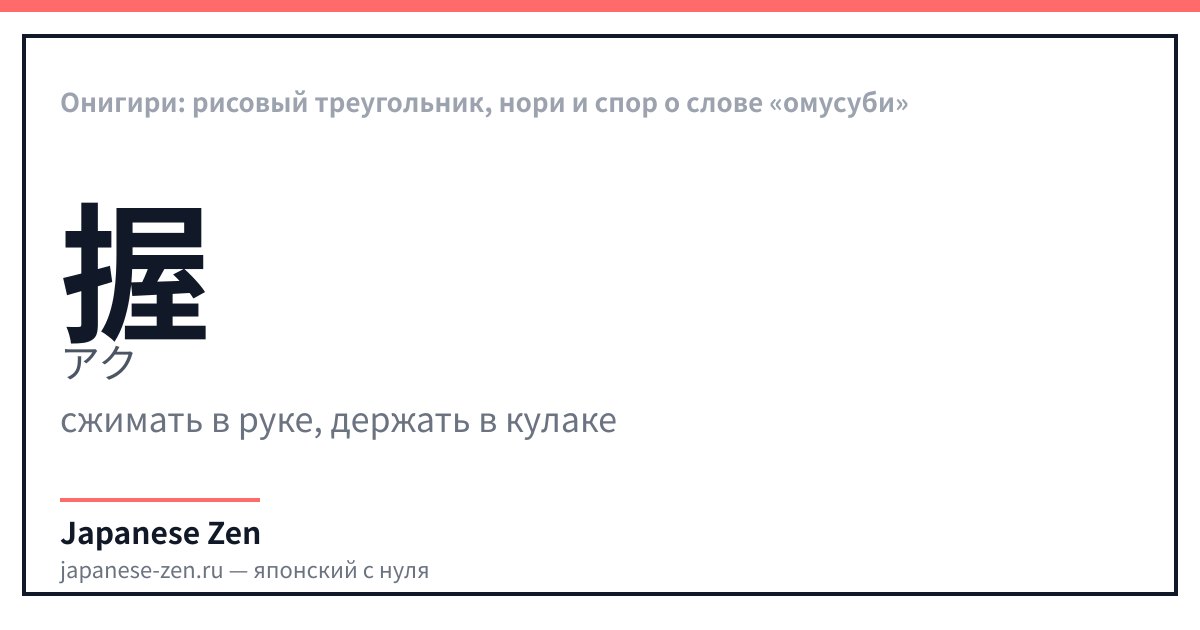
握 — значение: to grasp in the hand, to hold in the fist — онъёми: アク — кунъёми: にぎ.る — 12 штрих(ов). 握 — "to grasp in the hand": the very motion from which onigiri got its name. The same character is in 握り寿司, nigiri sushi, which is also shaped by hand.
The word おにぎり is made up of the polite prefix お and a noun formed from the verb 握る (nigiru) — "to grasp in the hand." The kun reading of the character is にぎ.る (nigiru), the on reading is アク (aku); the latter is heard, for example, in the word 握手 (akushu) — "handshake," though the meaning there is already different.
| Japanese | Reading | Translation |
|---|---|---|
| おにぎり | onigiri · onigiri | Onigiri |
| おむすび | omusubi · omusubi | Another name for onigiri, more ceremonial |
| 握る | nigiru · nigiru | To grasp in the hand |
| 握り | nigiri · nigiri | Nigiri — rice shaped by hand, including in sushi |
| 握手 | akushu · akushu | Handshake |
| 塩むすび | shio musubi · shio musubi | Onigiri without filling, only with salt |
Write 握 along the guides — the character "to grasp in the hand," from which onigiri got its name.
The Same Gesture — in Rice and in Greeting
握る describes a physical action — to close the fingers around something, whether it be rice, another person's palm in a handshake, or a steering wheel. That is why the character 握 is equally appropriate in a culinary and in a most ordinary everyday context: Japanese does not make a difference here between "shaping an onigiri" and "gripping something tightly."
FAQ
- What is onigiri?
- Onigiri is everyday Japanese food: cooked rice without vinegar, pressed by hand into a dense ball and usually wrapped in nori seaweed, often with a filling like salted plum umeboshi or salmon. It is precisely the absence of vinegar in the rice that distinguishes onigiri from sushi. It is eaten as a snack, a lunch on the go, or part of a bento, and the shape — triangular, round, or barrel-shaped — depends on the region and habit.
- How does onigiri differ from sushi?
- The main difference is in the rice: for sushi it is seasoned with rice vinegar, while for onigiri plain cooked rice without additives is used. Visually, ball-shaped onigiri and nigiri sushi can be confused, but in taste and tradition they are different dishes with different purposes: sushi is a restaurant treat, onigiri is everyday food and travel food.
- What is the difference between onigiri and omusubi?
- Most Japanese dictionaries consider these words equivalent — both mean the same rice ball. The difference is more a matter of habit: nationwide, "onigiri" clearly predominates, while in certain regions and in children's speech and speech of court origin, "omusubi" was heard more often. One linguist even called "omusubi" the more ceremonial variant of the word.
- Is it true that onigiri was made as early as the Yayoi period?
- The 1987 find at an excavation in Ishikawa Prefecture was first called exactly that — the "oldest onigiri." But on closer study it turned out that the rice was most likely steamed and then baked, meaning the ball is closer to the rice wrap temaki than to today's onigiri. Today scholars call the find differently, and the interpretation remains disputed.
- What is the most popular onigiri filling?
- A ranking of favorite fillings compiled in 2014 for "Omusubi Day" was topped by salmon, followed by salted plum umeboshi and pollock roe mentaiko. Such fillings — simple, salty, or sour — were historically valued also because they keep longer, and the rice with them needs no additional seasoning.
- How is "onigiri" written in kanji?
- Usually おにぎり is written in hiragana, without kanji at all — the kanji spelling did not take root in everyday use. The word has a more official synonym with kanji — 握り飯 (nigirimeshi), "rice grasped in the hand": it is believed that the modern "onigiri" originated precisely from it. The root of both words is the verb 握る (nigiru), "to grasp in the hand."
Sources
Updated: 2026-09-15