Sushi in Japanese: 寿司 — what the kanji mean and where the word comes from
Sushi in Japanese is 寿司 (すし, sushi). The kanji are ateji: 寿 'long life' and 司 'to govern' were chosen for the sounds su and shi, not for their meaning. Real sushi means vinegared rice, so nigiri, maki and rolls are sushi, while sashimi, served without rice, is not.
The kanji 寿司 say nothing about fish or rice, and the word itself comes from an old adjective meaning "sour". Below: what each character means, how すし is written in Latin letters, and which dishes at the counter count as sushi.
The duo 寿司: longevity sounds like "su"
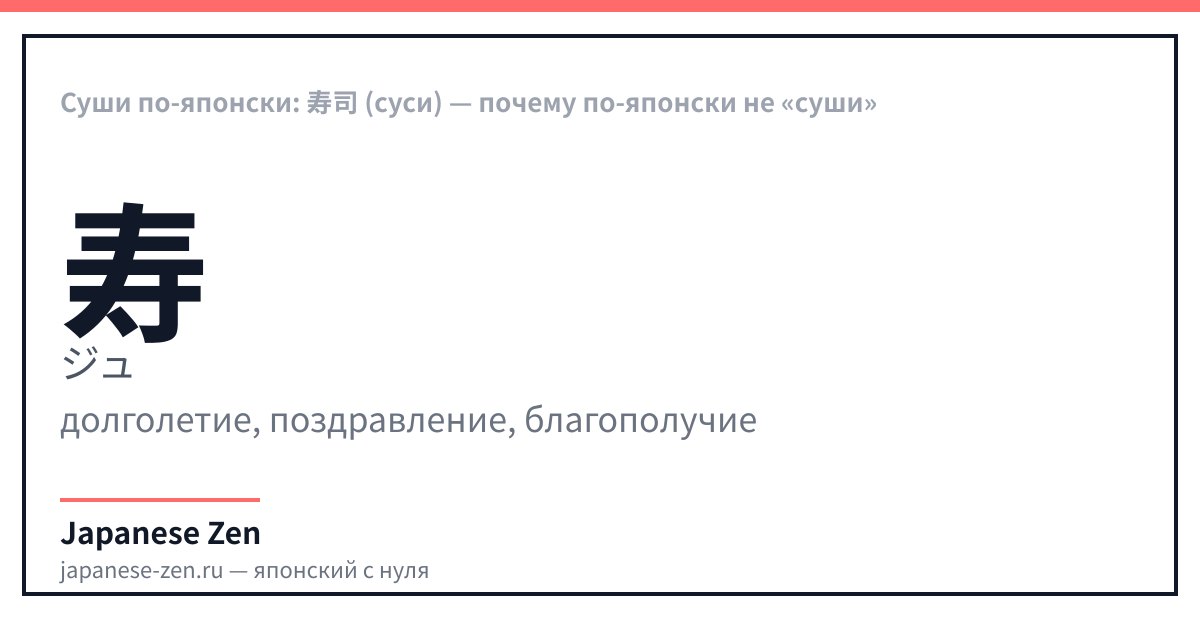
寿 — значение: longevity, congratulation, well-being — онъёми: ジュ、ス、シュウ — кунъёми: ことぶき、ことぶ.く、ことほ.ぐ — 7 штрих(ов). 7 strokes. Click "Show stroke order" — the strokes will appear as if written by hand.
How ateji replaced meaning with sound
On its own, 寿 is read ことぶき (kotobuki) and means "longevity, congratulation" — this character is given at New Year and at weddings. In the word 寿司 it loses its original meaning and works simply as a sign for the syllable "su": the combination 寿司 is ateji, kanji chosen for their sound, not their meaning. The second character 司 usually means "to administer, to manage," and here it too is responsible only for the syllable "shi."
Sushi and -zushi: the words at the sushi counter
| Japanese | Reading | Translation |
|---|---|---|
| 寿司 | sushi · sushi | Sushi (general word) (Hepburn: sushi, Kunrei: susi; in compounds it becomes -zushi) |
| 握り | nigiri · nigiri | Nigiri sushi, rice with fish on top (the most recognizable kind, shaped by hand) |
| 巻き | maki · maki | Maki sushi, a roll in nori (rice and filling wrapped in seaweed) |
| 刺身 | sashimi · sashimi | Sashimi — raw fish without rice (without rice — formally not sushi) |
| 酢 | su · su | Rice vinegar (the very vinegar used to season sushi rice) |
| 回転寿司 | kaiten-zushi · kaiten-zushi | Conveyor belt sushi (plates travel along the belt right to your table) |
| 寿司屋 | sushiya · sushiya | Sushi bar, sushi restaurant |
The word comes from sour taste, not from fish
The name 寿司 describes neither fish nor rice — it goes back to the adjective 酸し, "sour." That is what the ancient dish narezushi was called: fish was fermented in rice for months, and it was the sour taste of fermentation that gave the whole dish its name. Today's vinegared rice is a distant descendant of that technology, and the beautiful kanji 寿司 were chosen later, when people wanted to write the word elegantly rather than literally. For rice itself at the table — 米, ご飯, and ライス — there is a separate page nearby.
Write 寿 yourself
Trace the character along the guides — the system will evaluate each stroke.
FAQ
- How do you write "sushi" in Japanese?
- 寿司, or すし in hiragana. Hepburn romanization writes し as shi, so the standard Latin spelling is sushi; the Kunrei system taught in Japanese schools writes it susi. In compound words the first sound is voiced: 回転寿司 kaiten-zushi, 巻き寿司 maki-zushi.
- Is it "sushi" or "susi"?
- Both spellings record the same Japanese sound: し is softer than the English "shee", somewhere between "shi" and "si". Hepburn romanization, used on menus and in dictionaries worldwide, writes it shi, hence sushi; the Kunrei system, taught in Japanese schools, writes si, hence susi. Outside Japan, sushi is the standard spelling.
- What do the kanji 寿司 mean?
- On its own, 寿 means "longevity," and 司 means "to administer." But in this word the characters are ateji: they were chosen for the sounds "su" and "shi," not for their meaning. A literal translation "longevity and administration" has nothing to do with what is on the plate.
- Is sashimi also sushi?
- No. 刺身 (sashimi) is raw fish without rice, a separate dish. Sushi necessarily includes vinegared rice, so nigiri, maki, and rolls are sushi, while sashimi is not.
- What is kaiten-zushi?
- 回転寿司 (kaiten-zushi) is a sushi bar with a conveyor belt on which plates travel past the tables. The format was invented in Osaka in 1958, and it made sushi much cheaper.
- How do you say "roll" in Japanese?
- The classic Japanese version is 巻き寿司 (maki-zushi), rice and filling wrapped in nori. Western-style rolls like the California roll are called in Japan by a separate borrowing, カリフォルニアロール, and are seen as a guest rather than an original dish.
Sources
Updated: 2026-09-09