Rice in Japanese: 米 (kome) and ご飯 (gohan) — what's the difference
Rice in Japanese is not one word but three. 米 (kome) is the grain, the raw rice that you buy in a bag and plant in a field. ご飯 (gohan) is cooked rice, and also any meal: the same word means breakfast and lunch. Rice on a plate in a European-style dish, like a cutlet or curry, gets a third word — ライス (raisu).
The same grain goes through three names in one meal: in the field it's 米, on the plate it's ご飯, and in a café on a tray it's ライス. The difference isn't about meaning but about where the rice ended up.
Six strokes for one grain
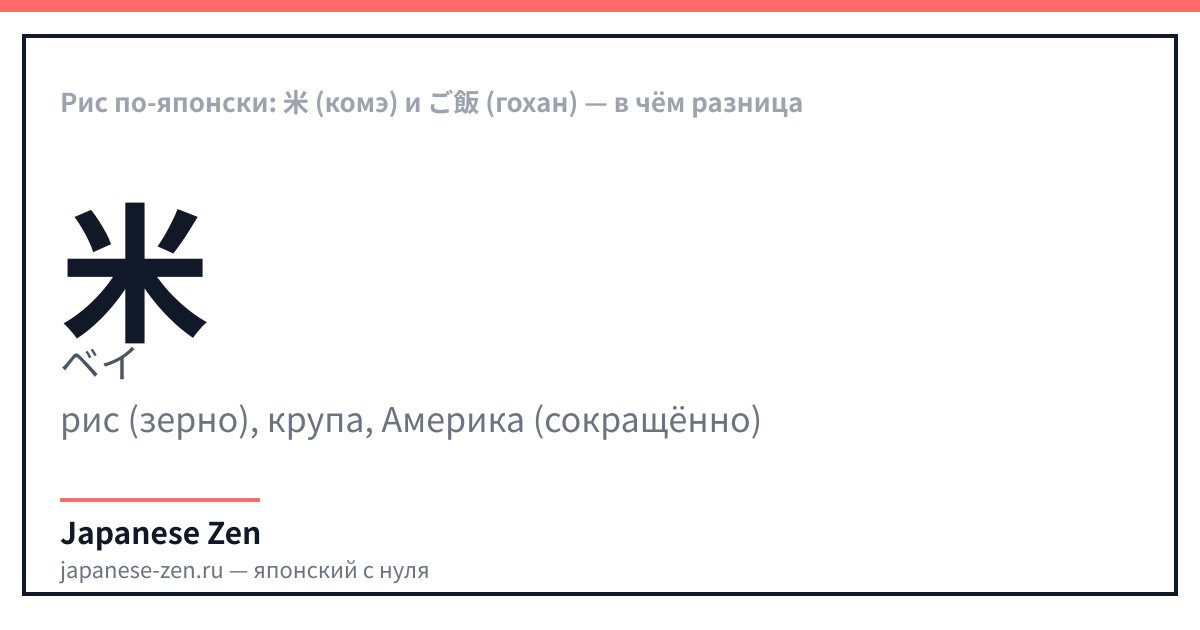
米 — значение: rice (grain), uncooked rice, America (abbreviation) — онъёми: ベイ、マイ、メエトル — кунъёми: こめ、よね — 6 штрих(ов). 6 strokes. Tap “Show stroke order” — the strokes will appear as if written by hand.
Two readings of one character
The character 米 is drawn with six strokes, and it's one of the old pictograms: the cross in the center resembles a stalk with grains, and the four dots on the sides are the grains themselves. The kun reading こめ (kome) is used when talking about rice as a product: 米を買う — “to buy rice.” The on readings べい and まい appear in compound words and are almost never heard on their own — but it's べい that gives the name 米国, which we'll look at below.
米, ご飯, and ライス — one grain, three words
| Japanese | Reading | Translation |
|---|---|---|
| 米 | kome · kome | Rice (grain, uncooked rice) (what you buy at the store and plant in a field) |
| ご飯 | gohan · gohan | Cooked rice; food in general (the same word is used for breakfast, lunch, and dinner) |
| ライス | raisu · raisu | Rice on a plate (European-style serving) (this is how rice is served with a cutlet or curry, not with sushi) |
| 白米 | hakumai · hakumai | White polished rice (ready to cook, without the bran) |
| 玄米 | genmai · genmai | Brown rice (with the bran, a little chewier) |
| おにぎり | onigiri · onigiri | Rice ball (from the verb 握る — to squeeze in the hand) |
| ご飯を食べる | gohan o taberu · gohan o taberu | To eat (literally “to eat rice”) |
Where did 米国 — “the land of rice” — come from?
米国 is the standard Japanese name for the USA, and rice has nothing to do with it. The word grew out of an old phonetic spelling of “America” — 亜米利加, where the character 米 simply represented the syllable “me.” Over time the long word was shortened to a single kanji, and 米 became an abbreviation for the country, not a hint at rice. The same rice, but seasoned with vinegar for the table, is a separate story about sushi, covered on another page.
Write 米 yourself
Trace the character along the guides — the system will score each stroke.
FAQ
- How do you say rice in Japanese?
- 米 (kome) if you mean rice as a grain, and ご飯 (gohan) if the rice is already cooked and served. On a menu of European-style dishes you'll see a third option — ライス (raisu).
- How is ご飯 different from 米?
- 米 is the raw grain, what you weigh at the store or plant in a field. ご飯 is already cooked rice, and also food in general: the word is used for breakfast, lunch, and dinner.
- Why is rice on menus often written in katakana as ライス?
- Katakana in Japanese is used for concepts that came from the West along with the dish. Rice served with a cutlet or curry follows the European model, so the word for it is the loanword ライス, not the native 米 or ご飯.
- Why does 米国 mean “America” and not “the land of rice”?
- The character 米 in this word is an abbreviation of an old phonetic spelling of “America,” 亜米利加, where the character simply represented the sound “me.” There is no meaning of “rice” in 米国; it's a pure coincidence of spelling.
- What is a rice ball called in Japanese?
- おにぎり (onigiri) — rice shaped by hand, often with a filling inside and a strip of nori outside. The word comes from the verb 握る — to squeeze in the hand.
- How is the character 米 read — “kome” or “bei”?
- Both are correct, just in different cases. The kun reading こめ (kome) is used when talking about rice on its own; the on reading べい appears in compound words like 米国 and is almost never used by itself.
Sources
Updated: 2026-09-09