Mom in Japanese: 母 (haha) and お母さん (okāsan) — what's the difference
Mom in Japanese is 母 (haha) when you're talking about your own mother to someone outside the family, and お母さん (okāsan) when you're addressing her directly or talking about someone else's mother. The difference is about politeness, not meaning. At home, the simple ママ (mama) is common — often the first word a Japanese child says.
A Japanese speaker will use two different words for mom in a single conversation: one for their own family in public, another to address her directly or to politely talk about someone else's mother.
Five strokes left from a nursing mother
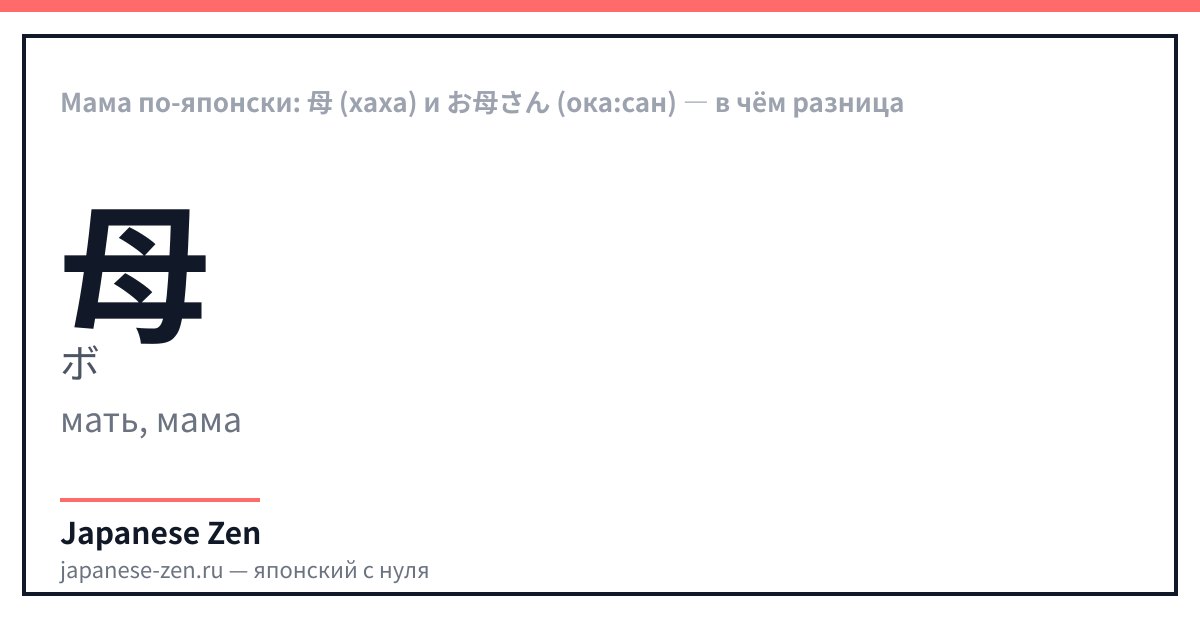
母 — значение: mother, mom — онъёми: ボ — кунъёми: はは、も — 5 штрих(ов). 5 strokes. Tap "Show stroke order" — the strokes will appear as if written by hand.
From a nursing mother's breast to five strokes
母 is a pictogram: in ancient times the character depicted a woman on her knees, and the two dots inside represented the breast of a nursing mother. Over millennia the picture wore down to five straight and curved strokes, but the character denoted motherhood, not just "woman," from the very beginning. The kun reading はは (haha) is how you refer to your mother when talking about your own family to outsiders; the on reading ぼ works in compound words like 母国 "motherland," literally "mother country."
Your own mom, someone else's mom — two different words
| Japanese | Reading | Translation |
|---|---|---|
| 母 | haha · haha | Mom (about your own, to outsiders) (used when talking about your own mom to outsiders) |
| お母さん | okāsan · okāsan | Mom (address and about someone else's mom) (both addressing your own mom and politely referring to someone else's) |
| ママ | mama · mama | Mom (homey, childish word) (homey, childish word) |
| 母国 | bokoku · bokoku | Motherland (literally "mother country") |
| 母の日 | haha no hi · haha no hi | Mother's Day |
| 母親 | hahaoya · hahaoya | Mother (neutral, formal word) (neutral word for a form or document) |
| お袋 | ofukuro · ofukuro | Mom (warm and a bit rough, usually men) (warm and a bit rough, more often used by men) |
The mistake almost everyone learning Japanese makes
Learners often use お母さん for their own mother all the time — and in polite speech that's a slip. When telling an outsider about your own family, Japanese lowers the register: 母 is used by a private person about a private person, while お母さん is reserved for two cases — addressing your own mother directly and talking about someone else's mother, where politeness is obligatory. At home, the very simple ママ is common, especially among children and young parents.
Write 母 yourself
Trace the character along the guides — the system will score each stroke.
FAQ
- How do you say mom in Japanese?
- 母 (haha) when you're talking about your own mother to someone outside the family, and お母さん (okāsan) when you're addressing your mom directly or talking about someone else's mother. At home, simply ママ.
- Why can't you always say お母さん about your own mother?
- In polite speech, it's customary to speak humbly about your own family, and お母さん is a polite form appropriate only when addressing your mom directly or talking about someone else's mother. When telling an outsider about your own mom, you use 母.
- How do you say "mom" to a child who has just started talking?
- ママ is the simplest and earliest word, often the first a Japanese baby says, along with パパ "papa."
- What does the word お袋 mean?
- "Mom" — a warm, slightly rough word used mainly by men, especially older ones, to talk about their own mother. Women in the same role more often just say 母 or ママ.
- Why does 母国 "motherland" contain "mother"?
- 母国 literally means "mother country" — the same image as in English "motherland." Languages across cultures independently compare the land where one was born to a mother.
- How do you correctly write "mom" in kanji — 母 or 母親?
- 母 is the usual colloquial word. 母親 (hahaoya) sounds more formal and is suitable for forms, legal texts, and academic articles where a neutral term for "mother" is needed.
Sources
Updated: 2026-09-09