Fish in Japanese: 魚 (sakana) — writing, readings, and words
Fish in Japanese is 魚, and this character can be read in two ways: さかな (sakana), when the fish is on a plate or cutting board, and うお (uo), when it refers to a living creature in the water. The same character 魚 forms the kanji for specific fish — 鮭 salmon, 鮪 tuna — and the word 金魚, 'goldfish'.
At a sushi bar, you might see a dozen kanji on the plates that aren't in any beginner's textbook — they all mean 'fish', just different kinds. The character 魚 inside them unites their families into one picture.
魚 — a pictogram that still looks like a fish
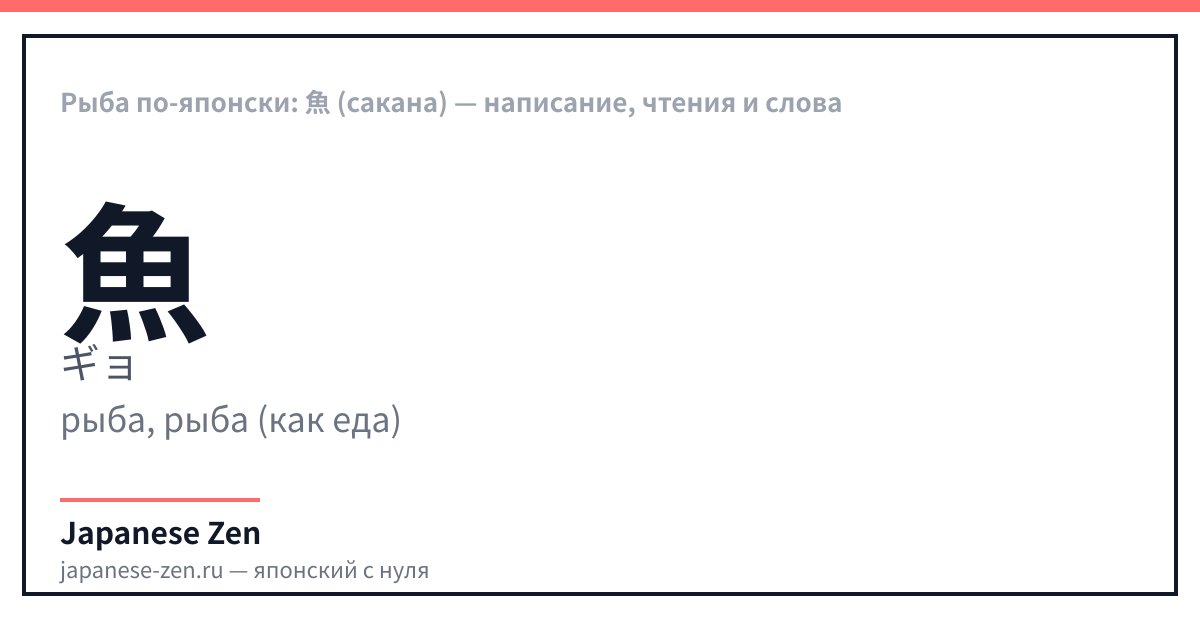
魚 — значение: fish, fish (as food) — онъёми: ギョ — кунъёми: うお、さかな — 11 штрих(ов). 11 strokes. Click 'Show stroke order' — the strokes will appear as if written by hand.
From pictogram to reading
魚 is one of the oldest pictograms: it was originally drawn as a whole fish, head up, with the four lower dots representing the tail fin. Over thousands of years, the drawing straightened into eleven strokes, but the silhouette is still recognizable if you know where to look. The on'yomi ぎょ appears in compound words like 金魚 'goldfish', while the kun'yomi — うお and さかな — work on their own.
'Sakana' and 'uo' — one fish, two words
| Japanese | Reading | Translation |
|---|---|---|
| 魚 | sakana · sakana | Fish (as food, on the table) (fish on the table, in conversation about food) |
| 魚 | uo · uo | Fish (as a living creature) (fish as a creature, in the water) |
| 刺身 | sashimi · sashimi | Sashimi, raw fish slices (slices without rice and vinegar) |
| 焼き魚 | yakizakana · yakizakana | Grilled fish |
| 金魚 | kingyo · kingyo | Goldfish (decorative, not food) |
| 魚屋 | sakanaya · sakanaya | Fish shop, fishmonger |
| 魚座 | uoza · uoza | Constellation Pisces (zodiac sign, not a dish) |
Fish kanji on sushi bar dishes
Many commercial fish have their own kanji with the 魚 sign on the left: 鮭 — salmon, 鮪 — tuna, 鰤 — yellowtail. Some of these characters were invented by the Japanese themselves, not borrowed from China: 鰯 (sardine) and 鰤 (yellowtail) are 'kokuji', kanji of local origin. On dishes and menus in sushi bars, these characters are printed specifically so that a customer can recognize the fish at a glance. How the same fish and rice become sushi is a separate page nearby.
Write 魚 yourself
Trace the character along the guides — the system will evaluate each stroke.
FAQ
- How do you say fish in Japanese?
- 魚: the word is read either さかな (sakana) when referring to fish as food, or うお (uo) when talking about fish as a living creature.
- What is the difference between 'sakana' and 'uo'?
- さかな (sakana) is used in conversation about food — at the market, on a menu, in the kitchen. うお (uo) is more common in names of fish and fishing, where the fish remains a living creature, not a dish.
- Is sashimi fish or sushi?
- 刺身 (sashimi) is simply sliced raw fish, without rice and vinegar. Sushi is a separate dish where the same fish is placed on rice.
- Why do fish have separate kanji in Japanese?
- Kanji have radicals — semantic parts that group characters by topic. The 魚 radical on the left immediately indicates that you are looking at the name of a fish, even if the right part of the character is unfamiliar.
- What does the word 金魚 mean?
- 金魚 (kingyo) means 'goldfish', literally 'gold' plus 'fish'. In Japan, they have been bred as ornamental fish since the Edo period, and catching kingyo with a paper scoop is a classic summer festival pastime.
- How is the character 魚 read?
- Three ways: the on'yomi ぎょ in compound words, and the kun'yomi さかな and うお on their own, with the nuance of 'food' and 'living creature' respectively.
Sources
Updated: 2026-09-09