Night in Japanese: 夜 (yoru) — writing, readings, and words
Night in Japanese is 夜 (yoru). As a standalone word it is read only as yoru, but inside many compounds the same character shortens to yo: 夜中 "deep night", 夜空 "night sky". Japanese also has a second word of similar meaning, 晩, but it refers to evening as a part of the day and appears in the greeting konbanwa, not in 夜.
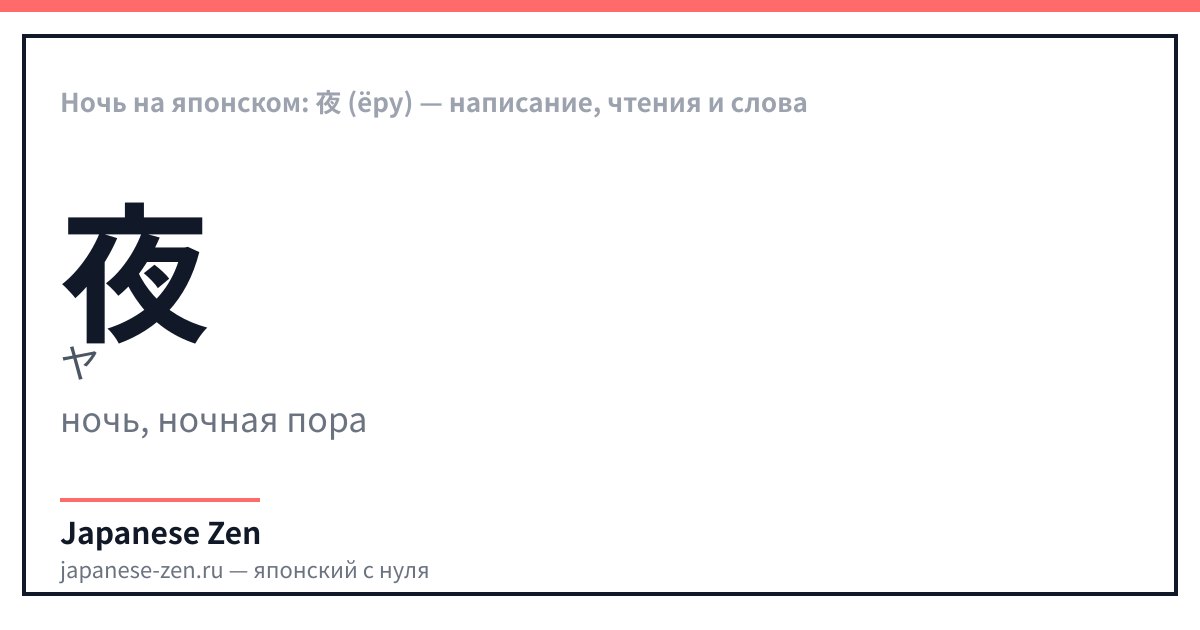
English "night" and "evening" are easy to tell apart by ear. In Japanese the boundary runs differently: one word covers both midnight and deep darkness, while the other is tied to a specific hour of greeting and dinner.
The character 夜: the reading yoru and the second reading yo inside compounds
夜 — значение: night, nighttime — онъёми: ヤ — кунъёми: よ、よる — 8 штрих(ов).
When it is yoru and when it is just yo
As a standalone word, night is called yoru: the full form of the kun reading. Inside many compound words the same morpheme shortens to yo: 夜中 yonaka — deep night, midnight; 夜空 yozora — night sky. The on reading ya appears in Sino-Japanese words: 今夜 kon'ya — tonight, 深夜 shin'ya — late night, an official term like 深夜営業 — "open at night". The three forms of one character — yoru, yo, and ya — are distributed by word type, not by meaning.
夜 or 晩 — how to choose the right word for evening-night
| Japanese | Reading | Translation |
|---|---|---|
| 夜 | yoru · yoru | Night |
| 今夜 | kon'ya · kon'ya | Tonight (here the character 夜 is read ya, not yoru) |
| 夜中 | yonaka · yonaka | Deep night, midnight |
| 深夜 | shin'ya · shin'ya | Late night (an official term, for example on signs like 深夜営業) |
| 夜空 | yozora · yozora | Night sky |
| 夜更かし | yofukashi · yofukashi | Staying up late |
| 晩ご飯 | bangohan · bangohan | Dinner (here 晩 is used, not 夜 — evening as a meal) |
こんばんは is about 晩, not 夜
晩 ban denotes evening as a segment of the day tied to the daily routine: dinner time, time to come home, the time of the greeting こんばんは konbanwa, which literally means "this evening". 夜 is broader in meaning and covers the whole dark part of the day, including late night: staying up until midnight is called 夜更かし, not some ban-word. In practice 今夜 and 今晩 are often interchangeable meaning "this evening/tonight", but 晩 remains more everyday and tied to a specific hour.
Write 夜 yourself
Trace the character 夜 along the guides — the system will evaluate each stroke.
FAQ
- How do you say "night" in Japanese?
- 夜 (yoru). Inside compound words the same character shortens to yo: 夜中, 夜空.
- How is 夜 different from 晩, if both are about evening and night?
- 夜 is the whole dark part of the day, including deep night. 晩 is evening as a segment of the day tied to routine: dinner, coming home, the greeting こんばんは.
- Why is 夜 read ya in 今夜, and not yoru?
- 今夜 is a Sino-Japanese compound, and in such words 夜 usually takes the on reading ya: 今夜, 深夜. The kun reading yoru appears only as a standalone word.
- What does 夜更かし mean and when is it used?
- Literally "extending the night" — staying up late, not going to bed on time. It is used for studying before an exam, as well as for games or TV series.
- How do you wish someone good night in Japanese?
- The basic phrase is おやすみなさい, literally "rest well". A breakdown of polite and informal variants is on a separate page of the site.
Sources
Updated: 2026-09-09