Tiger in Japanese: 虎 (tora) — Writing, Readings, and Words
Tiger in Japanese is 虎 (とら, tora), 8 strokes. A live tiger has never existed in Japan: the entire image came from the continent along with Chinese art and Buddhist motifs. This is also where the expression 虎の巻 comes from — "cheat sheet," literally "tiger scroll." The zodiac sign "tiger" uses a different kanji, 寅, and the two should not be confused.
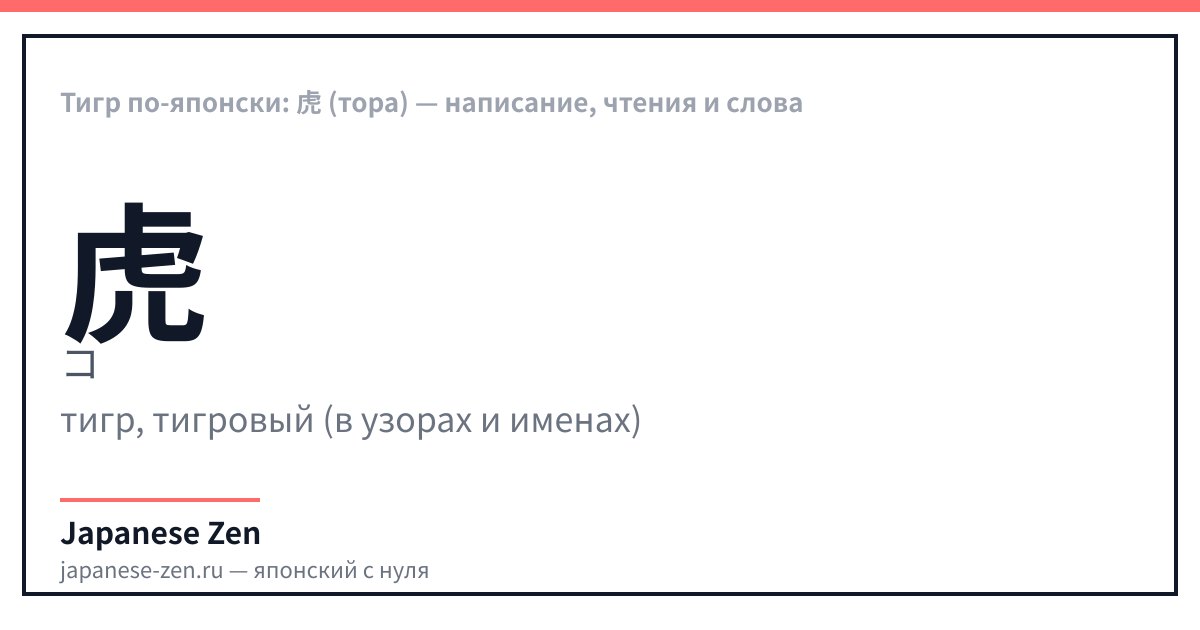
The kanji depicts a beast that none of the Japanese artists had seen alive: tigers remained an image from foreign prints and treatises. Yet in the language, 虎 has left a mark far wider than in fauna.
The "tiger" sign: 虎 and its double 寅
虎 — значение: tiger, tiger-patterned (in designs and names) — онъёми: コ — кунъёми: とら — 8 штрих(ов).
How 虎 differs from the zodiacal 寅
虎 is a character with the radical 虍, which represents a tiger skin and stripes. It is read "tora" on its own and "ko" in some Sino-Japanese compound words. A separate confusion concerns the zodiac: the year of the tiger in the twelve-year cycle is written not with the character 虎 but with another kanji — 寅, which is also read "tora" but does not directly depict the animal and is used only in the calendar system.
The tiger that no one in Japan had seen
| Japanese | Reading | Translation |
|---|---|---|
| 虎 | tora · tora | Tiger |
| 虎の巻 | tora no maki · tora no maki | Cheat sheet (literally "tiger scroll") |
| 虎の子 | tora no ko · tora no ko | Cherished savings, one's most precious possession (literally "tiger cub") |
| 寅 | tora · tora | Tiger in the zodiac cycle (a different kanji, not used outside the calendar) |
| 寅年 | toradoshi · toradoshi | Year of the Tiger |
| 張り子の虎 | hariko no tora · hariko no tora | Paper tiger, an empty threat (a papier-mâché toy with a nodding head) |
Where the "tiger scroll" — 虎の巻 — came from
Tigers have never lived on the Japanese islands: the entire image is an import along with Chinese painting and Buddhist art, which is why in old prints the beast sometimes looks more like a striped cat. The expression 虎の巻 (tora no maki), "cheat sheet," goes back to an ancient Chinese military treatise, one of whose scrolls was called "Tiger" — that is how a scroll of secret knowledge turned into school slang. Since long ago, the Japanese have compared precious things to tiger cubs: 虎の子 (tora no ko) means "cherished savings," for a tigress protects her cubs more than anything in the world.
Draw 虎 yourself
Go through all eight strokes of 虎 in order.
FAQ
- How do you say "tiger" in Japanese?
- 虎 (とら, tora), 8 strokes. The character has a zodiacal double 寅 with the same reading but a different spelling.
- Is it true that the zodiacal "tiger" is written with a different kanji?
- True. The year of the tiger in the twelve-year cycle is written with the character 寅, not 虎. Both are read "tora," but 寅 is used only in the calendar and horoscopes, not for the animal itself.
- Where does the expression 虎の巻 — "cheat sheet" — come from?
- The expression goes back to an ancient Chinese military treatise in which one of the scroll sections was called "Tiger." Over time, "tiger scroll" came to mean any text with secret or life-facilitating knowledge — including a school cheat sheet.
- Did tigers ever live in Japan?
- No, never. The entire image of the tiger in Japanese art and language came from the continent along with Chinese painting and Buddhist motifs — artists drew the beast from others' descriptions and skins.
- What does the idiom 虎の子 mean?
- Literally "tiger cub," but in meaning it refers to cherished savings or the most precious thing that one carefully keeps. The basis is the idea of a tigress who fiercely protects her cubs.
- What is 張り子の虎?
- A papier-mâché toy in the shape of a tiger with a head that nods on a spring. Figuratively, a "paper tiger": someone who looks menacing but is actually harmless.
Sources
Updated: 2026-09-09