Wolf in Japanese: 狼 (ōkami) — Writing, Readings, and Words
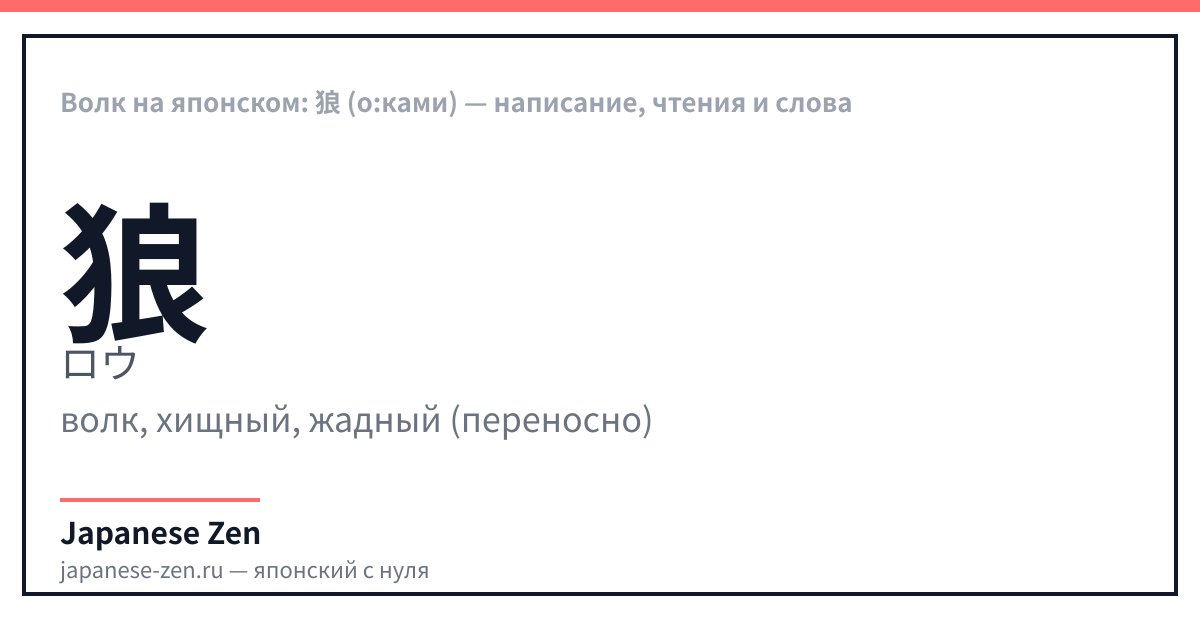
Wolf in Japanese is 狼 (おおかみ, ōkami), 10 strokes. The word happens to sound identical to 大神 — "great god"; the title of the game Ōkami is built on this homophony. The subspecies ニホンオオカミ, the Japanese wolf, went extinct in the early 20th century — this is a historical fact, not a legend.
The same set of sounds "ōkami" in a Japanese speaker's mouth can mean both the predator and a reverent address to a deity — and this is not a metaphor, but a direct coincidence in pronunciation of two different words.
How "wolf" is written: the character 狼
狼 — значение: wolf, predatory, greedy (figuratively) — онъёми: ロウ — кунъёми: おおかみ — 10 штрих(ов).
狼 and 大神 — same sound, different meaning
狼 consists of the radical 犭, the same "animal" sign as in dog and cat, and a phonetic component on the right. It is read "おおかみ" (ōkami) — and 大神, "great god", a combination of two other kanji, sounds exactly the same. This is a pure coincidence of pronunciation, not a word relation, but it turned out to be so striking that it became the basis for the title of the game Ōkami. The mythological "great gods" themselves are a separate topic; here only the homophony matters.
Lone wolf and the extinct ニホンオオカミ
| Japanese | Reading | Translation |
|---|---|---|
| 狼 | ōkami · ōkami | Wolf |
| ニホンオオカミ | nihon ōkami · nihon ōkami | Japanese wolf (subspecies that went extinct in the early 20th century) |
| 一匹狼 | ippiki ōkami · ippiki ōkami | Lone wolf (about a person who works on their own) |
| 狼男 | ōkami otoko · ōkami otoko | Werewolf |
| 遠吠え | tōboe · tōboe | Howling |
| 送り狼 | okuri ōkami · okuri ōkami | "Escorting wolf" (about a man with not entirely honest intentions) |
| 大神 | ōkami · ōkami | Great god (sounds like "wolf", written with different characters) |
What 送り狼 — "escorting wolf" — means
The idiom 一匹狼 (ippiki ōkami), "lone wolf", describes a person who works and lives on their own — with a respectful rather than judgmental nuance. 送り狼 (okuri ōkami) has a more ironic meaning: it refers to a man who offers to walk a woman home but is pursuing his own interest. Another layer of the word is historical: the subspecies ニホンオオカミ, the Japanese wolf, was officially declared extinct in the early 20th century, and this is an established fact of zoology, not part of folklore.
Trace 狼 stroke by stroke
Trace 狼 — the system will check every stroke.
FAQ
- How do you say "wolf" in Japanese?
- 狼 (おおかみ, ōkami), 10 strokes. The radical on the left is 犭, the same "animal" radical as in dog and cat.
- Is it true that "狼" and "great god" sound the same?
- True: 狼 (wolf) and 大神 (great god) are both read "ōkami". This is a homophony, not a relation in meaning, and the title of the game Ōkami is built on it — see the separate page for a detailed mythological breakdown.
- What happened to the Japanese wolf ニホンオオカミ?
- The subspecies was officially declared extinct in the early 20th century. This is a zoological fact, not a legend, although the cult of the guardian wolf in mountain shrines is still alive today.
- What does the idiom 一匹狼 — "lone wolf" — mean?
- It is said of a person who acts independently, without a team or group — usually with respect for their self-reliance, not with condemnation.
- Who is "送り狼" — the "escorting wolf"?
- A colloquial expression for a man who offered to walk a woman home but has not entirely honest intentions. The word "wolf" works here the same way as in the English "wolf in sheep's clothing".
Sources
Updated: 2026-09-09