Dog in Japanese: 犬 (inu) and why a dog says "wan-wan"
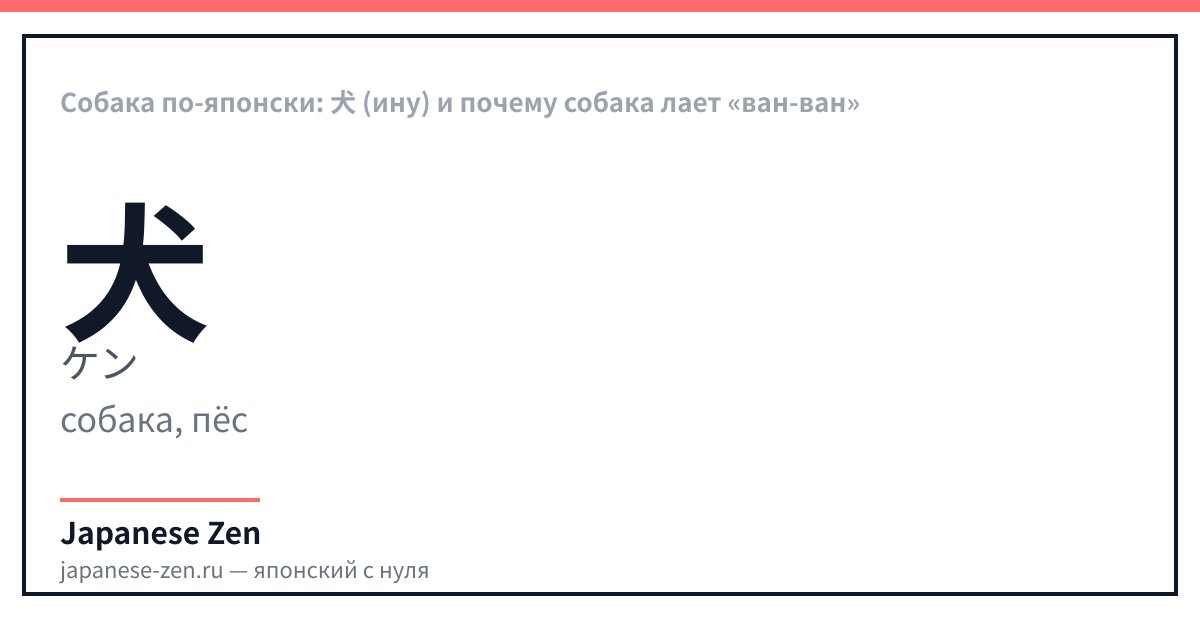
Dog in Japanese is 犬 (いぬ, inu), a character of four strokes. On its own it reads "inu", but in set compounds like 忠犬 or 番犬 it reads "ken". A bark in Japanese is not "woof-woof" but ワンワン (wan-wan), and children use the same word for the dog itself. There are also breeds with this kanji in their name — 柴犬 and 秋田犬.
A Japanese puppy for a small child is not "woof-woof" but "wan-wan": another language hears a bark differently. The character 犬 is recognizable in nicknames, breeds, and in the name of the dog the whole country remembers by name — Hachiko.
The character 犬: how "dog" is written in four strokes
犬 — значение: dog, hound — онъёми: ケン — кунъёми: いぬ、いぬ- — 4 штрих(ов).
Read "inu" or "ken" — it depends
The character 犬 draws a dog in four strokes and serves as the "beast" radical — from it comes 犭, the abbreviated form that stands on the left in 猫 (cat) and 狼 (wolf). On its own, outside compounds, 犬 is almost always read "inu": the dog itself, a stray dog 野良犬. In Sino-Japanese words it is read "ken" — 番犬 (banken, guard dog), 愛犬 (aiken, beloved pet), 忠犬 (chūken, faithful dog).
From "wan-wan" to Hachiko
| Japanese | Reading | Translation |
|---|---|---|
| 犬 | inu · inu | Dog, hound |
| 子犬 | koinu · koinu | Puppy |
| ワンワン | wanwan · wanwan | Woof-woof; in baby talk — "doggie" |
| 柴犬 | shibainu · shibainu | Shiba Inu breed (small, reddish, with a curled tail) |
| 秋田犬 | akita inu · akita inu | Akita Inu breed (large northern breed, the breed of Hachiko himself) |
| 忠犬ハチ公 | chūken hachikō · chūken hachikō | Faithful dog Hachiko (the monument by Shibuya Station became a meeting spot) |
| 番犬 | banken · banken | Guard dog |
Why a Japanese dog doesn't say "woof-woof"
English "woof-woof" and Japanese ワンワン (wan-wan) are different attempts to write down the same bark: dogs are the same everywhere, but languages divide the sound into syllables differently. ワンワン is also a baby word for the dog itself, like "doggie" in English. In breed names the same 犬 appears constantly: 柴犬 (shiba inu) and 秋田犬 (akita inu) are native Japanese breeds whose temperament is discussed separately.
Write 犬 by hand
Trace the character along the guides — the system will score each stroke.
FAQ
- How do you say "dog" in Japanese?
- 犬 (いぬ, inu). The character is written with four strokes, and in Sino-Japanese compounds it is read differently — "ken": 番犬 (banken, guard dog).
- Why does a Japanese dog say "wan-wan" and not "woof-woof"?
- It is the onomatopoeia ワンワン (wan-wan) — the Japanese way of writing a bark, which differs from English just as "meow" differs from "nyan". For children, wan-wan also means "doggie".
- Who is Hachiko and why is he called 忠犬?
- Hachiko was an Akita Inu dog who in the 1920s–30s met his owner at Shibuya Station every day and kept coming there for years after his owner's death. 忠犬 (chūken) means "faithful dog" — that is what he is called on the monument too.
- How does 柴犬 differ from 秋田犬?
- 柴犬 (shiba inu) is a smaller breed, the most recognizable "Japanese face" on the internet. 秋田犬 (akita inu) is noticeably larger — it is the breed of Hachiko himself. Both words carry the same character 犬 in its kun reading.
- Is the character 犬 read "inu" or "ken"?
- Both, depending on the word. On its own and in native Japanese compounds — "inu": 野良犬 (norainu, stray dog). In Sino-Japanese words — "ken": 愛犬 (aiken, beloved pet).
- How do you say "puppy" in Japanese?
- 子犬 (koinu) — "puppy", literally "child-dog". The same pattern works for other young animals: 子猫 (koneko) — kitten, 子熊 (koguma) — bear cub.
Sources
Updated: 2026-09-09