Okuri-inu — the "escorting dog" of the night mountain path
Okuri-inu, the "escorting dog," is a figure from Japanese folklore: a soundless beast, most often identified with the wolf, follows a traveler along a night mountain path and does not harm him as long as he stays on his feet. In some retellings it is called okuri-okami, the "escorting wolf": there it either threatens the fallen traveler or, on the contrary, protects him from other beasts.
Walking a mountain path at night and hearing steady footsteps behind you is the stuff of scary stories, but the Japanese belief leaves the victim a simple chance of escape: don't show that you've fallen. Let's look at where okuri-inu came from, how it is connected to the extinct Japanese wolf, what dual reputation — now a guardian, now a predator — it acquired in different regions of the country, and what the word "okuri-okami" means in modern language.
Okuri-inu: the dog that silently follows along the mountain path
Okuri-inu, the "escorting dog," is a figure from Japanese beliefs about the night mountain path: a soundless beast follows the traveler step for step and, as long as he stands firmly on his feet, does no harm. In areas from Kanto to Kinki and in Kochi, the same thing is told as okuri-okami, the "escorting wolf." In some retellings it is a dangerous predator, in others — on the contrary, a protector who drives other beasts away from the traveler if he behaves correctly.
Why you must not fall in front of okuri-inu
According to the belief, danger comes in one single case — if the traveler stumbles and falls: then the beast pounces on him. The sure way to avoid an attack was considered to be not showing that you've fallen: say something like "whew, that was a nice rest" and calmly get up, as if you had deliberately sat down for a minute rather than lost your balance.
Okuri-inu and the extinct Japanese wolf
It is with the wolf, and not simply with a wild dog, that folklorists most often connect okuri-inu. The Japanese wolf, which once lived on Honshu, went extinct in the early 20th century: the last reliably confirmed one was caught on January 23, 1905, at Washikaguchi in the village of Higashi-Yoshino, present-day Nara Prefecture, and sold to a visiting American zoologist.
The shrine where the wolf is still revered
At Mitsumine Shrine, the wolf is revered to this day as a protector from thieves and fires — an image close to okuri-okami: a beast that accompanies and guards if you behave correctly.
"Okuri-okami" in modern Japanese
In modern Japanese, 送り狼 (okuri-okami) is not so much a beast as a type: according to dictionary definitions, it refers to a man who politely escorts a woman home but is actually looking for an opportunity to behave brazenly. The connection with the belief is direct: the same cunning of one who walks alongside as if caring, but in fact biding his time.
How the "escort" turned into a warning
The shift from a forest predator to an everyday warning is a common path for Japanese folklore vocabulary: a frightening figure of the night path also works as an image for a person whose politeness should not be fully trusted. The word caught on so well that many today know only this modern meaning, not the story about the beast.
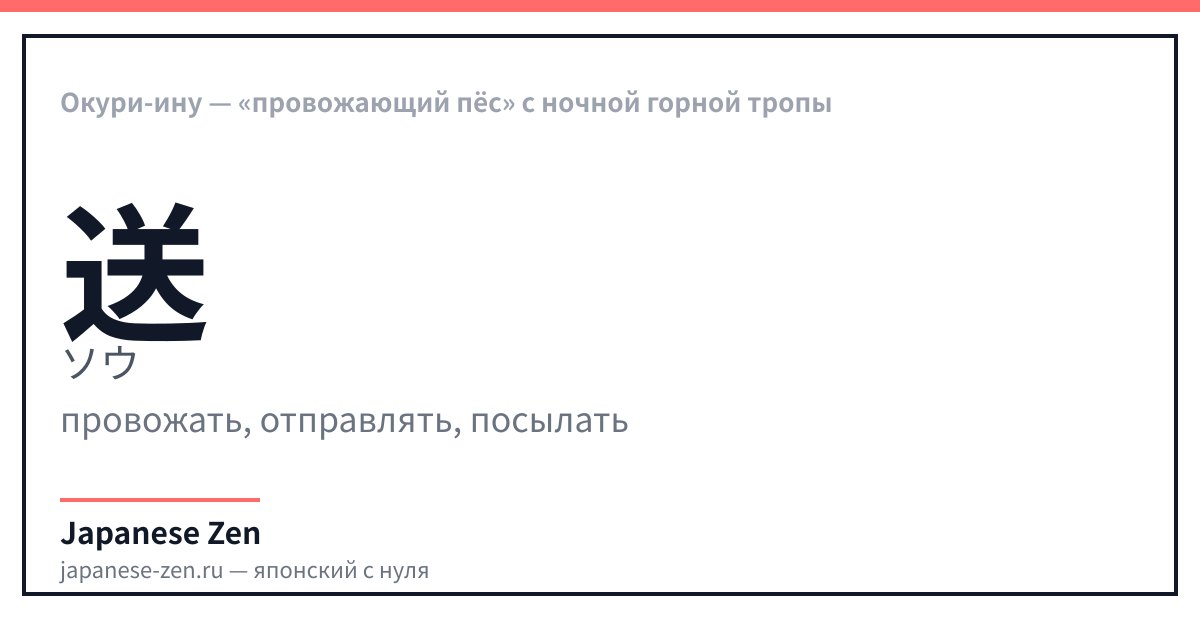
送 — the "escort" character in the name okuri-inu
送 — значение: to escort, to send, to dispatch — онъёми: ソウ — кунъёми: おく.る — 9 штрих(ов). 送 — "to escort, to send": the first character of the name 送り犬. The same character appears in 見送る (to see off) and 送別会 (farewell party).
送り犬 — "escorting dog": 送り, formed from the verb 送る "to escort, to send," plus 犬 "dog." The same root is in 見送る "to see off, to walk to the door" and in 送別会 "farewell party," which in Japan is held when someone leaves a company or moves away. On its own, the character 送 is read ソウ in Sino-Japanese words and おくる when it stands alone.
Seeing off as part of Japanese daily life
In everyday life, 送る is heard far more often than in connection with yokai: 送料 is the "shipping cost" in any online store, and walking a guest to the door of a house or office is still considered a polite, almost obligatory gesture. The mythical dog simply borrowed an everyday word to describe what it does the whole way — escort.
| Japanese | Reading | Translation |
|---|---|---|
| 送り犬 | okuri-inu · okuri-inu | The escorting dog of the mountain path |
| 送り狼 | okuri-ōkami · okuri-ōkami | The escorting wolf; figuratively, a dangerous suitor |
| 送る | okuru · okuru | To escort, to send |
| 見送る | miokuru · miokuru | To see off, to walk to the door |
| 送別会 | sōbetsukai · sōbetsukai | Farewell party for someone leaving |
| 送料 | sōryō · sōryō | Shipping cost |
Write 送 along the guides — "to escort," the very thing okuri-inu does the whole way.
FAQ
- Who is okuri-inu?
- Okuri-inu, the "escorting dog," is a figure from Japanese beliefs about the night mountain path: a soundless beast, most often associated with the wolf, follows the traveler and for the time being does no harm. In some retellings it is called okuri-okami, the "escorting wolf," and is regarded more as a guardian than a threat.
- What should you do if okuri-inu follows you?
- The main rule is not to show that you've fallen. If the traveler stumbled, he was supposed to say with a sigh something like "whew, that was a nice rest" and slowly get up, as if he had deliberately sat down for a minute. Then the beast took it for an ordinary rest stop and did not attack.
- Is okuri-inu an evil or a good spirit?
- It varies in different retellings: in some versions okuri-inu attacks a fallen traveler, in others — on the contrary, it guards him from other beasts as long as he stays on his feet. The same path could be considered either dangerous or safe, depending on local tradition.
- What does "okuri-okami" mean in modern Japanese?
- Today 送り狼 (okuri-okami) according to dictionaries means a man who politely escorts a woman home but is actually looking for an opportunity to behave brazenly. The meaning grew directly out of the folkloric image of a beast that walks alongside as if protecting, but in fact biding its time.
- Is okuri-inu connected to the Japanese wolf?
- Yes, researchers connect okuri-inu primarily with the Japanese wolf — a predator once common on Honshu that went extinct in the early 20th century. The last reliably confirmed wolf was caught in 1905 in the village of Higashi-Yoshino, present-day Nara Prefecture.
- How is "okuri-inu" written in kanji?
- 送り犬, read おくりいぬ: 送り from the verb 送る "to escort" plus 犬 "dog." The same root 送る is in 見送る "to see off" and 送別会 "farewell party," while the related word 送り狼 means the "escorting wolf" from the same belief.
Sources
Updated: 2026-09-15