Nurikabe — the invisible wall from Japanese folklore
Nurikabe (塗壁) is an invisible wall from Japanese folklore: at night it suddenly rises in a traveler's path and stretches in both directions no matter how far you search for a way around. The belief was recorded on the coast of Onga District in Fukuoka — the ethnographer Yanagita Kunio included it in an essay in 1938. The only salvation is to strike the bottom edge of the wall with a stick, and then it disappears; striking the top does not help.
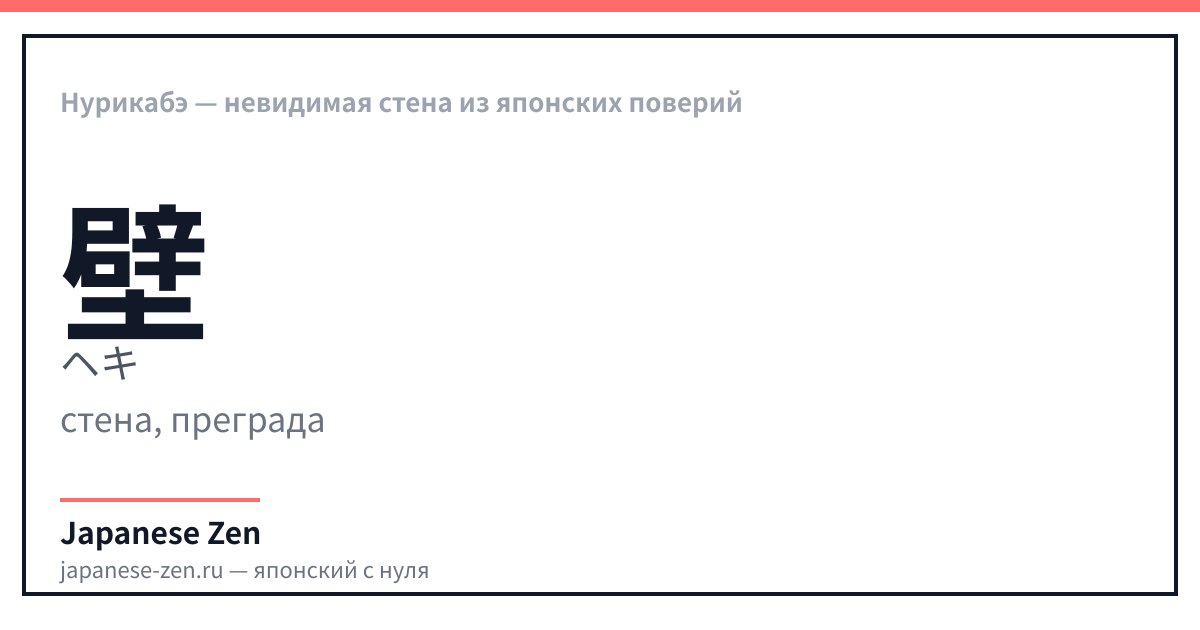
There is no way to turn off the path in the dark — this is how one of the most mundane yokai explains ordinary disorientation on the road: not a demon and not a beast, but simply a wall that should not be there. Let's look at where the belief in the nurikabe was born, where its current appearance with eyes and paws came from, which similar spirits block the road in other parts of Japan, and what the kanji for wall in its name means.
Nurikabe: the wall you cannot go around on a night road
According to a legend from the coast of Onga District in Fukuoka Prefecture, a traveler walking on a night road suddenly runs into an invisible wall. It appears right in front of him and stretches in both directions endlessly, so he cannot go around it. The name "nurikabe," "plastered wall," was recorded by the ethnographer Yanagita Kunio in 1938 in his essay "Yokai Mei" and later included in the book "Yokai Dangi."
What to do if a wall suddenly blocks the road
The belief names only one way to get rid of a nurikabe: strike the bottom edge of the wall with a stick — then it disappears. Hitting or pushing the top is useless; the wall does not react at all. Travelers had to remember this detail rather than try to break through by force.
What a nurikabe looks like: from an invisible wall to a manga hero
In folklore itself, the nurikabe has no described appearance — it is simply a wall that is felt, not seen. The familiar look today — a rectangular body the color of plaster, two eyes, and short paws — was invented by the artist Mizuki Shigeru. The character appeared in early Kitaro stories and later became one of the hero's regular companions in "GeGeGe no Kitaro."
The scroll in which "nurikabe" is not a wall at all
In 2007, yokai researcher Yumoto Koichi identified in an old scroll from the L. Tom Perry Collection at the Harold B. Lee Library of Brigham Young University, USA, a drawing of a three-eyed four-legged beast labeled "ぬりかべ." The scroll has neither an author's signature nor an exact date — specialists date it roughly to the late 17th to early 18th century. The beast in the drawing resembles neither a wall nor Mizuki's character: the connection of this image to the folklore of Fukuoka is unproven, and the name may simply have coincided.
Similar wall spirits in other parts of Japan
The road is blocked in the same way in other regions of the country. In Hata District of Tosa Province, present-day Kochi Prefecture, such a spirit was told of under the name nobusuma (野襖). The wall likewise stretches endlessly in all directions.
How, according to belief, the spirit retreats
From the nobusuma, according to legend, what helps is not a blow with a stick but ordinary calm: if a person stops and unhurriedly smokes tobacco, the wall disappears by itself. This nobusuma should not be confused with the homonymous spirit from Edo: there 野衾 is a completely different creature, a shapeshifter like a flying squirrel, not a wall on the road; only the pronunciation of the name coincides, not the kanji spelling.
壁 — the kanji for wall that gave the nurikabe its name
壁 — значение: wall, barrier — онъёми: ヘキ — кунъёми: かべ — 16 штрих(ов). 壁 — "wall": the second character in the name 塗壁, literally "plastered wall." The same character appears in 壁紙 (wallpaper) and in the idiom 壁にぶつかる "to hit a wall."
塗壁 is made up of 塗る "to coat, plaster" and 壁 "wall": first of all it is an ordinary word for a plastered wall of a house, and only secondarily the name of a spirit. 塗り壁 is still a current construction term: it refers to walls finished with clay or lime, as opposed to board walls 板壁. The character 壁 itself is read ヘキ in Sino-Japanese compounds, and as a standalone word "wall" it is かべ.
How "to hit a wall" sounds in Japanese
The expression 壁にぶつかる, literally "to bump into a wall," means the same as in English — to run into a difficult, seemingly insurmountable obstacle. It has nothing to do with the mythical nurikabe, but it once again shows how familiar the image of a wall in one's path is to the Japanese language.
| Japanese | Reading | Translation |
|---|---|---|
| 塗壁 | nurikabe · nurikabe | Spirit-invisible wall that blocks the road |
| 塗り壁 | nurikabe · nurikabe | Plastered wall — a construction term |
| 壁 | kabe · kabe | Wall |
| 壁にぶつかる | kabe ni butsukaru · kabe ni butsukaru | To hit a wall; to run into a difficulty |
| 板壁 | itakabe · itakabe | Board wall — as opposed to a plastered wall |
| 野襖 | nobusuma · nobusuma | A similar wall spirit from Tosa Province |
Write 壁 along the guides — the "wall" a traveler cannot go around at night.
FAQ
- What is a nurikabe?
- A nurikabe is an invisible wall spirit from Japanese folklore: according to a legend from the coast of Fukuoka, it suddenly rises before a traveler on a night road and stretches in both directions endlessly, so he cannot go around it. The monster-like appearance — with eyes and short paws — was invented much later, for the Kitaro manga.
- How do you get rid of a nurikabe according to the belief?
- The only way the legend names is to strike the bottom edge of the wall with a stick: then it disappears at once. A blow or push from above does not help — the wall does not react to it at all, so it is important to strike at the bottom, not try to break through by force.
- What does a nurikabe look like?
- In folklore itself, the nurikabe is not described visually at all — it is simply a wall that is felt in the dark, not seen. The rectangular body the color of plaster, two eyes, and short paws were invented by the artist Mizuki Shigeru for a manga character, and this image became generally accepted.
- Where did the nurikabe come from in "GeGeGe no Kitaro"?
- Mizuki Shigeru introduced the character into his Kitaro stories before the series received the title "GeGeGe no Kitaro." Drawing on a rare regional belief, he turned the faceless wall into one of the hero's regular companions.
- Are there similar spirits elsewhere in Japan?
- Yes, in Hata District of Tosa Province, present-day Kochi, the same spirit was told of under the name nobusuma (野襖): the wall likewise stretches endlessly. What helps is not a blow with a stick but calm: it was believed that the wall disappears if you stand and smoke tobacco.
- How is "nurikabe" written in kanji?
- 塗壁, read ぬりかべ: 塗る "to coat, plaster" plus 壁 "wall" — the same word used in Japanese for an ordinary plastered wall of a house. On its own, the character 壁 is read ヘキ in Sino-Japanese compounds, and as a standalone word "wall" it is かべ.
Sources
Updated: 2026-09-15