Sad Kaomoji: Crying Japanese Emoticons
Sad kaomoji are Japanese emoticons made of characters that depict sadness, tears, and fatigue. Three tables below: quiet sadness, crying, and despair. Any emoticon is copied with a click. It also explains what the letters T and D, the semicolon, and the kanji 一 do in a crying face. The simplest of them are visible even on an old phone.
Tears in kaomoji are drawn in different ways: with the letter T, the mark ;, or two small lines ╥. Below you will find faces for any shade of sadness — from light pensiveness to sobbing — as well as an explanation of why the Cyrillic Д became a Japanese mouth. Simple faces made of T and ; work on any device.
Sad Kaomoji to Copy
Click on an emoticon in the first column — it will be copied. Below, the faces are divided by intensity of feeling: from mild sadness to a stream of tears.
Quiet Sadness
| Kaomoji | What it expresses |
|---|---|
| (´;ω;`) | about to cry |
| (;_;) | quiet tear |
| (´・ω・`) | confused sadness |
| (´-ω-`) | tired sorrow |
| (。•́︿•̀。) | hurt face |
| (;へ;) | sulky resentment |
| (´д`) | disappointment |
| (´;Д;`) | tears welling up |
| (-_-;) | awkward fatigue |
| (;一_一) | cold glance with annoyance |
| ( ̄ω ̄;) | embarrassed silence |
| (´・_・`) | empty, sad look |
Tears and Crying
| Kaomoji | What it expresses |
|---|---|
| (T_T) | crying |
| (ToT) | sobbing |
| (TдT) | crying with open mouth |
| (T▽T) | crying from laughter or relief |
| (╥﹏╥) | streaming tears |
| (╥_╥) | two tear tracks |
| (ノД`) | wiping away tears |
| (ノ_<。) | crying while turned away |
| (;д;) | sniffling |
| (T⌓T) | trembling mouth |
| (。ノω\。) | hiding tears in hands |
| (ノ﹏ヽ) | bitter tears |
| (;´Д`) | about to burst into tears |
| (゚´Д`゚) | wailing loudly |
Fatigue, Despair, and Apologies
| Kaomoji | What it expresses |
|---|---|
| orz | collapsed in despair |
| m(_ _)m | deep bow, apology |
| (︶︹︶) | melancholy |
| (._.) | confused, looking down |
| (╯_╰) | hopeless gloom |
| (; ̄Д ̄) | stunned by failure |
| ( ̄▽ ̄;) | forced smile |
| (´_ゝ`) | indifferent, expecting nothing |
| (ノ∀`) | well, no luck |
| (=_=) | dead tired |
| (´Д⊂ヽ | rubbing wet eyes |
| (´ω`;) | anxious sadness |
How Tears Are Drawn with Characters
Tears and Mouth
- The letter T — Latin capital: its crossbar reads as a closed eye, and the stem as a falling tear; together they make two crying eyes.
- The mark ; — full-width semicolon; under an eye it looks like a drop.
- ╥ — a box-drawing symbol: two stems under a crossbar depict streams of tears.
- Д — Cyrillic capital letter: a wide square mouth, open in a scream or cry. The Japanese borrowed it from Cyrillic.
- ゝ — Japanese repetition mark; in an emoticon it serves as a slack mouth.
The Kanji 一 Instead of an Eye
The kanji 一 "one" consists of a single horizontal stroke, so in an emoticon with a cold glance it works as a closed eye. Anyone learning Japanese will recognize the character from the first lesson: it is both the first digit and the eye of a displeased face.
How to Use Sad Kaomoji
Where to Insert
A crying emoticon is just text, like a word. It is inserted into a message, caption, or profile description, and clicking in the table copies it entirely. One emoticon is enough for a message: two or three in a row read as a joke.
What to Do with Squares
Ordinary tears made of T, ;, and Д are visible on any device. Rare characters like ﹏ and ╥ are sometimes replaced by a square on old phones. If an emoticon falls apart, replace it with a simple variant from the first table.
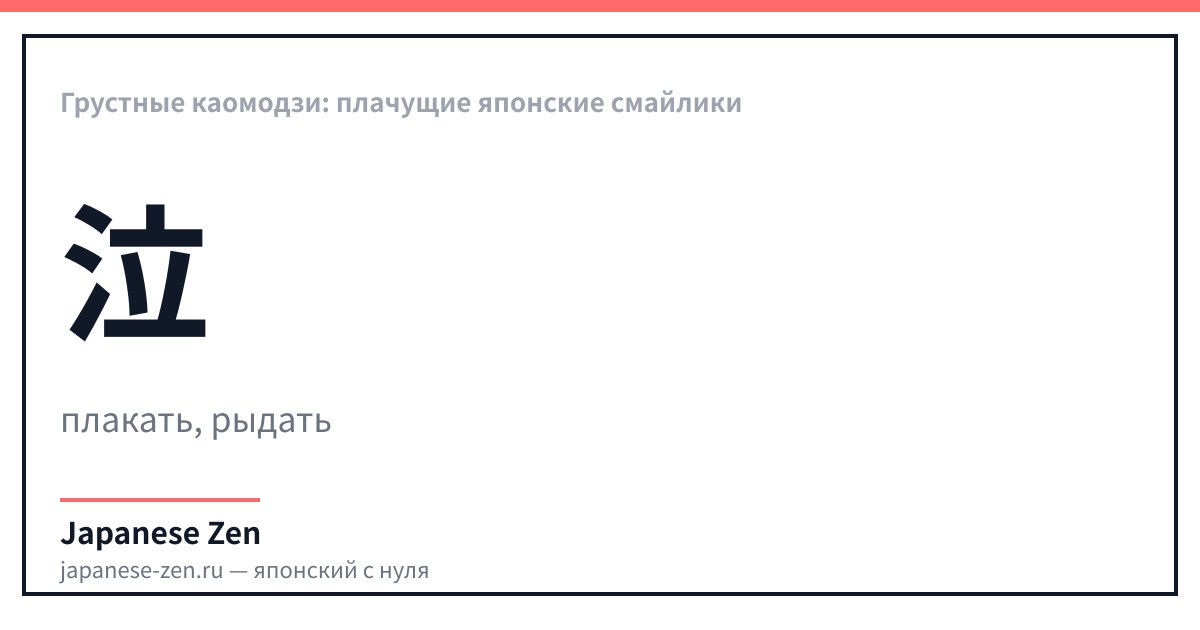
Name and Kanji: 泣く
泣 — значение: to cry, to weep — онъёми: キュウ — кунъёми: な.く — 8 штрих(ов). 泣 — "to cry": on the left three drops of water, on the right 立 "to stand". The word 泣く (naku) is the most common Japanese word for crying.
Words for Tears and Sadness
The character 泣 is read キュウ in the word 号泣 (gōkyū) "wailing" and な(く) in the verb 泣く. That is why a crying face is called 泣き顔 (nakigao) — "crying face". Nearby are 涙 (namida) "tears" and 悲しい (kanashii) "sad".
| Japanese | Reading | Translation |
|---|---|---|
| 泣く | naku · naku | To cry |
| 涙 | namida · namida | Tears |
| 悲しい | kanashii · kanashii | Sad, sorrowful |
| 泣き顔 | nakigao · nakigao | Crying face |
| 寂しい | sabishii · sabishii | Lonely, melancholy |
FAQ
- What kinds of sad kaomoji are there?
- From quiet sadness to sobbing and despair. They differ in eyes and mouth: a semicolon draws a tear, the letter Д an open mouth, and the mark ﹏ trembling lips. Everything is copied with a click from the tables above.
- How do you write a crying kaomoji?
- Take two tear-eyes and a mouth: T_T, ;_;, or ╥_╥ — all of these are crying faces. Add parentheses on the sides, and you get a ready emoticon. If you are too lazy to assemble one, copy a ready one from the "Tears and Crying" table.
- How are Japanese sad emoticons different from Western ones?
- The Western :-( is read sideways, you have to tilt your head ninety degrees. Japanese faces are read upright, and the feeling is conveyed by the eyes: a tear-dot, a closed line, or a wide open mouth.
- Why is the Cyrillic letter Д in a Japanese emoticon?
- The Cyrillic Д resembles a wide square mouth, open in a scream or cry, and kana has no such character. That is why it was borrowed for emoticons: the letter simply looks like the needed facial detail.
- Why do squares appear instead of a sad emoticon?
- The device cannot find the character in its font and substitutes a rectangle. Rare symbols break more often, for example ﹏ or ╥. Kana, Latin letters, parentheses, and the mark ; are displayed everywhere, so simple tears are safer.
Sources
Updated: 2026-09-29