Nurarihyon — Who Is This in Japanese Mythology
Nurarihyon is a yokai with an elongated bald head, resembling an old man in a silk kimono. According to legend, he enters someone else's house uninvited at dusk, drinks tea as if he owns the place, and leaves, while the hosts somehow take him for one of their own. The name is written only in kana, ぬらりひょん — "slippery, elusive." The label "supreme commander of all yokai" is a 20th-century invention, not part of the old legends.
Catching Nurarihyon by the hand, according to legend, is impossible — he always slips away with that very sound "hyon," from which his name is composed.
The Slippery Guest Who Is Hard to Describe Properly
Nurarihyon is depicted as an old man with a disproportionately elongated, gourd-shaped bald head and a wrinkled face, somewhat resembling a catfish. He is usually dressed in a respectable silk kimono or a monk's robe — that is, he looks more like an honored guest than a monster.
- Appears at dusk, usually without an invitation and without knocking.
- Enters someone else's house, sits in the best spot, and drinks tea as calmly as if he lived there.
- The hosts, according to legend, somehow take him for a relative or acquaintance and do not dare to throw him out.
- Leaves on his own, as unnoticed as he appeared — without stealing anything or causing harm.
Is He Actually Dangerous
No, at least not physically. All of Nurarihyon's eeriness lies in the situation itself: a stranger calmly violates the boundaries of your home, and you cannot even object. This is more an anxiety about politeness and power than a classic story about a monster with teeth.
Why the Name Has Not a Single Kanji
ぬらりひょん is written only in kana: no stable kanji ever became established for this name. According to one version, "nurari" describes a slippery, elusive movement, and "hyon" is the sound with which Nurarihyon slips out of your hands the moment you try to catch him. The name itself is constructed like a little scene of capture that never succeeds.
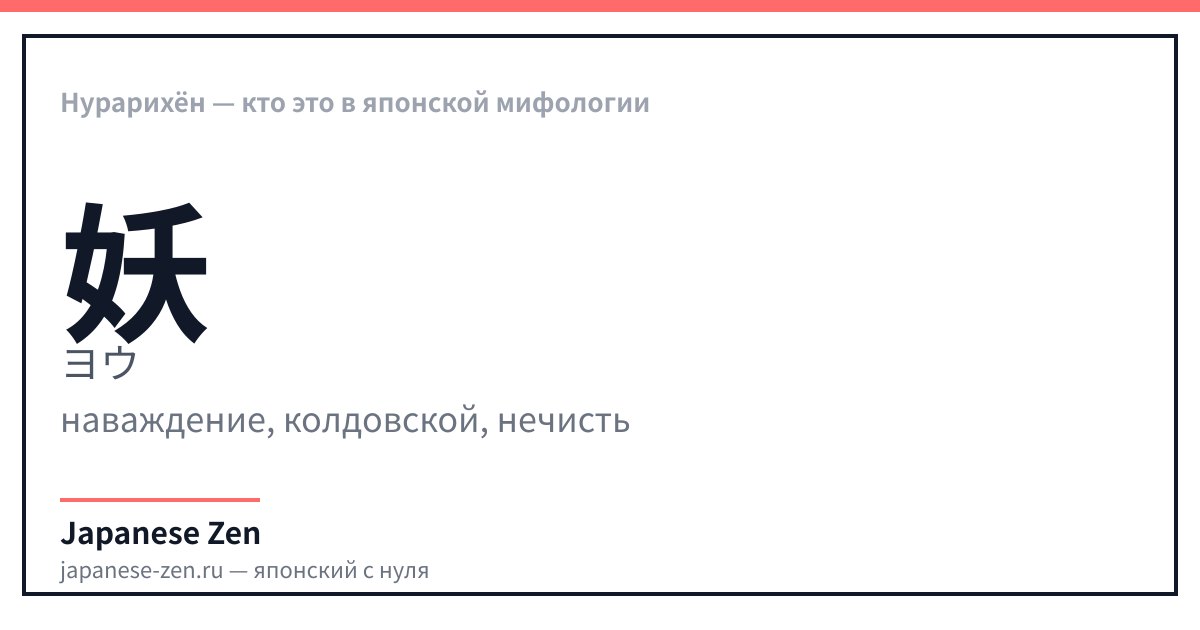
妖 — значение: apparition, bewitching, evil spirit — онъёми: ヨウ — кунъёми: あや.しい、なま.めく、わざわ.い — 7 штрих(ов). The name ぬらりひょん contains no kanji: it is written entirely in kana. The card shows 妖, "apparition, supernatural": the same character appears in the general word 妖怪 (yokai), to which Nurarihyon is formally assigned.
Write 妖 along the guides and study the stroke order.
Where Did This Spelling Come From
Nurarihyon appears on illustrated yokai scrolls as early as the Edo period, but details about him there are surprisingly few — he is mysterious even to the artists who painted him. According to one version, the legends come from the area of present-day Wakayama Prefecture, but he cannot be firmly tied to a single region.
"Supreme Commander" — a 20th-Century Label
Nurarihyon's reputation as "supreme commander of all yokai" is a relatively late addition, not part of the original legend. The folklorist Fujisawa Morihiko attached a caption with this interpretation to an illustration by Toriyama Sekien. The image was cemented by encyclopedias and Shigeru Mizuki's manga in the 20th century — especially after the anime "GeGeGe no Kitaro," where Nurarihyon became one of the protagonist's recurring rivals.
What Older Sources Say
In Edo-period texts there is no hierarchy or army of yokai under his command — there Nurarihyon is simply an uninvited guest who comes into someone else's house to drink tea. He received the post of "commander" retroactively, along with the growth of his own popularity.
The Grandson Invented in 2008
| Japanese | Reading | Translation |
|---|---|---|
| ぬらりひょん | nurarihyon · nurarihyon | Nurarihyon — the name of the yokai, written entirely in kana |
| お茶 | ocha · ocha | Tea — what Nurarihyon drinks in someone else's house |
| 客 | kyaku · kyaku | Guest, visitor |
| 総大将 | sōdaishō · sōdaishō | Supreme commander, leader |
| 妖怪 | yōkai · yōkai | Supernatural creature in general |
- "Nurarihyon no Mago" ("Nurarihyon's Grandson") — a manga by Hiroshi Shiibashi, serialized in Weekly Shōnen Jump from 2008 to 2012 and built directly on the legend of the "commander of yokai."
- "GeGeGe no Kitaro" by Shigeru Mizuki — a series where Nurarihyon became established as one of the protagonist's recognizable opponents.
FAQ
- Who is Nurarihyon?
- A yokai with an elongated bald head in the guise of a venerable old man, who enters someone else's house uninvited, calmly drinks tea, and leaves as unnoticed as he appeared.
- Is Nurarihyon dangerous to people?
- Physically, no — he does not attack or steal anything. The eeriness here is more in the situation itself: a stranger calmly violates the boundaries of the house, and the hosts do not dare to object.
- Why is the name Nurarihyon not written in kanji?
- No stable kanji ever became established for this name: it is written entirely in kana, ぬらりひょん. One version links the name to the sound with which he slips away when someone tries to catch him.
- Is it true that Nurarihyon is the commander of all yokai?
- This is a late 20th-century addition, not part of the original legend: the title was cemented by encyclopedias and Shigeru Mizuki's manga. In Edo-period texts he is simply an uninvited guest drinking tea in someone else's house.
- Where did the name ぬらりひょん come from?
- According to one version, "nurari" describes a slippery movement, and "hyon" is the sound with which he slips out of your hands when you try to catch him.
- In which manga and anime does Nurarihyon's grandson appear?
- "Nurarihyon no Mago" by Hiroshi Shiibashi, serialized in Weekly Shōnen Jump from 2008 to 2012. Nurarihyon himself also remains a recurring opponent in "GeGeGe no Kitaro."
Sources
Updated: 2026-09-09