Ayakashi — Who They Are in Japanese Mythology
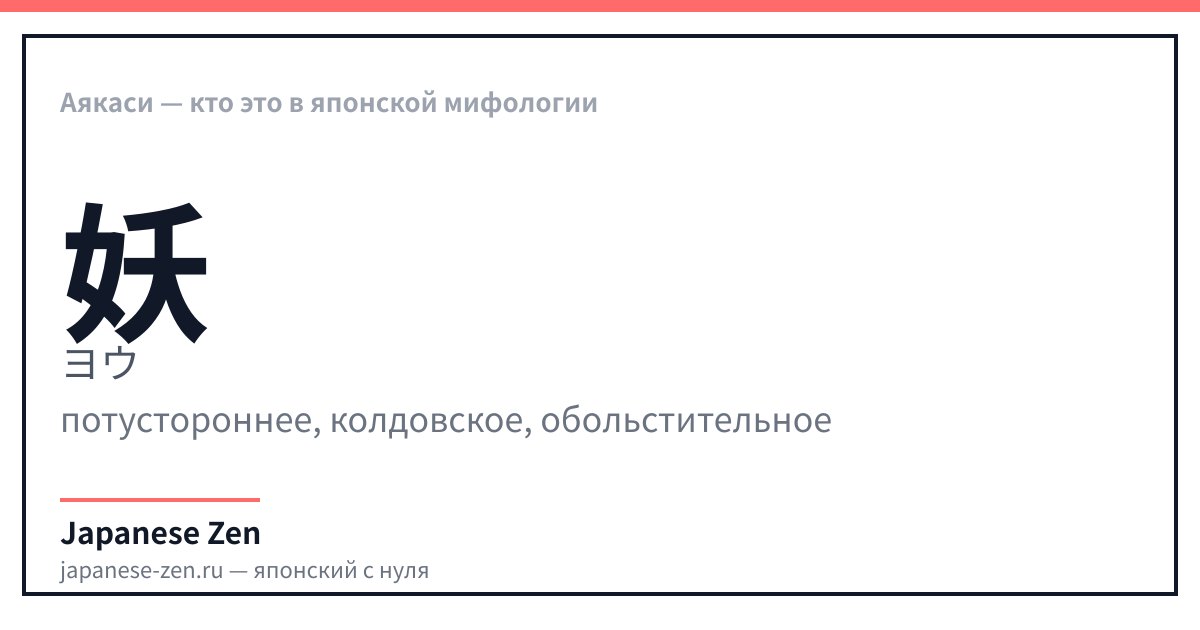
Ayakashi is a word with a double life. In old folklore, it referred to a sea spirit that appears to ships before they sink. In modern culture — anime, games, manga — it has become a collective name for supernatural beings in general, almost displacing the word "yokai." Both meanings are real, just from different centuries. The word has almost no kanji: the 妖 on the card is more a hint at its kinship with "yokai" than an exact spelling.
Ask about ayakashi and you'll get two different but equally honest answers: it depends on which century you mean, fishermen's tales or a title on a manga cover.
The Spirit That Sailors Specifically Feared
In its old meaning, ayakashi is not one specific creature but sea danger incarnate: something that appears at the side of a ship when a storm threatens to sink it. The name was given to mysterious lights over the water, and to very real but frightening-in-the-dark sharks, dolphins, and giant octopuses — any threat from the sea for which, in a moment of panic, no more precise name could be found.
- The appearance of an ayakashi was traditionally linked specifically to storms and the danger of shipwreck, not to a clear, calm night.
- The word mixed real sea animals with outright supernatural visions — fishermen did not always separate the two.
- Unlike most yokai, the ayakashi has no fixed appearance: descriptions change from story to story.
How This Differs from the Kappa and Other Water Yokai
The kappa is a freshwater dweller of rivers and ponds with a clear set of traits: a water-filled dish on its head, a love of cucumbers, a specific appearance. The ayakashi is about the open sea and the moment of danger itself, not a portrait of a specific creature: it is more a feeling that was given a name after the fact.
How a Narrow Word Came to Replace "Yokai" Entirely
The sea meaning is not the only one: over time the word went far beyond fishermen's tales. Literature helped — for example, the writer Izumi Kyoka actively used "ayakashi" in his prose for any supernatural phenomena, not just sea ones. Thus the narrow term gradually expanded into a general designation for the otherworldly.
妖 — the Common Ancestor of Half the Bestiary
The character 妖 carries two shades at once: "something otherworldly, bewitching" and "frighteningly beautiful, alluring." It appears in 妖怪 (yokai), in 妖精 (fairy), and in one of the spellings of the word ayakashi itself — 妖かし. The shared root explains why the boundary between "ayakashi" and "yokai" feels so thin to the ear.
妖 — значение: otherworldly, bewitching, alluring — онъёми: ヨウ — кунъёми: あや.しい、なま.めく、わざわ.い — 7 штрих(ов). In everyday use, the word あやかし is more often written in kana, with no kanji at all. On the card is 妖: one spelling variant using okurigana gives 妖かし, and the same character appears in the related word 妖怪 (yokai).
Trace 妖 along the guides and study the stroke order.
Is Ayakashi Already a Yokai or Not Yet
In modern colloquial and pop-culture speech — yes, almost without reservation: ayakashi and yokai are interchangeable there. But historically and terminologically, ayakashi is a narrower concept: a specific flavor of yokai tied to the sea and to the very moment of encountering the incomprehensible, not the entire vast bestiary.
| Feature | Yokai | Ayakashi |
|---|---|---|
| Scope | the entire bestiary of the supernatural | originally only a sea threat |
| Register | neutral, almost academic | literary, slightly poetic |
| Origin | folk folklore and popular compendia | fishermen's tales plus literary prose |
| Today | the standard term among researchers | a trendy word for titles and brands |
Ayakashi as a Brand: The Word Goes in the Title
- "Ayakashi Triangle" — a manga and anime that took the word itself as a title: only loosely connected to folklore, but it perfectly shows how the term works as a brand.
- Its poetic quality and slight ambiguity make "ayakashi" more attractive for a cover than the drier, more encyclopedic "yokai."
- At the same time, such titles almost never limit themselves to sea spirits in their plots — the word is used precisely in its broad, modern sense.
FAQ
- What does the word "ayakashi" mean?
- Originally, a sea spirit that appears at a ship before a storm or shipwreck. Today it is also a collective word for supernatural beings in general, especially in anime and games.
- Is ayakashi the same as yokai?
- In everyday speech, almost yes. Historically, however, ayakashi is a narrower concept: a specific sea variety of yokai, not the entire bestiary.
- Why was ayakashi considered specifically a sea spirit?
- The word was born from fishermen's omens: it named the danger that appeared at the side of a ship during a storm — from mysterious lights to real but frightening-in-the-dark sea animals.
- How did ayakashi come to mean the supernatural in general?
- Literature expanded the word: writers, including Izumi Kyoka, used it for any otherworldly phenomena, not just sea ones — and the narrow term gradually became general.
- Does ayakashi have kanji?
- The word is usually written in kana, あやかし. There is also a spelling with okurigana — 妖かし, where 妖 conveys the meaning "otherworldly, bewitching."
- Where is the word "ayakashi" used in modern culture?
- Most often in titles: the manga and anime "Ayakashi Triangle" is a direct example of the word working as a brand rather than as a folklore term.
Sources
Updated: 2026-09-09