Jorōgumo — who is it in Japanese mythology
Jorōgumo is a spider-woman shapeshifter, and Japanese mythology describes the transformation meticulously: a spider that lives to four hundred years old gains the ability to turn into a beautiful woman. Then, according to the script — playing the biwa, a silk thread, and a missing traveler. The name is also borne by a very real species of spider that in recent years has spread across the southeastern United States and regularly makes the news.
Jorōgumo is a rare case of a yōkai that hasn't stayed in the past: the real spider bearing this name is right now continuing to frighten people, just no longer with myth, but with the size of its web.
Who is Jorōgumo and how does she hunt
Jorōgumo is a spider shapeshifter: according to belief, a spider that lives to four hundred years old gains magical power and the ability to take the form of a beautiful woman. In human form, she lures a traveler — often with the sound of the biwa, a Japanese lute — and then wraps him in an invisible silk thread and drags him piece by piece into her web.
- Age: becomes a shapeshifter after 400 years of living as an ordinary spider.
- Bait: the form of a beauty, often with a musical instrument.
- Weapon: an ultra-strong silk thread with which she entangles her victim.
- Legendary location: Jōren Falls on the Izu Peninsula, long associated with tales of Jorōgumo.
How the encounter usually ends
In folklore — definitely yes: stories about Jorōgumo almost always end in the death or abduction of the victim. The real spider bearing this name (Trichonephila clavata), however, is not dangerous to humans — its bite, even if it happens, is no worse than a wasp's.
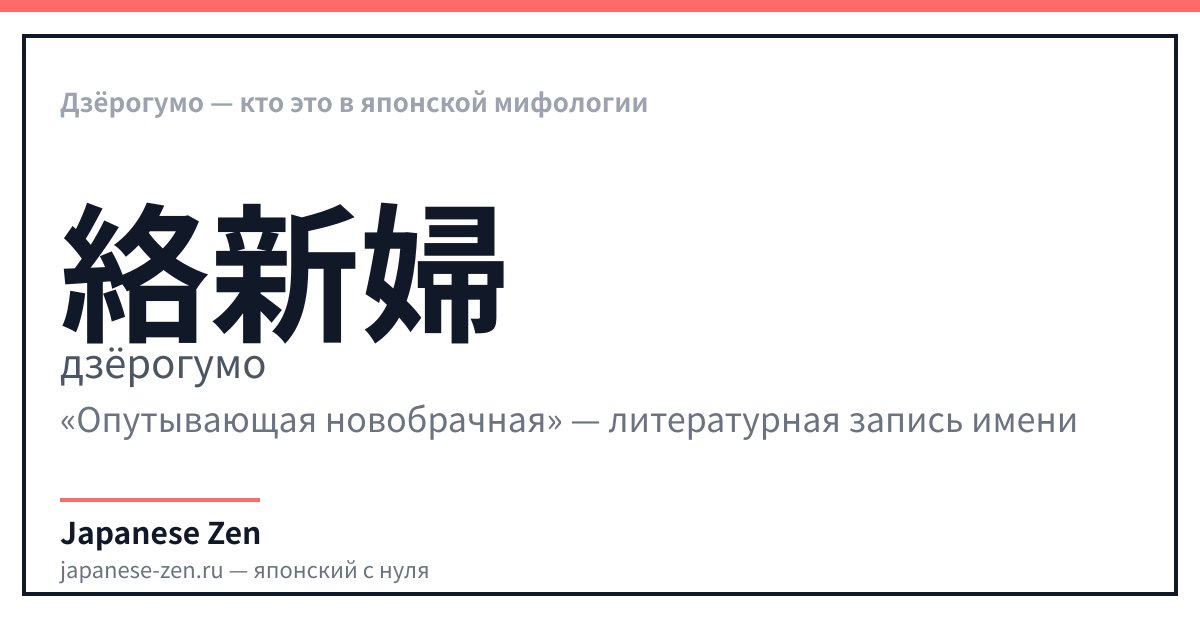
絡新婦 — “the entwining bride”
| Japanese | Reading | Translation |
|---|---|---|
| 絡新婦 | jorōgumo · jorōgumo | “The entwining bride” — the literary way to write the name |
| 女郎蜘蛛 | jorōgumo · jorōgumo | A more direct way to write the same name |
| 蜘蛛 | kumo · kumo | Spider |
| 琵琶 | biwa · biwa | Japanese lute |
| 糸 | ito · ito | Thread |
Two ways to write one name
Both written forms are read the same way — じょろうぐも. 絡新婦 is the more poetic variant: 絡 “to coil, to entwine” plus 新婦 “bride” — the image of a bride who lures and entangles her groom. 女郎蜘蛛 is read the same way but uses the direct word 蜘蛛 “spider”.
絡 — значение: coil around, get caught — онъёми: ラク — кунъёми: から.む、から.まる — 12 штрих(ов). 絡 — “to coil, to entwine, to connect with thread”: on the left is the radical “thread” 糸. The same root appears in 連絡 (connection, contact).
Write 絡 along the guides and break down the stroke order.
Jorōgumo in anime and old woodblock prints
- “Natsume's Book of Friends” and similar yōkai series periodically introduce spider-women as individual spirits with their own stories.
- “Demon Slayer” — the spider-demon image in the Hashira Training arc echoes the classic Jorōgumo motif.
- Role-playing games often use Jorōgumo as a “trap” boss: a beauty who turns into a giant spider.
- The real spider species Trichonephila clavata has been regularly mentioned in US news under its own Japanese name since the 2010s.
Where did the “beauty is actually a spider” motif come from
The motif of “the beauty is actually a spider” traces back to Chinese and Buddhist ideas about seductress demons and received its Japanese polish in Edo-period tales, where such stories were collected in kaidan anthologies for oral horror evenings.
Jōren Falls and the spider named after her
- Jōren Falls on the Izu Peninsula is the main place traditionally associated with the legend.
- The real namesake species (Trichonephila clavata) lives in Japan, Korea, China, and recently — in the southeastern United States, where it arrived accidentally.
- The large golden web of this species is not a myth but a real feature: it can reach a meter in diameter.
FAQ
- Is Jorōgumo a deity?
- No: she is a yōkai — a spider that lived to four hundred years old and gained the ability to transform into a beautiful woman to lure and entangle victims.
- What is Jorōgumo dangerous for?
- In folklore, she lures travelers with music, then entangles them with silk thread and drags them into her web. The real namesake spider is almost harmless to humans.
- How is the name Jorōgumo written?
- There are two variants: 絡新婦 (“the entwining bride”) and 女郎蜘蛛 (literally “woman-spider”). Both are read the same way — じょろうぐも.
- Where does Jorōgumo appear in anime?
- Periodically in yōkai series like “Natsume's Book of Friends,” and the spider-demon motif is recognizable in the Hashira Training arc of “Demon Slayer.”
- Where is Jorōgumo found today?
- The legend is firmly tied to Jōren Falls in Izu. And the real spider of the same name has spread across the southeastern United States since the 2010s and regularly makes the news.
- How is Jorōgumo classified: as a spirit or a shapeshifter?
- Neither in the strict sense: she is a yōkai, an animal shapeshifter that gained magical power from longevity, not a deity or the bodiless spirit of a dead person.
Sources
Updated: 2026-08-29