Monsters — who are they in Japanese mythology
In discussions of Japanese mythology, 'monsters' usually refers to physically dangerous yokai with bodies, fangs, and claws: oni, kappa, umibozu, jorogumo. A bodiless yurei spirit has a personal history and a grudge against an offender, while a monster has only habits and a way to harm if you happen to meet it.
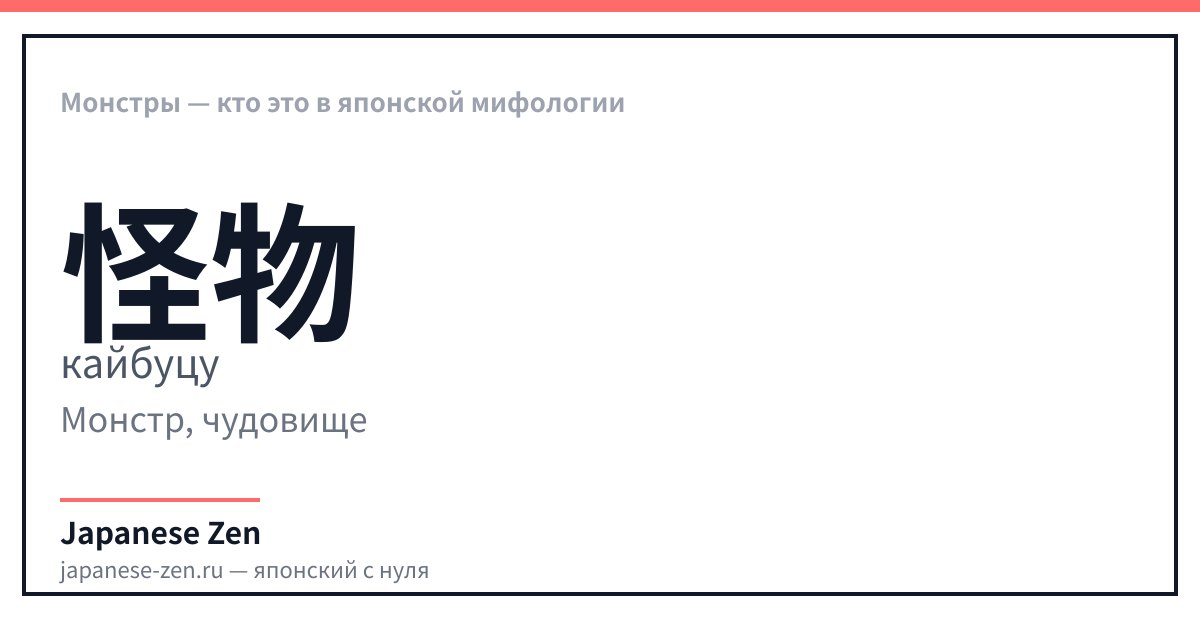
'Monster' is not a Japanese word but our own: a convenient label for anything in the bestiary that looks physically dangerous rather than merely otherworldly.
Who is called monsters in translations
In translations, 'monsters' most often refers to yokai with a clear physical body and the potential to cause direct harm: fanged oni demons, the giant silhouette of umibozu, the spider-woman jorogumo. Such a creature usually has no personal history or specific grudge, unlike bodiless yurei — it is dangerous by nature, not by motive.
- Common trait: a physical body, not a bodiless form.
- Motive: usually no personal history or revenge — it is simply the creature's nature.
- Examples: oni, umibozu, jorogumo, kasha.
- How to get rid of it: expel by force, deceive, or use a protective charm — not 'settle the matter' as with a spirit.
How dangerous are they
As a rule, yes — the very word 'monster' in Russian already implies a threat. But the degree of danger varies greatly: from deadly serious umibozu and oni to almost harmless, merely frightening-looking creatures like the karakasa umbrella.
怪物 — 'strange creature'
| Japanese | Reading | Translation |
|---|---|---|
| 怪物 | kaibutsu · kaibutsu | Monster, creature |
| 妖怪 | yōkai · yōkai | Supernatural being (broader term) |
| 怪獣 | kaijū · kaijū | Giant monster (cinematic genre) |
| 牙 | kiba · kiba | Fang |
| 爪 | tsume · tsume | Claw |
Why Japanese people would say 'yokai' rather than 'kaibutsu'
怪物 is read かいぶつ (kaibutsu): 怪 'strange, supernatural' plus 物 'thing, creature' — literally 'strange thing'. Unlike 妖怪 (yokai), which covers all things supernatural, 怪物 more often implies a physically frightening, large, or dangerous creature — hence the genre word 怪獣 (kaiju), 'giant monster' of cinema like Godzilla.
怪 — значение: suspicious, mystery, vision — онъёми: カイ、ケ — кунъёми: あや.しい、あや.しむ — 8 штрих(ов). 怪 — 'strange, supernatural': the heart radical 忄 on the left, 'wonderful' on the right. The same character appears in 妖怪 (yokai) and 怪談 (ghost story).
Write 怪 along the guides — the root character of the entire supernatural dictionary.
What is confused: monster and mononoke
| Trait | Monster | Mononoke |
|---|---|---|
| Nature | physical, corporeal being | bodiless possession or curse |
| How it manifests | visible, tangible | through illness, madness, misfortunes |
| Example | oni, umibozu, jorogumo | curse placed by an evil spirit |
| How to fight | by force or cunning | through exorcism ritual or exorcism |
The boundary runs along corporeality: if the creature can be seen and touched — it's a monster; if it's about an inexplicable illness or delusion without a cause — it's more likely mononoke.
FAQ
- Who are called monsters of Japanese mythology?
- A colloquial collective name for physically dangerous yokai with a clear body — oni, umibozu, jorogumo, and the like. A monster rarely has a personal history or motive — that's what distinguishes it from a spirit.
- What do monsters look like?
- It varies depending on the specific creature: fangs and claws for oni, a giant silhouette for umibozu, spider legs for jorogumo. The common feature is a clearly physical, not ghostly, form.
- How do you write 'monster' in Japanese?
- 怪物 (かいぶつ): 怪 'strange' plus 物 'thing'. Unlike the broader 妖怪 (yokai), this word more often implies a physically frightening creature.
- Are all of them dangerous?
- Most often dangerous by default — the word itself implies a threat. The degree of danger varies greatly: from deadly serious to merely frightening-looking but harmless creatures.
- In which anime do Japanese monsters appear?
- Practically in any yokai series — from 'Natsume's Book of Friends' to 'Inuyasha'. The kaiju genre (giant monsters like Godzilla) grew from the same root concept 怪 as mythological monsters.
- How are monsters different from Mononoke?
- A monster is physically visible and tangible, while mononoke is a bodiless possession or curse that manifests through illness or misfortunes without a visible cause. They have to be fought differently.
Sources
Updated: 2026-08-29