Baku — who is it in Japanese mythology
Baku is a dream-eating spirit: Japanese mythology describes it as a chimera with an elephant's trunk, rhinoceros eyes, bull's tail, and tiger paws. After waking from a scary dream, it is believed that you should call out: 'Baku-san, eat my dream' — and he will take the nightmare away. The same word 獏 in modern Japanese also refers to a very real animal — the tapir.
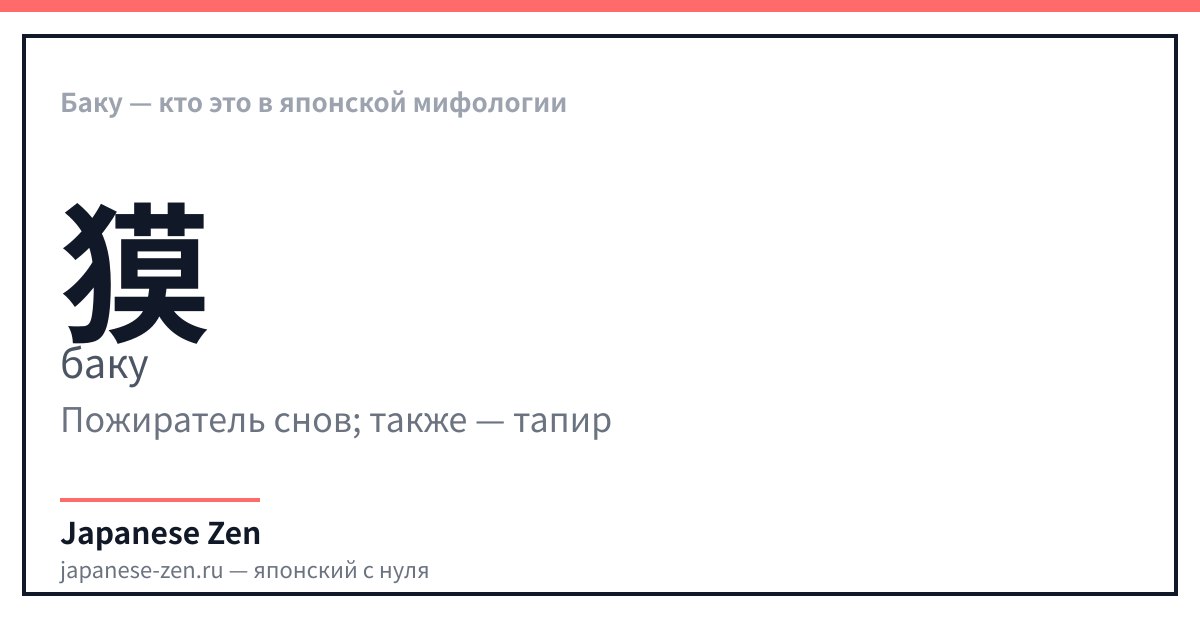
Baku is a rare yokai with a job description strictly for good: it doesn't scare, but eats away others' fear. Just don't confuse it with the ordinary tapir, which also answers to this name.
Who is baku and what is it made of
Baku is a chimera assembled from parts of several animals: the trunk and head of an elephant, the eyes of a rhinoceros, the tail of a bull, and the paws of a tiger. Its only known 'function' is to eat the nightmares of sleeping people: if you call baku immediately after waking from a scary dream, according to belief, the bad vision will disappear without a trace, eaten by the spirit.
- Appearance: elephant trunk, rhinoceros eyes, tiger paws, bull tail.
- Ability: eats nightmares upon the sleeper's call.
- Summoning ritual: say 'Baku-san, eat my dream' three times right after waking.
- Charm: an image or the character 獏 under the pillow — protection against bad dreams in the future.
Can baku cause harm
Completely harmless — a rare case of a yokai devoid of any malicious intent. The only old caveat: it is not recommended to call baku too often, because without fresh nightmares it risks going hungry and, according to some versions, might eat good dreams as well.
獏 — a sign shared by spirit and tapir
| Japanese | Reading | Translation |
|---|---|---|
| 獏 | baku · baku | Dream eater; also — tapir |
| 夢 | yume · yume | Dream, vision |
| 悪夢 | akumu · akumu | Nightmare |
| 獏さん、夢を食べてください | Baku-san, yume o tabete kudasai · Baku-san, yume o tabete kudasai | 'Baku-san, eat my dream' — summoning phrase |
| 食べる | taberu · taberu | To eat |
How to read 獏 and where the sign came from
獏 is read ばく (baku). The character came from China, where it originally denoted a similar-looking real animal — the ancestor of the modern tapir. The mythological function of 'dream eater' is a Japanese, local addition to the borrowed image.
獏 — значение: tapir — онъёми: バク、ミャク — 13 штрих(ов). 獏 — 'baku': on the left the radical 'beast' 犭, on the right the phonetic element. The same sign names both the mythical chimera and the real tapir.
Write 獏 along the guides and learn the stroke order.
What gets confused: baku-spirit and baku-tapir
| Feature | Baku-spirit | Baku-tapir |
|---|---|---|
| What it is | mythical chimera made of parts of different animals | real mammal with a small trunk |
| Where it lives | in beliefs, comes when called by the sleeper | Southeast Asia and South America |
| Abilities | eats nightmares | eats leaves and aquatic plants |
| Character | 獏 | 獏 (same word) |
A one-second check: eats dreams — spirit, eats leaves — tapir. The coincidence of the word is not accidental: the original Chinese image of the mythical beast apparently really was based on vague descriptions of a real animal.
FAQ
- Who is baku?
- A dream-eating spirit, a chimera with an elephant's trunk, rhinoceros eyes, and tiger paws. Call him after a scary dream — and, according to belief, the nightmare will disappear, eaten by baku.
- What does baku look like?
- It is assembled from parts of several animals: elephant trunk, tiger paws, bull tail, rhinoceros eyes. The same name and sign in Japanese also refer to the real tapir.
- How do you write 'baku' in Japanese?
- 獏, read as ばく (baku). The same character historically came from China, where it denoted an animal similar to the modern tapir.
- Is baku evil or good?
- Good — a rare yokai without malicious intent, helping to get rid of nightmares. The only caveat in beliefs is not to overuse the summoning, so that a hungry baku doesn't eat good dreams as well.
- In which anime does baku appear?
- It often appears as a minor spirit in series about yokai and dream-related magic — usually in episodes involving nightmares and characters' dreams.
- How is the baku-spirit different from the baku-tapir?
- The baku spirit eats dreams and exists only in beliefs; the tapir is a real herbivorous animal from Southeast Asia and South America. They are united only by the common word 獏 in Japanese.
Sources
Updated: 2026-08-29