Nekomata — who it is in Japanese mythology
Nekomata is a cat that has lived to a great old age and turned into a yokai with a forked tail: according to belief, the tail of a long-lived cat slowly splits in two, and along with this the cat gains magical power. There are two kinds: the mountain nekomata, which lives wild in the forests and, according to legend, attacks people, and the domestic one — a former favorite that grew old in its owner's house. The first written mention is in the essay "Tsurezuregusa" by the monk Kenko, 14th century.
The Japanese custom of not keeping a cat too long is not a superstitious fear of a pet's old age: it is a direct echo of the belief in the nekomata, a beast whose tail forks with age and whose nature ceases to be feline.
Nekomata: when a cat's tail forks
Nekomata is an aged cat that has gained supernatural power: the main sign is a tail forked at the tip, which, according to belief, splits when the cat lives long enough. From that moment it can speak in a human voice, walk on its hind legs and take on human form, and in some stories — raise the dead and dance. There are two kinds: the mountain nekomata, which lives wild in forests far from people and is considered dangerous, and the domestic one — a former favorite that grew old beside its owner.
- Signs: a tail forked at the tip, an unnaturally long life, a gaze as if the cat understands everything.
- Abilities: human speech, walking on two legs, shapeshifting, and according to some versions — necromancy.
- Mountain kind: lives far from people, larger than an ordinary cat, considered truly dangerous.
- Domestic kind: a former favorite whose tail eventually forked right in its owner's house.
At what age a cat should fear its own tail
Folklore does not name an exact age — sources differ, naming either ten or far more years — but the general principle is the same: the longer a cat lives, the higher the chance that its tail will begin to fork. This same fear, according to one version, gave rise in Japan to the fashion for short-tailed bobtail cats: a naturally short tail simply has nothing to fork.
猫又 — the cat that is a cat "again"
| Japanese | Reading | Translation |
|---|---|---|
| 猫又 | nekomata · nekomata | A shapeshifting cat with a forked tail |
| 猫 | neko · neko | Cat |
| 尻尾 | shippo · shippo | Tail |
| 二股 | futamata · futamata | Fork, split — what happens to the tail |
| 化け猫 | bakeneko · bakeneko | A related yokai — a transformed cat, not an aged one |
What the second half of the name means — 又
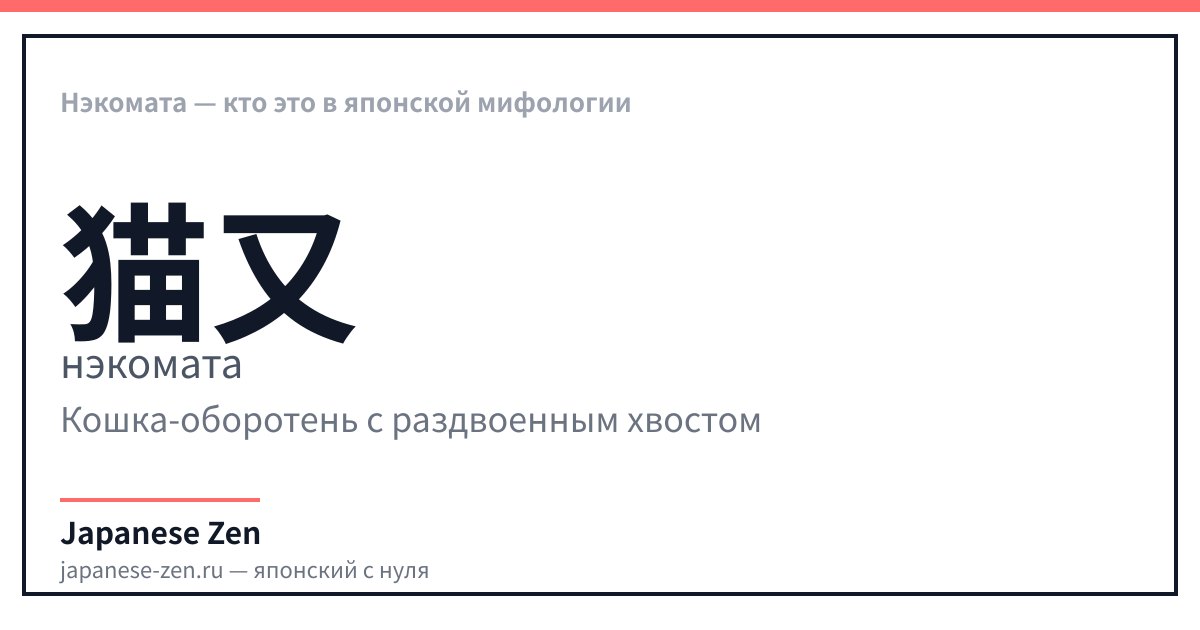
猫又 is read ねこまた: 猫 means "cat", while 又 on its own means "again, once more" and in this name hints at the fork — "a cat that is now as if two". The same character 又 also appears in the ordinary conjunction "also, moreover", with no mysticism at all.
猫 — значение: cat, tomcat — онъёми: ビョウ — кунъёми: ねこ — 11 штрих(ов). 猫 — "cat": 11 strokes, on the left the radical "beast" 犭, on the right the phonetic 苗. The same radical 犭 appears in 狐 (fox) and 狼 (wolf).
Write 猫 along the guides and work through the stroke order.
Nekomata in literature, prints and anime
- "Tsurezuregusa" (徒然草) by the monk Kenko, 1330s, is the earliest known written mention of the word "nekomata": the author writes of a beast in the mountain wilds that eats people.
- The artist Toriyama Sekien included the nekomata in his 18th-century catalog of yokai along with the rokurokubi, kappa and yuki-onna.
- Kirara from "Inuyasha" is a two-tailed cat companion able to transform into a large beast with fire on its paws and tails: a classic image of the nekomata carried over into an adventure anime.
- In the Shin Megami Tensei games, the nekomata is one of the summonable demons with its own name and abilities.
How the same beast ended up both in the mountains and in the house
Originally, judging by "Tsurezuregusa", the nekomata was a purely mountain monster the size of a dog. Only by the Edo period did a parallel belief take shape about domestic cats that can themselves become a nekomata if they live long enough — so the same yokai split into a wild and a domestic version, almost like its own tail.
Nekomata or bakeneko: how to tell who is in front of you
| Trait | Nekomata | Bakeneko |
|---|---|---|
| How it becomes a yokai | the tail forks with age | living long is enough, the tail does not matter |
| Where it lives | mountain kind — in forests; domestic kind — in the house | almost always in the house, among people |
| Main trick | human speech, sometimes necromancy | replacing the owner, pretending to be human |
| Danger | the mountain kind is considered a serious threat | cunning, but more often acts by stealth |
The easiest way to remember is this: nekomata is about the tail and age, bakeneko is about transformation and replacement. If in a story a cat grows a second tail — it is a nekomata; if it frighteningly accurately imitates the lady of the house — it is a bakeneko. A detailed breakdown of the bakeneko and the story of the cat from the Nabeshima clan is on a separate page.
FAQ
- Who is the nekomata in Japanese mythology?
- Nekomata is a cat that has lived to a great old age and gained magical power: the main sign is a tail forked at the tip. There are two kinds: the wild mountain kind and the domestic kind that grew up in its owner's house.
- How can you tell that a cat's tail has forked?
- In folklore this happens gradually with age — sources do not name exact times. It is precisely this fear, according to one version, that made short-tailed bobtail cats popular in Japan.
- How is "nekomata" written and what does it literally mean?
- 猫又, read ねこまた: 猫 "cat" plus 又 "again, once more" — a hint at the fork, "a cat that is as if two".
- How does the nekomata differ from the bakeneko?
- The nekomata gains power from age and a forked tail, and often lives wild in the mountains. The bakeneko is almost always a domestic cat whose main trick is transformation and replacing its owner, not the tail.
- When was the nekomata first mentioned?
- In the essay "Tsurezuregusa" by the monk Kenko, written in the 1330s: it describes a mountain beast that devours people — the earliest known written evidence of the nekomata.
- In which anime does the nekomata appear?
- The most famous example is Kirara from "Inuyasha", a two-tailed cat companion able to transform into a large fiery beast. In the Shin Megami Tensei games, the nekomata is a summonable demon.
Sources
Updated: 2026-09-09