Japanese Demons — Who Is Really Hiding Behind the Word
Japanese demons — that's what English speakers usually call several different creatures at once: the horned strongman oni, the shapeshifting yokai, the restless spirit yurei, the sea ayakashi. None of them resembles the European demon with horns from hell and a deal for your soul. Let's figure out which of them is actually closest to that word, and which just got stuck with it by a translation accident.
Japanese has its own word for the devil in the European sense — 悪魔, akuma. It has almost nothing to do with the bestiary of oni, yokai, and yurei, and that's already half the answer to the question of who is even called a "demon" here.
Four Words That Wrongly Share One Translation
In the Japanese worldview there is no hell with eternal torment and no deals for the soul — the framework that the European demon rests on. That's why the word "demon" in translations gets attached to several different creatures at once, simply for lack of a more precise term. Below is who is actually hiding behind it most often.
| Who | What it actually is | Does it resemble a demon? |
|---|---|---|
| Oni (鬼) | a horned man-eating giant, guardian of the Buddhist hell | closest of all: clearly dangerous, clearly an adversary |
| Yokai (妖怪) | any supernatural creature, not necessarily evil | rarely: most yokai are just strange, not evil |
| Yurei (幽霊) | the spirit of a dead person with a personal story | no: it's a former human, not a separate breed of evil |
| Ayakashi (あやかし) | a sea spirit, and in modern culture a synonym for yokai | no: it frightens by the unknown, not by evil intent |
Which of the Four Words Is Closest to "Demon"
If you had to pick one, it's the oni: horned, fanged, openly hostile, and deserving of its own annual exorcism ritual. But even it is not demonic in the Christian sense — there is no hell with eternal torment and no bargaining for the soul in this worldview.
A Separate Question: What Does "Oni Demon" Mean
"Oni demon meaning" is mostly searched for because of tattoos and games. Oni (鬼) is a horned strongman with fangs, a tiger-skin loincloth, and a spiked club called a kanabo: brute destructive force with no hidden depth, driven out with beans at the Setsubun festival rather than with prayer. It still doesn't become closer to the classic European demon — it's just the most unambiguously dangerous character of the whole four.
悪魔 — The Word That Got Along Without Folklore
| Japanese | Reading | Translation |
|---|---|---|
| 鬼 | oni · oni | Demon, horned man-eating giant |
| 妖怪 | yōkai · yōkai | Supernatural creature in general |
| 幽霊 | yūrei · yūrei | Spirit of a dead person |
| あやかし | ayakashi · ayakashi | Sea spirit; in modern culture a synonym for yokai |
| 悪魔 | akuma · akuma | Devil, Satan — a demon specifically in the Christian sense |
Why Akuma Is Not the Same as Oni
Japanese has a separate word specifically for the devil in the Christian understanding — 悪魔 (akuma), "evil spirit, Satan." It has almost nothing to do with the local bestiary: the word entered the language along with translations of the Bible and European literature, rather than growing out of Shinto or Buddhist legends. So when a translator writes "demon" for oni, yokai, or yurei, they are choosing not an exact term but the closest one in spirit.
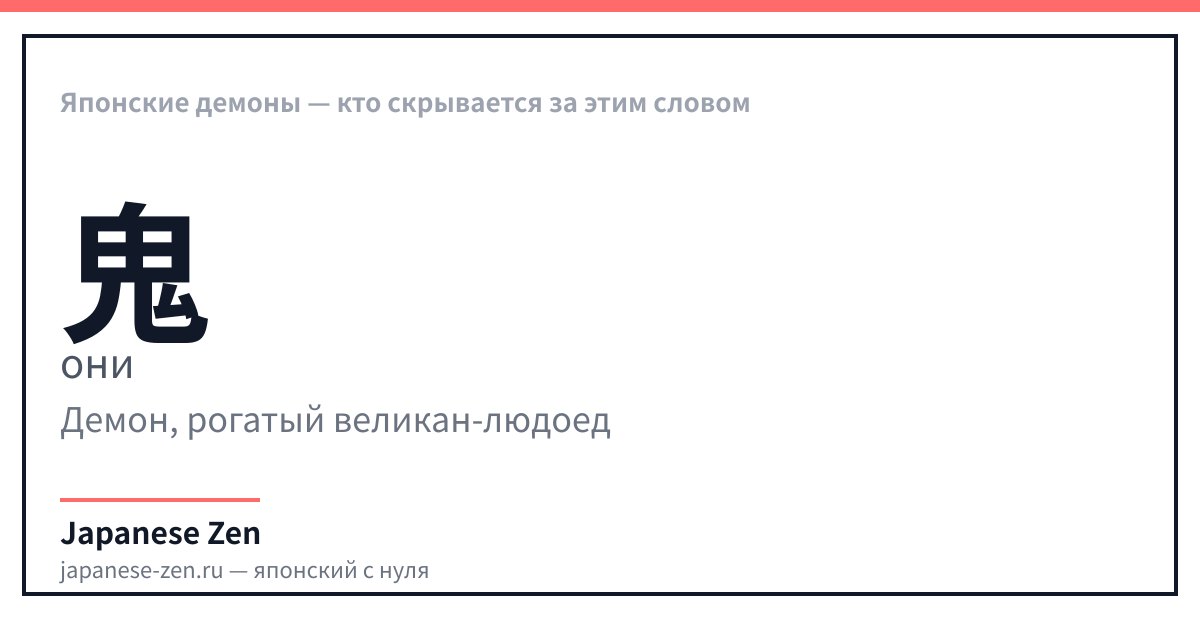
鬼 — значение: demon, ogre, fiend — онъёми: キ — кунъёми: おに、おに- — 10 штрих(ов). 鬼 — "demon, ogre": on top, disheveled hair; below, a body with a hook-like tail. The same character also has a peaceful meaning — in 鬼籍 (kiseki, "register of the dead") it simply refers to the deceased, with no malice at all.
Write 鬼 along the guides and work through the stroke order.
Where the Habit of Calling Them All "Demons" Came From
The word "demon" stuck to Japanese monsters not because of an exact match in meaning, but out of convenience: English has no separate niche for "a dangerous non-human creature without a clear connection to hell," and "demon" feels closest. In translations of games, anime, and tattoo catalogs, it has become a universal label for everything scary and horned at once.
- In video game translations, oni, large yokai, and spirits from different parts of the bestiary often end up in one common list of "demons" — it's easier for the interface than explaining the difference.
- Tattoo catalogs in English almost always label the oni mask with the word "demon," even though in Japan itself it is primarily a character from fairy tales and festivals, not an occult symbol.
- "Demon Slayer" is called 鬼滅の刃 in the original — literally "the blade that exterminates oni," with no generalized word "demon" at all.
FAQ
- Who are Japanese demons, really?
- Under this name, English mixes several different creatures: the horned oni, the shapeshifting yokai, the restless yurei, the sea ayakashi. The closest to a demon is the oni, but even it doesn't fit the Christian picture of hell.
- Is the oni a demon in the European sense of the word?
- Closest of the four, but not entirely: the oni is a horned man-eating giant and guardian of the Buddhist hell, yet there is neither eternal torment nor bargaining for the soul in this worldview.
- What does "oni demon" mean?
- A horned strongman with fangs, in a tiger skin, with a spiked club called a kanabo — the embodiment of brute destructive force. It is driven out with beans at the Setsubun festival, not by exorcism.
- Does Japanese have a separate word for demon?
- Yes, 悪魔 (akuma) — "devil, Satan" in the Christian sense. It has almost nothing to do with the local bestiary: the word entered the language along with translations of the Bible.
- How is a yokai different from a demon?
- A yokai is simply a "strange creature," with no obligatory malice: an animated umbrella and a water kappa are also yokai. A demon in translations is almost always unambiguously dangerous, and such are a minority among yokai.
- How are Japanese demons most often written in kanji?
- Most often people mean 鬼 (oni) — "demon, ogre." If the reference is specifically to the devil in the Christian sense, a different word is used — 悪魔 (akuma).
Sources
Updated: 2026-09-09