Gashadokuro — the giant skeleton of Japanese folklore
Gashadokuro is a giant skeleton yokai at least ten meters tall: according to belief, it forms from the bones of people who died in battle or from starvation and were left unburied. At night the gashadokuro wanders and rattles its bones — hence the name: がしゃ conveys the sound itself, and どくろ means "skull." The most recognizable portrait of the gashadokuro is the giant skeleton in Utagawa Kuniyoshi's print, although the word itself appeared in the language a century after that image.
The gashadokuro has an unusual fate for a yokai: its most recognizable portrait is a good hundred years older than its name — the image appeared in the 19th century, while the word "gashadokuro" only attached itself to it in the 20th.
A skeleton as tall as an apartment building
The gashadokuro is a spirit in the form of a colossal skeleton: its height, by various accounts, ranges from ten meters and up. According to belief, it assembles from the bones of people who died on the battlefield or from starvation and were left unburied — accumulated resentment multiplies the bones into a single being. At night the gashadokuro wanders in search of lone travelers; the sound helps you notice it first — the characteristic "gasha-gasha" of grinding bones, which gave it its name.
- Height: from ten meters, in some accounts noticeably more.
- What it is made of: the bones of unburied victims of war or famine.
- When it is active: at night, far from human dwellings.
- Identifying sign: the rattling "gasha-gasha" sound as it moves.
Does it really attack people?
In folk belief — yes: the gashadokuro grabs and kills a traveler unlucky enough to meet it at night in a deserted place. As with most such stories, there are no documented encounters — this is part of the folklore about the unburied dead, not a description of a real incident.
がしゃどくろ — a name younger than its most famous picture
| Japanese | Reading | Translation |
|---|---|---|
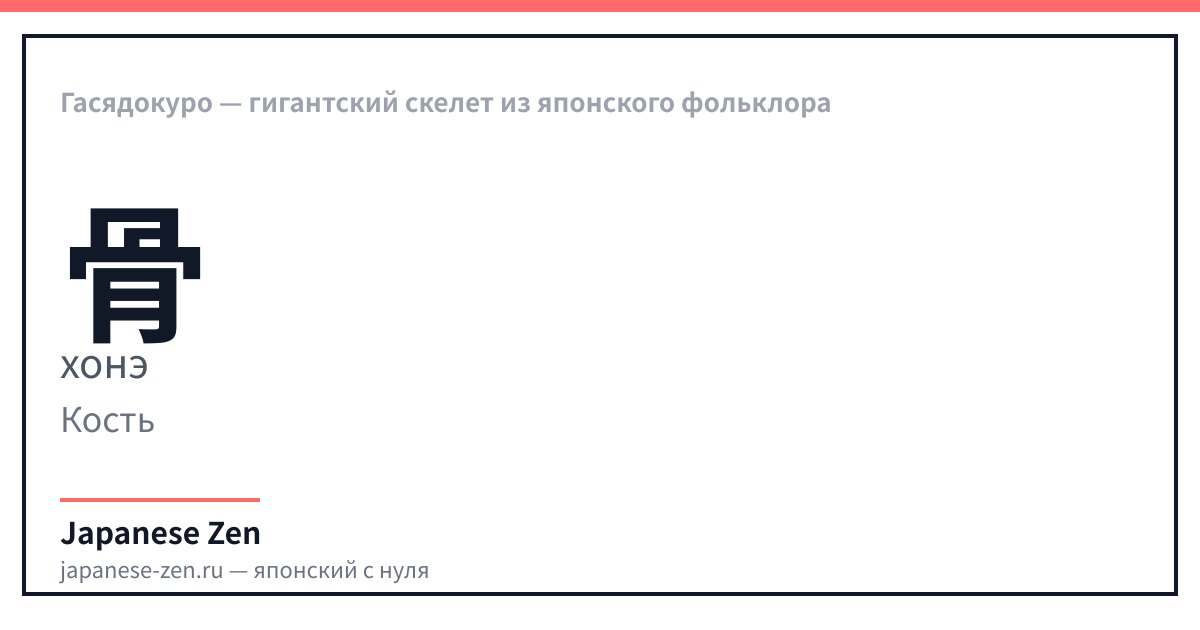
| 骨 | hone · hone | Bone |
| 骸骨 | gaikotsu · gaikotsu | Skeleton, remains |
| 餓死 | gashi · gashi | Starvation |
| 巨人 | kyojin · kyojin | Giant, colossus |
The word is assembled from two parts: がしゃ — an onomatopoeia for that very clatter and grinding of bones, and どくろ (髑髏) — "skull, skeleton." The combination がしゃどくろ itself is written in kana: it has no established kanji spelling.
What does Utagawa Kuniyoshi's print have to do with it?
The most famous "portrait" of the gashadokuro is Utagawa Kuniyoshi's print "Sōma no Furudairi" (相馬の古内裏, mid-1840s): in it, Princess Takiyasha summons a colossal ghostly skeleton against the warrior Ōya no Mitsukuni. In the earlier literary source that Kuniyoshi drew on, there were many spirits of ordinary height — the artist was the first to gather them into a single gigantic being. The name "gashadokuro" has nothing to do with this picture: it appears in print only from the mid-20th century, in the work of Morihiro Saitō, author of books about monsters — the image and the name were joined retroactively, more than a century after the print itself.
骨 — значение: bone, remains — онъёми: コツ — кунъёми: ほね — 10 штрих(ов). 骨 — "bone": the same character appears in 骸骨 "skeleton" and in 骨組み "framework, frame." The word "gashadokuro" itself contains no kanji, but the semantic bridge to it runs precisely through 骨.
Write 骨 along the guides and break down the stroke order.
Gashadokuro in anime and games
- "Nura: Rise of the Yokai Clan" — in the second season, the gashadokuro appears as one of the hostile Kyoto yokai, acting alongside the spirit Kyōkotsu.
- The "Shin Megami Tensei" series — the gashadokuro appears as one of the summonable demon allies.
- "Yo-kai Watch" — the image of the giant skeleton has also found a place among the game's yokai.
Why such a yokai fares better in games than in anime
A giant opponent you can't mistake for anyone else is a ready-made final boss design, so the gashadokuro suits games better than series: in anime it's harder to keep it in frame, while in a game scale is exactly what you need.
The gashadokuro is not the same as Kuniyoshi's print
| What we compare | Gashadokuro (the yokai image) | Kuniyoshi's print |
|---|---|---|
| When it appeared | the name — from the mid-20th century | the picture — mid-1840s |
| What it is | a composite spirit made of the bones of the unburied | a specific scene: Princess Takiyasha and the warrior |
| The title on the picture itself | does not appear | "Sōma no Furudairi" (相馬の古内裏) |
The confusion arises precisely because modern books about yokai almost always illustrate the entry on the gashadokuro with this very print — and rightly so: you just have to remember that the name was attached to the picture only later.
FAQ
- What is the gashadokuro?
- A spirit in the form of a colossal skeleton at least ten meters tall, which, according to belief, assembles from the bones of people who died in battle or from starvation and were left unburied.
- What is the gashadokuro believed to be made of?
- From the bones of unburied victims of war or famine — their resentment and the accumulated bones, according to legend, combine into one enormous being.
- Where did the name "gashadokuro" come from?
- The name is composed of がしゃ — an onomatopoeia for the grinding of bones — and どくろ "skull." It appears in print from the mid-20th century, noticeably later than the most famous depiction of such a skeleton.
- Is the gashadokuro depicted in the famous print with the skeleton?
- Not exactly: the famous print by Utagawa Kuniyoshi, "Sōma no Furudairi" (mid-1840s), depicts a giant skeleton from a different legend — about Princess Takiyasha — and the name "gashadokuro" was attached to this image only decades later.
- Is the gashadokuro evil?
- In folklore — yes: the gashadokuro hunts lone travelers at night. Documented encounters, of course, do not exist.
- In which anime and games does the gashadokuro appear?
- For example, in the second season of "Nura: Rise of the Yokai Clan" and in the "Shin Megami Tensei" and "Yo-kai Watch" game series, where the giant skeleton is a recognizable opponent.
Sources
Updated: 2026-09-09