Cute Kaomoji: Japanese Emoticons to Copy
Cute kaomoji are Japanese emoticons made from ordinary characters: big eyes, blush, ears, and hugging arms. Below are three tables of ready-made faces, each can be copied with a click. There is also a breakdown of which character draws what and why rare symbols turn into squares on old phones.
A cute kaomoji relies on a few tricks: round sparkling eyes, a small curved mouth, and blush on the cheeks. Below you can see which characters are responsible for this, how a bear differs from a cat, and how to check that the emoticon reaches your friend without breaking. A separate table covers bears and puppies whose cheeks and ears are drawn with letters from phonetic alphabets.
Cute Kaomoji to Copy
Click on an emoticon in the first column — it will be copied to your clipboard. Then just paste it into a message, caption, or profile description.
Smiles and Big Eyes
| Kaomoji | What it expresses |
|---|---|
| (◕‿◕) | big cute eyes |
| (。◕‿◕。) | radiant smile |
| (◠‿◠) | calm smile |
| (。・ω・。) | face with round eyes |
| (´∀`) | warm smile |
| (^‿^) | open joy |
| (*´▽`*) | happiness with blush |
| (〃´∀`〃) | shy smile |
| (〃ω〃) | bashful face |
| (˘ω˘) | content and sleepy |
| (๑>◡<๑) | squinting joy |
| (。•ᴗ•。) | affectionate smile |
| (◍•ᴗ•◍) | gentle look |
| (*^‿^*) | soft smile |
Bears, Puppies, and Other Eared Creatures
| Kaomoji | Who it is |
|---|---|
| ʕ•ᴥ•ʔ | bear cub |
| ʕ·ᴥ·ʔ | bear cub with dot eyes |
| ʕ´•ᴥ•`ʔ | bear with blush |
| U・ᴥ・U | puppy |
| (ᵔᴥᵔ) | kind doggy |
| (◕ᴥ◕ʋ) | puppy with sparkling eyes |
| (❍ᴥ❍ʋ) | puppy with huge eyes |
| (・(ェ)・) | bear face |
| ( ̄(エ) ̄) | brown bear |
| ( ´(ェ)` ) | bear with blush |
| (•ө•) | chubby little animal |
| ₍ᐢ。•ᴗ•。ᐢ₎ | little animal with ears |
Hugs, Flowers, and Sparkles
| Kaomoji | What it expresses |
|---|---|
| (づ。◕‿‿◕。)づ | hugs |
| ⊂((・▽・))⊃ | tight embrace |
| (っ˘ω˘ς) | sleepy hug |
| (つ✧ω✧)つ | asking for a hug |
| (っ´▽`)っ | open arms |
| (ノ◕ヮ◕)ノ*:・゚✧ | delight with sparkles |
| (*・ω・)ノ | quiet hello |
| (๑˃ᴗ˂) | squinting tenderness |
| (*≧▽≦) | joyful squeal |
| ヽ(´▽`)/ | hooray, hello everyone |
| ☆*:.。.o(≧▽≦)o.。.:*☆ | festive sparkles |
| (✿◠‿◠) | smile with a flower |
| (◕ᴗ◕✿) | smile with a little flower |
What a Cute Face Is Made Of
Kaomoji are not drawn but assembled from ready-made characters, like a construction set. Cuteness almost always comes from one set of parts.
Eyes, Mouth, and Blush
- Eyes: the circle ◕ with a filled part gives a 'wet' look, the dot • is simple, and the arcs ^ and ◠ are squinting from joy.
- Mouth: the arc ‿ is a smile, the Greek omega ω is a 'cat' mouth made of two rounded shapes, and the letter ᴥ is an animal's nose and mouth.
- Blush: the Japanese repetition mark 〃 in an emoticon reads as strokes on the cheeks, and asterisks * on the sides as sparkle.
- The circle 。 is the same character as the Japanese period '。', only narrow: in an emoticon it frames the face like cheeks.
Ears, Hands, and Framing
The brackets ʕ and ʔ are letters from phonetic alphabets; in a bear cub they draw cheeks and ears. Stick arms ⊂ ⊃ and っ reach out to you from both sides: you get a hug. Sparkles ✧ and ☆ are just decoration, they can be swapped.
How to Use and Why Squares Appear
Where to Paste
Kaomoji are plain text, not an image, so they can be pasted anywhere that accepts any characters: in messages, captions, comments, and profile descriptions. You can copy and paste them just like a word.
Squares Instead of an Emoticon
Each character needs a symbol in the device's font. Kana, Latin letters, and ordinary brackets are available on any phone, but rare symbols like ᴥ, ᐢ, or ʋ are not drawn by old systems and are replaced with an empty rectangle. Send the emoticon to yourself and see how it looks before putting it somewhere important.
Name and Kanji: 可愛い
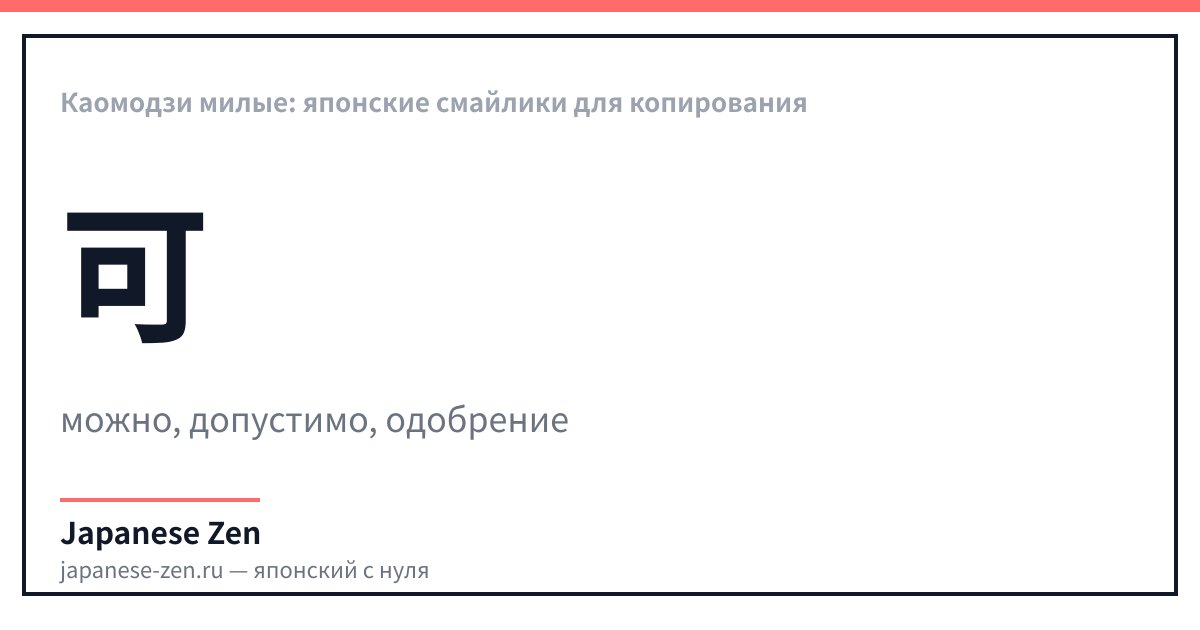
可 — значение: possible, permissible, approval — онъёми: カ、コク — кунъёми: -べ.き、-べ.し — 5 штрих(ов). 可 — the character for 'possible, permissible', the first half of the word 可愛い 'cute'. The spelling was chosen by meaning, so the whole word is read: かわいい.
How the Word 'Cute' Is Written
The word 可愛い (kawaii) is written with two characters: 可 'possible' and 愛 'love'. The reading かわいい applies to the whole word at once; it cannot be broken down by character. Kaomoji itself in Japanese is 顔文字: 顔 'face' and 文字 'characters'.
| Japanese | Reading | Translation |
|---|---|---|
| 可愛い | kawaii · kawaii | Cute, pretty |
| 顔文字 | kaomoji · kaomoji | Kaomoji, 'face made of characters' |
| 笑顔 | egao · egao | Smiling face, smile |
| 耳 | mimi · mimi | Ear |
| 熊 | kuma · kuma | Bear |
FAQ
- What kinds of cute kaomoji are there and how do I copy them?
- Cute kaomoji are faces with big eyes, blush, and ears: smiles, bear cubs, puppies, hugs. To copy, click on the emoticon in the first column of the table, then paste it into a message or profile description.
- How do I draw ears in a kaomoji?
- Ears are placed on the sides of the face: for a bear cub these are ʕ and ʔ, for a bunny or cat the arcs ᐢ and ₍ ₎. It's easier to take a ready-made face from the table 'Bears, Puppies, and Other Eared Creatures' and copy it whole.
- Why do squares appear instead of an emoticon?
- The device's font lacks one of the characters, and it is replaced with an empty rectangle. Most often rare symbols like ᴥ and ᐢ are the culprits. Kana, Latin letters, and ordinary brackets display on any phone.
- What does the word 'kawaii' mean and what does it have to do with emoticons?
- 可愛い (kawaii) means 'cute, pretty'. That's what Japanese people call anything that evokes affection: animals, faces, small things. Cute kaomoji are built from characters that make the face round, soft, and slightly shy.
- How does a cute emoticon differ from an ordinary smile?
- An ordinary smile is dot eyes and a curved mouth. In a cute emoticon, sparkle is added to the eyes, blush 〃 and asterisks, and the mouth is made small: ω or ᴥ. The face becomes round and a little shy.
Sources
Updated: 2026-09-29