Kaomoji: Japanese emoticons made from symbols — list
Kaomoji (顔文字, "face characters") are Japanese emoticons assembled from keyboard letters and symbols: (^▽^), (`Д´), ¯\_(ツ)_/¯. Unlike the Western :-) they are read upright, without tilting your head: the emotion is carried by the eyes. Below are tables where each emoticon can be copied with one tap, plus a breakdown of the symbols they are built from.
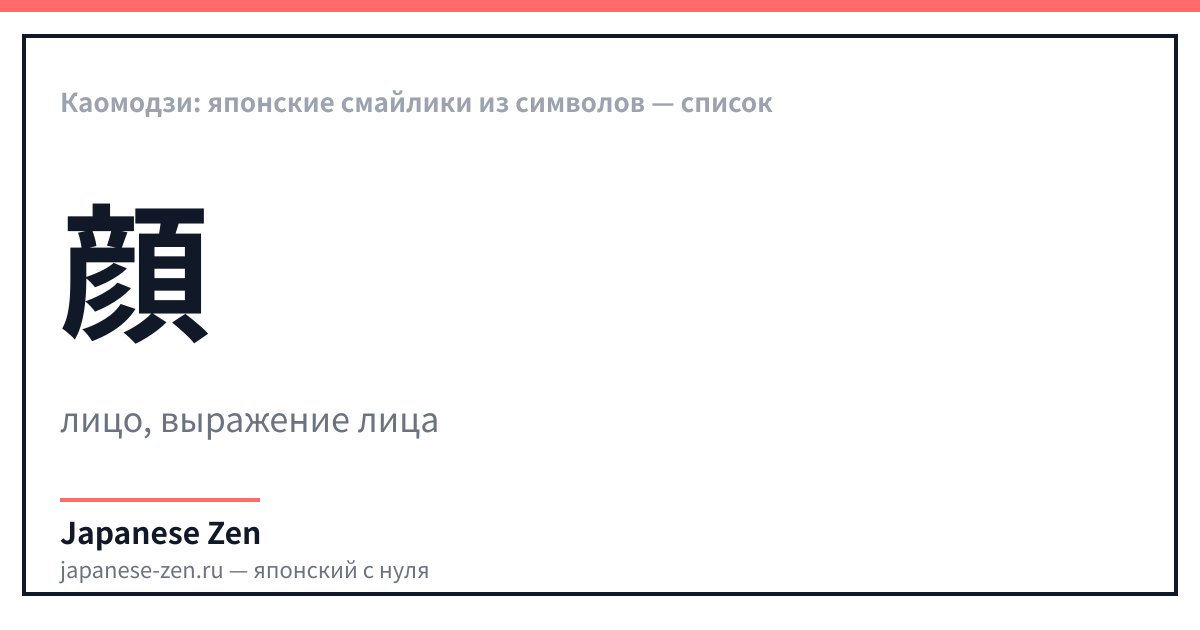
Kaomoji work anywhere there is text: in Telegram, in a nickname, in a profile bio. Below are ready-made emoticons by emotion, a set of "parts" for building your own, and an answer to why on old phones you sometimes see empty squares instead of a face. Tap any emoticon in the table and it will be copied to your clipboard.
Popular kaomoji by emotion
The Japanese "smile" emoticon and other happy faces
| Kaomoji | What it expresses |
|---|---|
| (^▽^) | broad smile |
| (^_^) | calm smile |
| (≧▽≦) | wild delight |
| \(^o^)/ | hooray, victory |
| (^_-) | wink |
| ( ̄▽ ̄) | smug grin |
| (^v^) | pleased smile |
| (*^▽^*) | joy with a blush |
| (^0^) | laughing out loud |
| ヽ(´▽`)/ | joyful wave |
| (^◇^) | beaming look |
| (´∀`) | quiet pleasure |
| (*^ω^*) | content little face |
| (゚▽゚)/ | greetings |
Angry kaomoji, embarrassment and surprise
| Kaomoji | What it expresses |
|---|---|
| (`Д´) | anger |
| ヽ(`Д´)ノ | rage, raised fists |
| ( ̄へ ̄) | displeasure, pouting lips |
| (`ー´) | determination |
| (¬_¬) | distrust, sidelong glance |
| (>_<) | frustration, eyes squeezed shut |
| (//▽//) | embarrassment, blush |
| (*/ω\*) | shy, hiding my face |
| (;・∀・) | awkwardness, cold sweat |
| (⊙_⊙) | surprise, wide eyes |
| (゚Д゚) | shock |
| Σ(゚д゚) | astonishment |
| ¯\_(ツ)_/¯ | shrug |
| (・_・) | bewilderment |
| (-_-) | tiredness, boredom |
| ( ̄ー ̄) | composure |
What a kaomoji is made of and how to read it
A kaomoji is not a picture but a string of ordinary characters that the eye assembles into a face. Brackets set the outline, eyes and mouth sit inside, and arms and a blush are added on the sides. Change one character and a smile turns into surprise.
Parts for building: eyes, mouth, cheeks, arms
| Part of the face | Characters | What they change |
|---|---|---|
| Eyes | ^ ^ ・ ・ ° ° ◎ ◎ ≧ ≦ | joy, calm, surprise, delight |
| Mouth | _ ▽ ω ∀ Д o | smile, grin, shout |
| Cheeks | * // | blush, embarrassment |
| Arms | ヽ ノ ノ \ / ⊂ ⊃ | wave, cheering, hug |
| Outline | ( ) ( ) | the boundaries of the face |
| Sweat and tears | ; ´ ` T | fright, awkwardness, crying |
Why Japanese emoticons are read without tilting your head
The Western emoticon :-) lies on its side: you have to tilt your head to the left to find the mouth. The Japanese one is built around the eyes and stands upright. Because of this its expressions are richer: ^_^ smiles, >< squints, ・_・ stares blankly, and all of that without a mouth at all.
Emoji are a different matter: they are ready-made pictures, not strings of characters. Kaomoji are typed as text and look the same almost anywhere the needed characters are displayed.
How to type and copy kaomoji
The easiest way is to copy a ready-made emoticon and paste it into a message. On a Windows computer there is also a built-in method: press Win + period and a panel with emoji opens, with a kaomoji tab next to it. Pick a face and it will be inserted into the input field.
Kaomoji from a phone keyboard
On keyboards with a Japanese layout, faces are often suggested as candidates when you type the word かお ("face") or the name of an emotion. If you don't have such a layout, copying works: hold the emoticon, choose "Copy" and paste it into a chat, nickname or profile bio.
Why you see empty squares instead of an emoticon
Each character is drawn by the device's font. Kana, ASCII and Greek letters are available almost everywhere, but rare symbols like ᴥ or ꒰ may turn into empty squares on old phones. Check on your own device and choose emoticons made from ordinary characters: they are safer.
Kaomoji by theme
- For decorating posts, nicknames and bios — frames, dividers, sparkles and large emoticons.
- Wings and angels made from characters.
- Cute kaomoji with ears and a blush.
- Sad kaomoji and crying faces.
- Cat and rabbit kaomoji.
- Hearts and confessions.
The name and the kanji: 顔文字
顔 — значение: face, facial expression — онъёми: ガン — кунъёми: かお — 18 штрих(ов). 顔 — "face", the first character of the word 顔文字. The second character, 文字, means "written character, letter": together they make "face characters".
Readings of 顔: ガン and かお
In the word 顔文字 the character is read with its kun reading: かお (kao). The on reading ガン (gan) is rare, for example in the word 洗顔 (sengan) "face washing". Next to it stands 笑顔 (egao) "smiling face": that is exactly the kind of face most kaomoji draw.
| Japanese | Reading | Translation |
|---|---|---|
| 顔文字 | kaomoji · kaomoji | Emoticon made from characters |
| 顔 | kao · kao | Face |
| 笑顔 | egao · egao | Smile, smiling face |
| 表情 | hyōjō · hyōjō | Facial expression |
| 文字 | moji · moji | Character, letter |
What characters hide inside emoticons
Many "parts" are real letters from different writing systems. ツ is the katakana "tsu": two dot-eyes and an arc-mouth make it look like a face, which is why it appears in ¯\_(ツ)_/¯. ノ is the katakana "no", ノ is its half-width form: together they make an arm. ヽ is the katakana repetition mark, and in emoticons it draws a raised arm.
ω is the Greek omega; it has two arcs, like a "cat" smile mouth. Д is the Cyrillic capital "De": in (`Д´) it draws a mouth open in a shout. ゚ is the half-width katakana semi-voicing mark, used for eyes, and in frames it represents sparkles.
Trace 顔 along the guides — "face", the character the word 顔文字 begins with.
FAQ
- What is a kaomoji?
- A kaomoji is a Japanese emoticon assembled from letters, digits and punctuation marks, for example (^_^) or (^▽^). The word 顔文字 means "face characters". Such faces are read upright, without tilting your head, and convey emotion mainly through the eyes.
- How do Japanese emoticons differ from Western ones?
- The Western emoticon :-) lies on its side and is built around the mouth. The Japanese one stands upright and is built around the eyes, so it has more shades: a smile, embarrassment, frustration. It also often includes arms and a blush.
- How do I type kaomoji on a Windows computer?
- Press Win and period: an emoji panel opens. It has a separate kaomoji tab where faces are sorted by mood. Pick the one you want and it will be inserted where the cursor is.
- Why do empty squares appear instead of a kaomoji?
- Each character is drawn by the device's font, and if the font lacks the needed symbol, an empty square is shown. Rare symbols like ᴥ display worse on old phones than kana, ASCII or Greek letters.
- Why are there so many katakana in emoticons?
- The katakana characters ツ, ノ and ヽ resemble parts of a face and arms: ツ looks like a smile with two eyes, ノ like a waving arm. They are ordinary letters of the Japanese syllabary, so they are available on any Japanese layout.
Sources
Updated: 2026-09-29